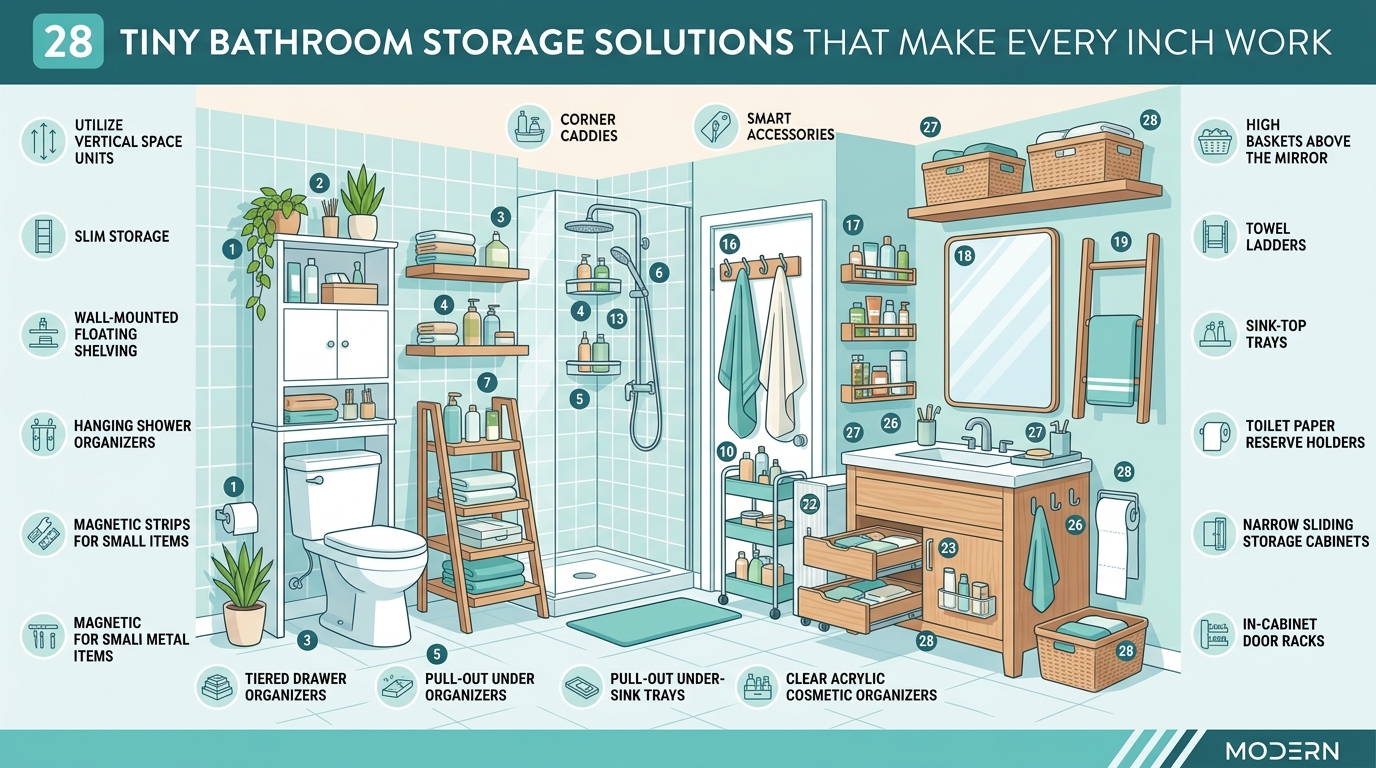
A tiny bathroom storage solution is any system, fixture, or organizing strategy that creates usable storage capacity within a bathroom under 50 square feet without sacrificing floor space or visual calm. This article delivers exactly 28 tiny bathroom storage solutions covering walls, vertical space, fixtures, furniture, and finishing details that make compact bathrooms feel organized, spacious, and genuinely designed.
Small bathrooms fail at storage not because they lack space — they lack the right relationship with the space they already have. The square footage is fixed; the cubic footage almost never gets used. Every bare wall above the toilet, every hollow door, every inch of dead space between the vanity and the floor is storage waiting to be claimed. Tiny bathroom storage done right doesn’t look like storage at all — it looks like a bathroom where everything has a home. Here are 28 solutions worth saving — and stealing.
Why Tiny Bathroom Storage Design Works So Well
The discipline of tiny bathroom storage design draws from a specific convergence of influences: Japanese ma philosophy (the purposeful use of negative space), Scandinavian functional minimalism, and the growing small-space living movement that emerged from urban density, rising housing costs, and a cultural shift toward intentional living with fewer, better things. What distinguishes genuinely good small bathroom storage from the typical over-organized approach is restraint — systems that conceal as much as they reveal, surfaces that breathe, and an editing discipline that keeps only what belongs in a bathroom in the bathroom.
The materials palette for storage solutions in a tiny bathroom must balance moisture resistance with aesthetic warmth. Solid teak and bamboo handle humidity without warping; powder-coated steel and blackened iron resist rust; glazed ceramic, solid surface, and lacquered MDF hold up against splash and steam. Warm accents — unlacquered brass hardware, natural rattan, warm white oak — prevent the organized bathroom from reading as clinical. The most effective tiny bathroom storage is the kind that disappears into the room’s design language rather than announcing itself as a problem being solved.
The timing of this focus is direct: urban apartment sizes have continued to shrink across major global cities, with the average new bathroom in a city apartment frequently falling below 45 square feet. Pinterest searches for “small bathroom storage ideas,” “tiny bathroom organization,” and “bathroom storage hacks” consistently rank among the highest-volume home improvement searches, reflecting a genuine widespread need rather than a niche interest. The solutions that perform best on these platforms are the ones that solve a real problem and look deliberate while doing it.
A bathroom under 35 square feet — a true micro-bathroom — can still accommodate generous storage through strict vertical thinking. The principle is simple: anything that sits on a horizontal surface (countertop, floor, shelf edge) should be evaluated for whether it can move to a wall, a door, or a concealed drawer instead, freeing the horizontal planes that make small rooms feel open.
Style at a Glance
| Element | Key Trait | Detail |
| Philosophy | Use cubic feet, not square feet | Go vertical, go concealed |
| Key Materials | Teak, powder-coated steel, ceramic | Moisture-resistant and warm |
| Key Approach | Conceal, contain, mount | Edit ruthlessly, organize once |
28 Tiny Bathroom Storage Solutions
1. Over-the-Toilet Ladder Shelf Unit
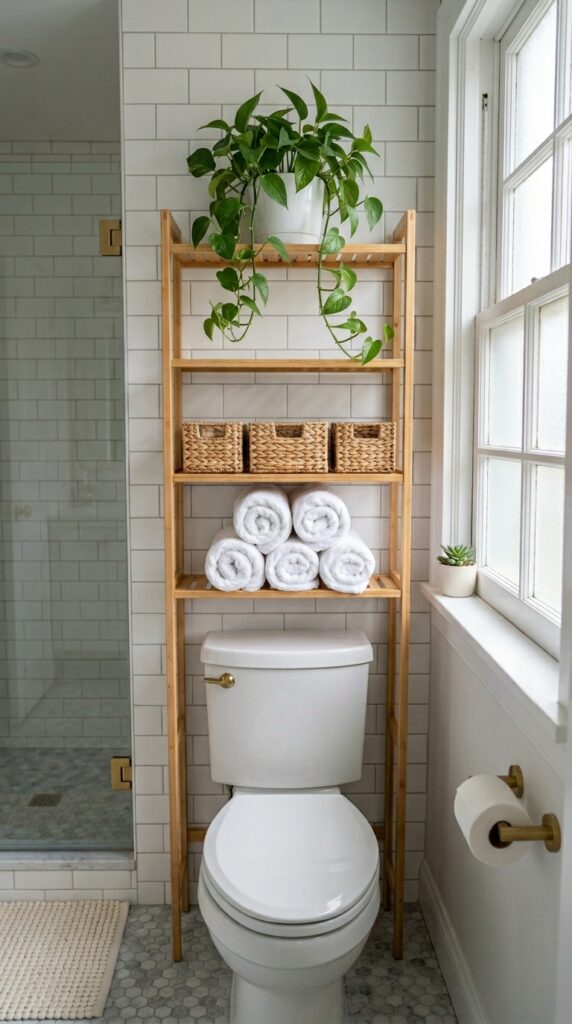
Vibe: Organized — a ladder shelf over the toilet turns the room’s most awkward dead zone into its most functional one.
Why it works: The vertical space above a toilet tank is the single most consistently wasted area in a tiny bathroom — typically 36–48 inches of clear wall and airspace that most bathrooms leave entirely empty. A slim ladder shelf (12–14 inches deep, no wider than the toilet tank) slots into this zone without requiring any wall mounting, using the floor footprint the toilet already occupies. The tiered shelf structure creates three distinct storage zones at different heights: rolled towels at the lowest level (easy access), baskets and daily-use items at mid level, and decorative or infrequently used items at the top. The ladder’s lean-to-wall construction also means zero wall damage — ideal for renters.
How to get it: Measure the toilet tank width before purchasing — a ladder shelf wider than the tank reads as intrusive rather than integrated. Choose bamboo or solid teak for humidity resistance over pine or MDF, which will swell and degrade within one season in a bathroom environment. Ensure the top of the shelf clears the toilet’s flush handle by at least 4 inches.
💡 Quick Win: Roll all towels stored on the ladder shelf rather than folding them flat — rolled towels take up 40% less shelf space and read as spa-intentional rather than casually stacked.
Shop The Look
| Product |
| Bamboo ladder shelf over toilet freestanding slim |
| Small woven seagrass basket set of 3 bathroom |
| Rolled towel holder shelf insert |
| White hand towel set bathroom luxury |
| Trailing pothos plant small 4 inch pot |
2. Recessed Medicine Cabinet With Mirror Front
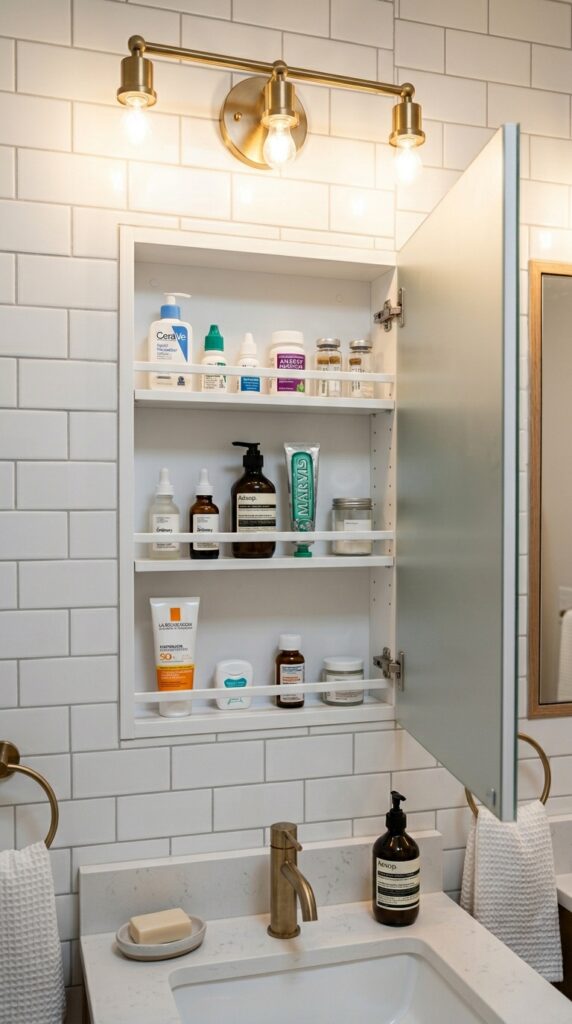
Vibe: Clean — a recessed cabinet stores a bathroom’s entire medicine supply without occupying an inch of floor or counter space.
Why it works: A recessed medicine cabinet is the most space-efficient storage solution in any tiny bathroom because it uses the dead space within the wall cavity — typically 3.5 inches deep between studs — that already exists and is otherwise completely unused. Flush-mounted with a mirror front, it contributes a functional mirror to the vanity wall while concealing an entire bathroom’s worth of medicine, skincare, and grooming supplies behind it. The mirror front doubles the perceived depth of a small bathroom through reflection — a single installation that solves three problems simultaneously: storage, mirror, and spatial expansion.
How to get it: Verify stud spacing before purchasing — standard medicine cabinets are sized for 14.5-inch or 22.5-inch stud bays (standard 16-inch-on-center framing). If studs don’t align with your desired location, a surface-mount medicine cabinet (which protrudes 3–4 inches from the wall rather than recessing) achieves the same storage function with simpler installation.
Shop The Look
| Product |
| Recessed medicine cabinet mirror front 24×36 |
| Surface mount medicine cabinet white 20×26 |
| Cabinet shelf liner non-slip bathroom |
| Brushed brass vanity light bar 3 bulb |
| Small bottle organizer insert shelf |
3. Magnetic Strip for Metal Grooming Tools
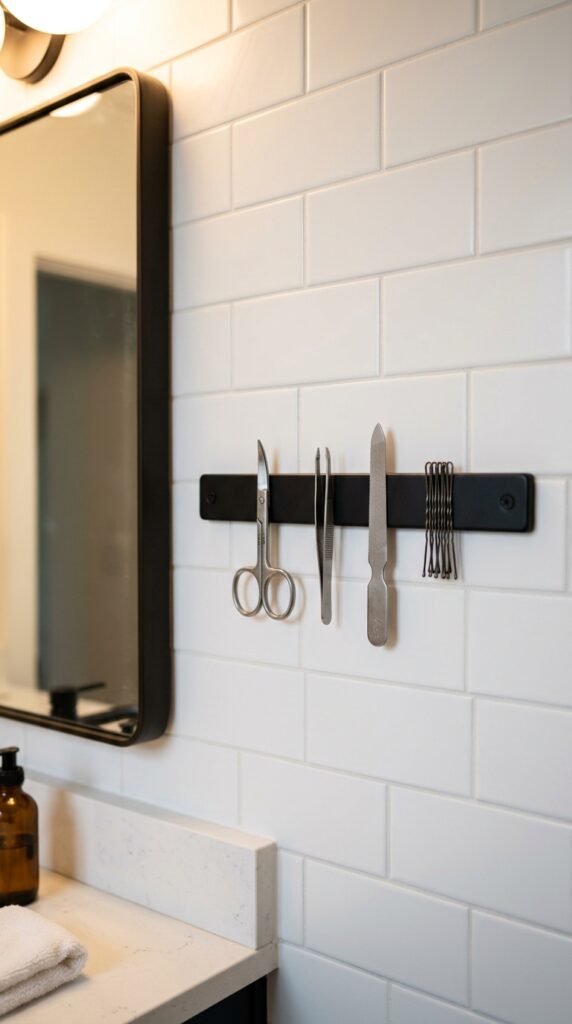
Vibe: Precise — a magnetic strip for grooming tools is the solution that makes you wonder why you ever kept them in a drawer.
Why it works: Small metal grooming tools — nail scissors, tweezers, cuticle pushers, bobby pins, metal nail files — are the category of bathroom item most frequently lost at the bottom of drawers because they’re small, lightweight, and easily buried under other items. A magnetic strip mounted on the wall beside the mirror holds all of these items visibly, accessibly, and off every horizontal surface simultaneously. The magnetic hold is strong enough for tool-weight metal items but gentle enough to remove with one hand — no clips, no containers, no digging. In a tiny bathroom where drawer space is limited, this frees an entire drawer zone for other categories.
How to get it: Mount the magnetic strip on the inside of a cabinet door rather than the wall surface if visual minimalism is a priority — the tools remain accessible when the cabinet is open but completely hidden when closed. Use a strip with a foam or rubber backing to prevent scratching the tools’ cutting edges.
💡 Quick Win: A 12-inch stainless steel magnetic knife strip ($12–18 from kitchen supply retailers) works identically to purpose-built bathroom magnetic strips at a fraction of the cost — mount horizontally inside a cabinet door with two screws.
Shop The Look
| Product |
| Magnetic wall strip tool holder stainless steel |
| Magnetic cabinet door organizer strip adhesive |
| Stainless steel nail scissors grooming set |
| Bobby pin organizer magnetic holder |
| Adhesive wall mount strip no drill bathroom |
4. Floating Shelves Stacked Vertically to Ceiling
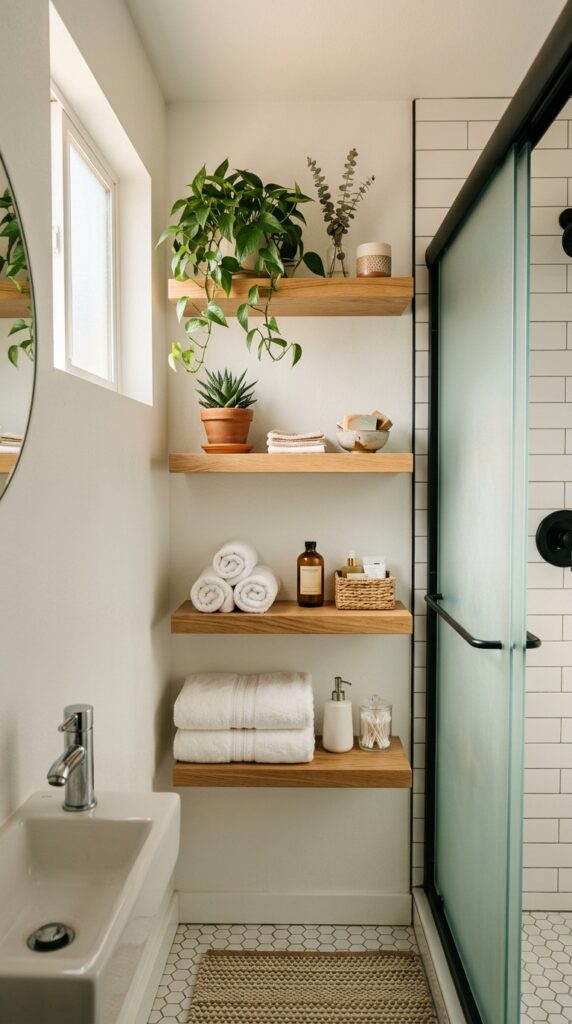
Vibe: Vertical — shelves that climb to the ceiling make the room feel taller and more organized simultaneously.
Why it works: Standard bathroom storage thinking stops at eye level — the top shelf in most bathroom installations sits at 60–66 inches, leaving 18–36 inches of wall above it entirely unused. Stacking floating shelves all the way to the ceiling (with the final shelf installed 6–8 inches below the ceiling line) converts this dead zone into active storage territory. Items used daily sit on the lowest two shelves; less-frequently-used items climb progressively higher. The visual effect of shelves reaching the ceiling also draws the eye upward, making the room feel taller than it is — the same optical principle that makes vertical-stripe wallpaper work.
How to get it: Use concealed bracket floating shelves (the bracket inserts into a channel routed in the back of the shelf) for the cleanest visual result — visible metal brackets under each shelf interrupt the clean horizontal line and make the installation read as utilitarian rather than designed. Space shelves at 10–12-inch intervals for practical accessibility across all heights.
Shop The Look
| Product |
| Floating shelf white oak concealed bracket 24 inch |
| Floating shelf bracket heavy duty blind mount set |
| Small ceramic bathroom container set with lids |
| Rolled linen hand towel set bathroom white |
| Wall anchor screw set bathroom tile drywall |
5. Tension Rod Under the Sink for Spray Bottle Storage
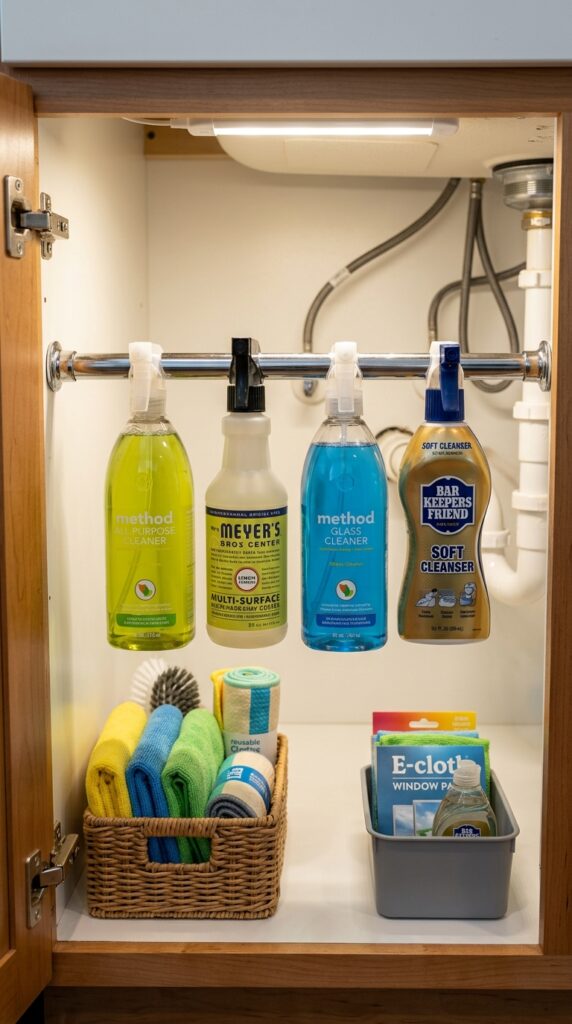
Vibe: Resourceful — a tension rod under the sink is the storage idea that costs $6 and changes how the whole cabinet works.
Why it works: Spray bottles stored upright on the floor of an under-sink cabinet are inefficient in two ways: they use valuable floor space for an item that only needs to hang, and they fall over when other items are removed from the cabinet. A tension rod installed horizontally across the upper interior of the under-sink cabinet converts the unused upper cabinet space into a dedicated spray bottle zone — bottles hang by their trigger handles from the rod, their bodies suspended in the air above the cabinet floor, freeing the entire floor area below for flat-stored items like cleaning cloths, toilet paper backup, and bathroom cleaning supplies. No tools, no installation — a tension rod presses into place in seconds.
How to get it: Purchase a tension rod in the adjustable range that spans your cabinet width — measure the interior width between the side walls (not the door opening width, which is narrower). Install the rod at the highest position the bottle handles can comfortably reach — typically 6–8 inches below the cabinet top.
💡 Quick Win: Add a second tension rod 2 inches below the first — the two rods together can hold twice the bottles and stabilize them from swinging when the cabinet is opened and closed.
Shop The Look
| Product |
| Tension rod adjustable 16-28 inch chrome pack of 2 |
| Spray bottle refillable cleaning set of 3 |
| Under sink organizer basket sliding pull out |
| Cleaning cloth microfiber set 12 pack |
| Cabinet door organizer adhesive mount |
6. Door-Mounted Organizer for the Bathroom Door Interior
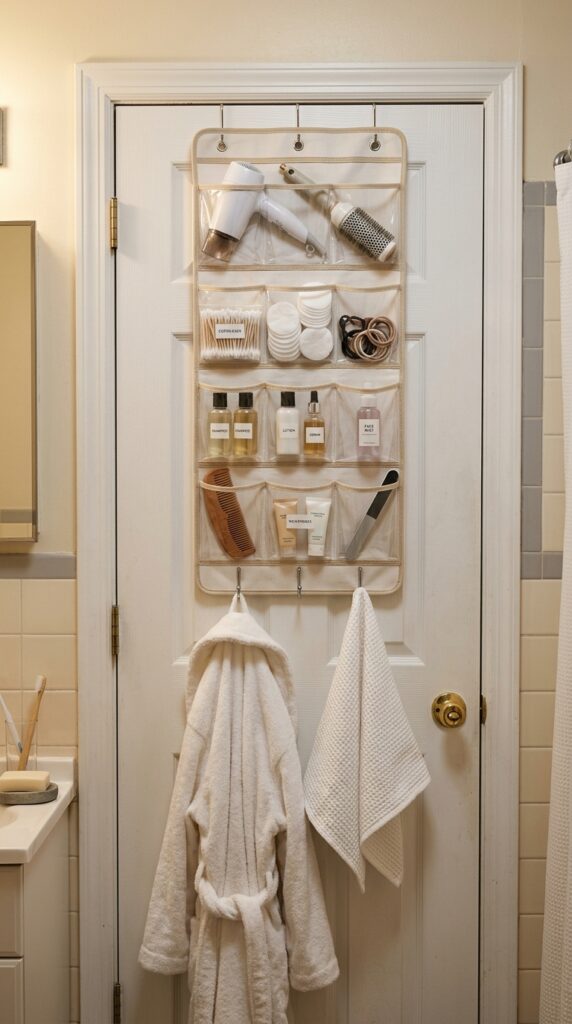
Vibe: Functional — the back of the bathroom door is a full wall of storage that most bathrooms waste entirely.
Why it works: The interior face of a bathroom door is one of the most consistently overlooked storage surfaces in residential design — it’s flat, it’s vertical, it’s always accessible when the door is closed (which is most of the time in a bathroom), and it typically holds nothing but air. An over-door organizer with clear pockets (using the door’s top edge as the hanging point, requiring no tools and no wall damage) converts this dead surface into active storage for the category of items that accumulate on countertops: cotton pads, hair tools, small bottles, nail care items, and styling products. The clear pockets maintain visual accessibility — everything is visible without being on display.
How to get it: Measure the door thickness before purchasing an over-door organizer — doors in older buildings can be up to 1.75 inches thick, while standard interior doors are 1.375 inches. Most over-door hooks fit both, but thick doors may require an extended hook model. Check that the organizer’s total hanging depth (door thickness + hook projection + organizer depth) doesn’t prevent the door from closing fully within the door frame.
Shop The Look
| Product |
| Over door organizer clear pocket 6 pocket bathroom |
| Over door hooks bathroom heavy duty set of 4 |
| Door robe hook over door double chrome |
| Cotton pad container refillable bathroom |
| Hair tool holder loop strap organizer |
7. Corner Shower Shelf in Brushed Brass
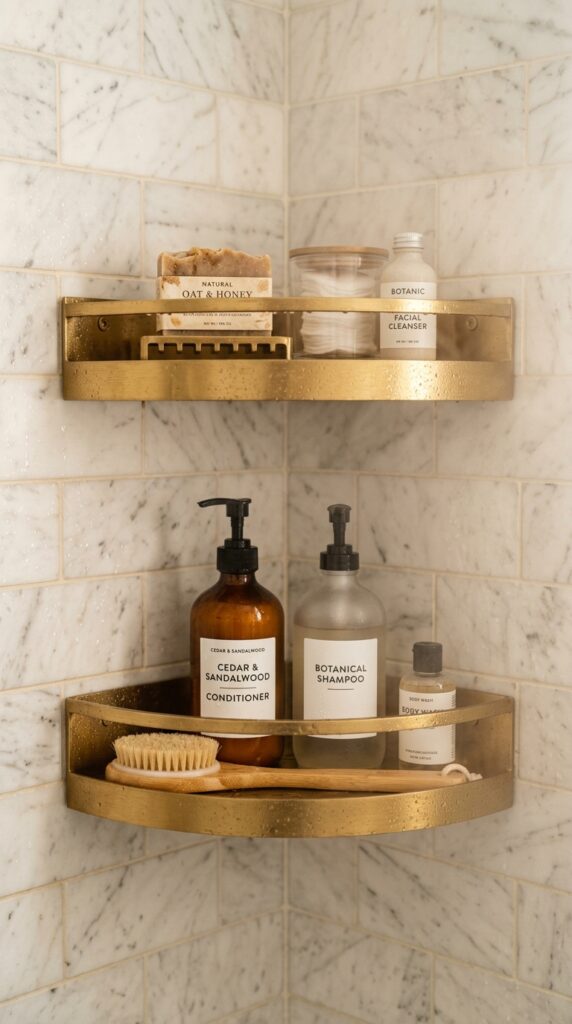
Vibe: Spa-like — brushed brass corner shelves turn shower storage into something you’d find at a boutique hotel.
Why it works: Shower corners are the most structurally stable mounting location in a shower space — the 90-degree angle provides two wall surfaces for anchoring, distributing load more effectively than a single-wall shelf. Triangular corner shelves maximize the use of this structural advantage while occupying zero floor and zero primary wall space — they exist entirely within the corner geometry that would otherwise be wasted. Stacking two shelves at 12-inch vertical intervals doubles the storage without doubling the footprint. Brushed brass in a shower context introduces a warm metal accent that elevates the shelf from a functional object to a design detail.
How to get it: Use epoxy-based tile adhesive or a waterproof silicone adhesive specifically rated for wet environments — standard construction adhesive is not waterproof and will fail within a few months in a continuously wet shower environment. Install on a clean, dry tile surface and allow 48 hours of cure time before loading the shelves.
💡 Quick Win: Switch all shower products to pump or bar format (eliminating the cluttered collection of various bottle shapes and sizes) — matching apothecary-style pump bottles in white or amber glass reduce visual noise on the shelf by 70% while using the same products.
Shop The Look
| Product |
| Brushed brass corner shower shelf set of 2 |
| Apothecary glass pump bottle set 3 piece |
| Waterproof silicone adhesive clear shower rated |
| Bar soap holder wall mount brass |
| Marble look shower tile 4×12 white grey |
8. Mirrored Wall Cabinet Spanning Full Vanity Width
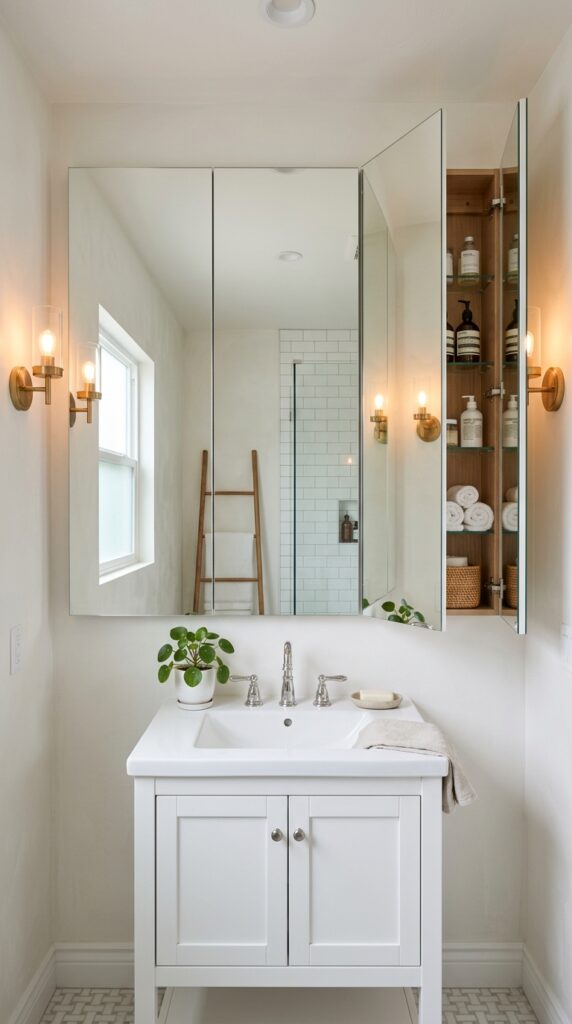
Vibe: Airy — a full-width mirrored cabinet doubles the room visually while tripling the storage practically.
Why it works: A mirrored wall cabinet spanning the entire vanity wall width achieves what no other single installation can: it simultaneously maximizes mirror surface (making the small bathroom feel larger through reflection), maximizes concealed storage (the cabinet depth of 4–6 inches holds a complete bathroom’s supply behind each mirror panel), and eliminates the counter clutter that accumulates on every visible bathroom surface. The reflection principle is the most powerful spatial tool in a tiny bathroom — a full-width mirror doubles the perceived width of the room by reflecting the opposite wall, creating the impression of a bathroom twice the actual size.
How to get it: Standard bathroom wall cabinet systems (like those from IKEA’s GODMORGON series or similar) are available in modular widths that can be combined to span most vanity wall widths. Specify soft-close hinges on every door panel — in a tiny bathroom where every surface is used frequently, the tactile and acoustic quality of cabinet hardware is noticed constantly.
Shop The Look
| Product |
| Mirrored bathroom wall cabinet three door |
| Soft close hinge set bathroom cabinet |
| Cabinet shelf peg insert set 20 piece |
| Wall cabinet mounting bracket kit level |
| Small ceramic soap dish countertop white |
9. Wicker Baskets Inside Open Shelving for Concealed Organization
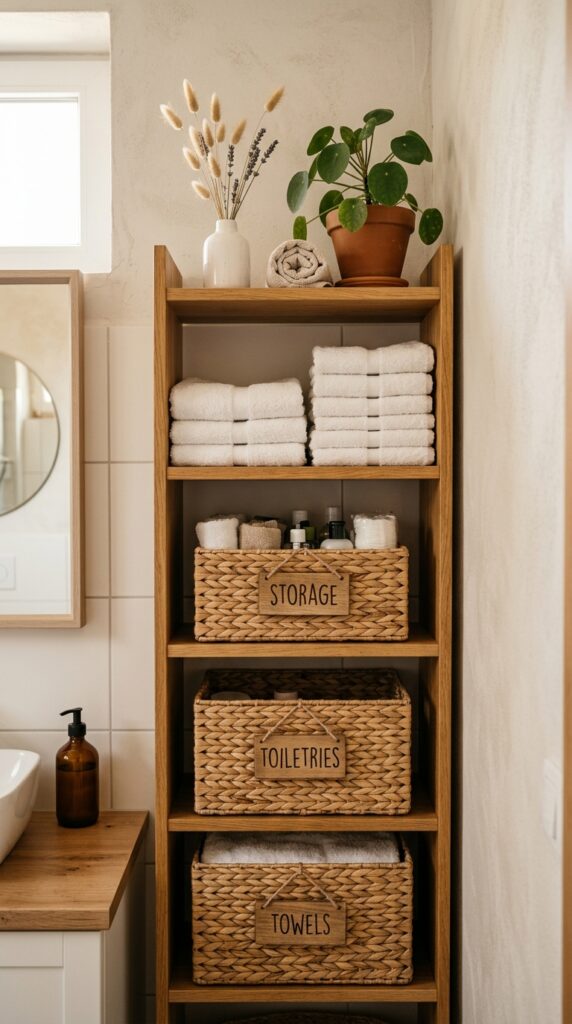
Vibe: Warm — wicker baskets on open shelves are the organizational move that makes a bathroom look curated rather than cluttered.
Why it works: Open shelving in a tiny bathroom creates a visual dilemma: the storage is accessible, but everything stored on it is permanently on display. Wicker baskets inserted into the shelf openings solve this by creating concealed-within-open storage — the baskets contain the visual noise of bathroom miscellany (cotton balls, backup products, hair accessories) while the baskets themselves become a design element. Uniform baskets in a single material (natural rattan or seagrass) replace the random visual assortment of different product packaging with a consistent, warm, organic texture. The basket-and-shelf system is also fully flexible — categories can be reorganized without any structural change.
How to get it: Measure the interior depth and height of each shelf opening before purchasing baskets — the basket should fill 80–90% of the shelf opening height to read as intentional rather than undersized. Label each basket on the front face (a small tag tied through the weave) so the system maintains categorical organization as products are added and removed.
Shop The Look
| Product |
| Seagrass wicker basket set of 3 matching |
| Chalkboard label tag set round wicker |
| Open shelf bathroom unit white 4 tier |
| Linen drawer liner cut to size shelf |
| Dried botanicals mini stem vase bathroom |
10. Pegboard Panel for Flexible Wall Organization
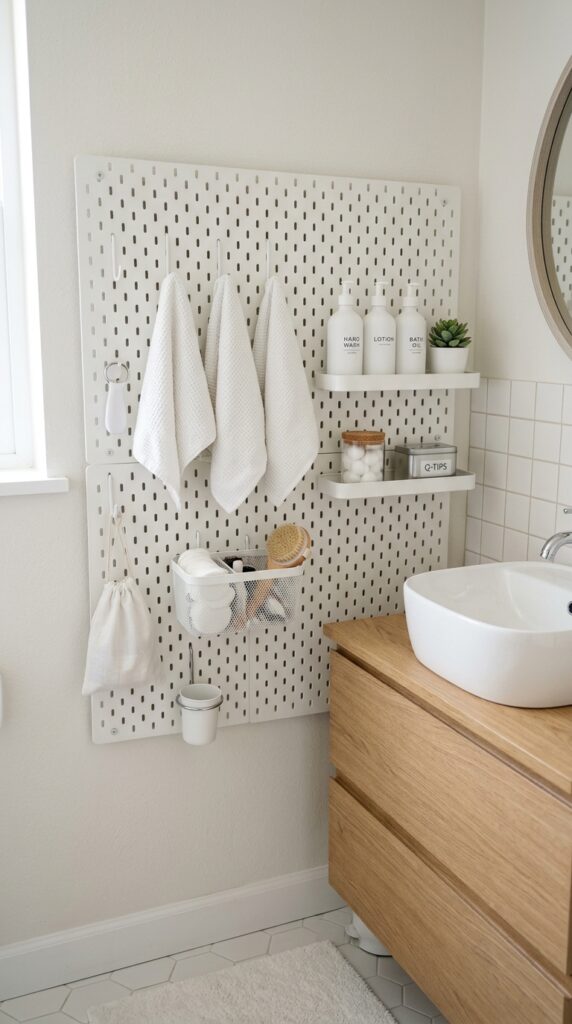
Vibe: Flexible — a pegboard can be reorganized in five minutes when needs change, which no other wall system can claim.
Why it works: Pegboard is the most adaptable wall storage system available — every hook, shelf, and basket is repositionable in any configuration without tools, wall damage, or any commitment to a fixed layout. In a tiny bathroom where storage needs change with seasons (more products in winter skincare routines, different tools for different hair lengths), this flexibility has genuine practical value. Painting the pegboard and all its accessories in a single matte white (or any single tone matched to the bathroom palette) eliminates the utilitarian, workshop aesthetic typically associated with pegboard and converts it into a cohesive wall storage element that reads as designed.
How to get it: Mount the pegboard panel on 1-inch standoffs (small spacer blocks between the panel and the wall) so the hooks can insert fully into the holes from the back — pegboard mounted flush to the wall has no clearance for the hook bend and cannot be used. The standoff gap also allows air circulation behind the panel, preventing moisture accumulation in a bathroom environment.
💡 Quick Win: Prime and spray-paint a pegboard panel in the same color as the bathroom walls before mounting — the panel visually recedes into the wall while the white accessories and towels pop as the foreground, creating a seamless storage wall rather than an obvious add-on.
Shop The Look
| Product |
| Pegboard panel white 24×36 MDF bathroom |
| Pegboard hook set assorted sizes white |
| Pegboard shelf insert small white |
| Pegboard basket insert wire white |
| Pegboard standoff mounting kit 1 inch |
11. Slim Rolling Cart That Fits Between Toilet and Wall
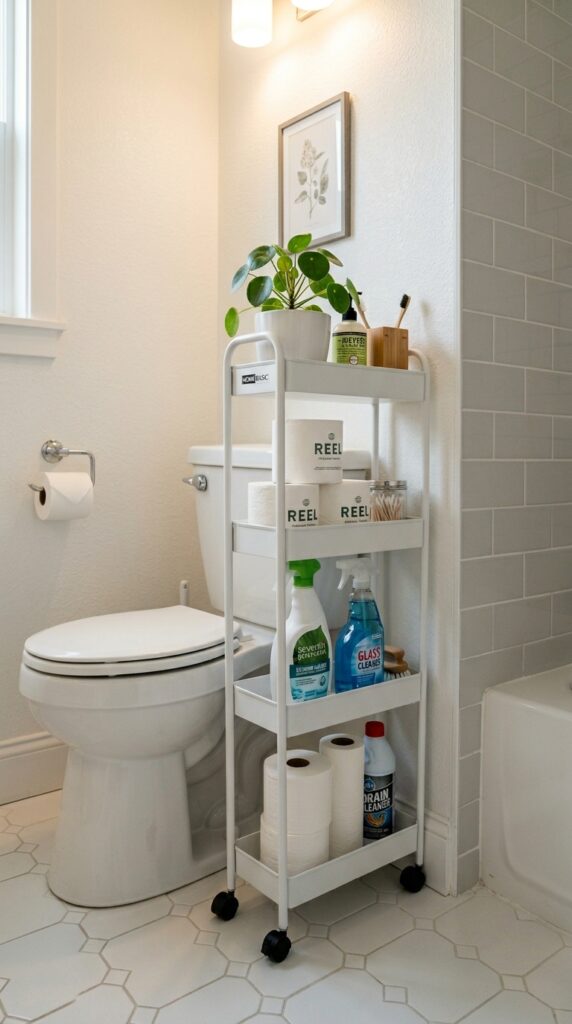
Vibe: Resourceful — a rolling cart in a 6-inch gap is the storage solution that makes you measure every gap in the bathroom afterward.
Why it works: The gap between the toilet and the adjacent wall — typically 4–8 inches wide — is one of the most consistently unused spaces in any bathroom layout. Most storage solutions cannot access this zone because they require more width. A purpose-built slim rolling cart (sold specifically in 5.5–7-inch widths for this application) slides into the gap on wheels, filling the space with four to five tiers of storage for toilet paper rolls, cleaning products, personal care items, and small bathroom supplies. The rolling wheels allow the cart to be pulled out for restocking and pushed back in flush with the toilet — the cart disappears into the gap when not in active use.
How to get it: Measure the gap width at the narrowest point — toilet tanks often have protruding flush mechanisms or supply lines that reduce the effective clearance. Measure at three heights (floor level, mid height, and tank level) and use the smallest measurement to determine the maximum cart width. Most purpose-built bathroom carts are sized for 5.5-inch or 7-inch gaps.
Shop The Look
| Product |
| Slim rolling bathroom cart 6 inch white 4 tier |
| Toilet paper roll holder cart insert |
| Bathroom cleaning supply set compact bottles |
| Rolling cart wheel lock brake small |
| Mini succulent plant bathroom top shelf |
12. Suction-Cup Shelf for Shower Glass or Tile
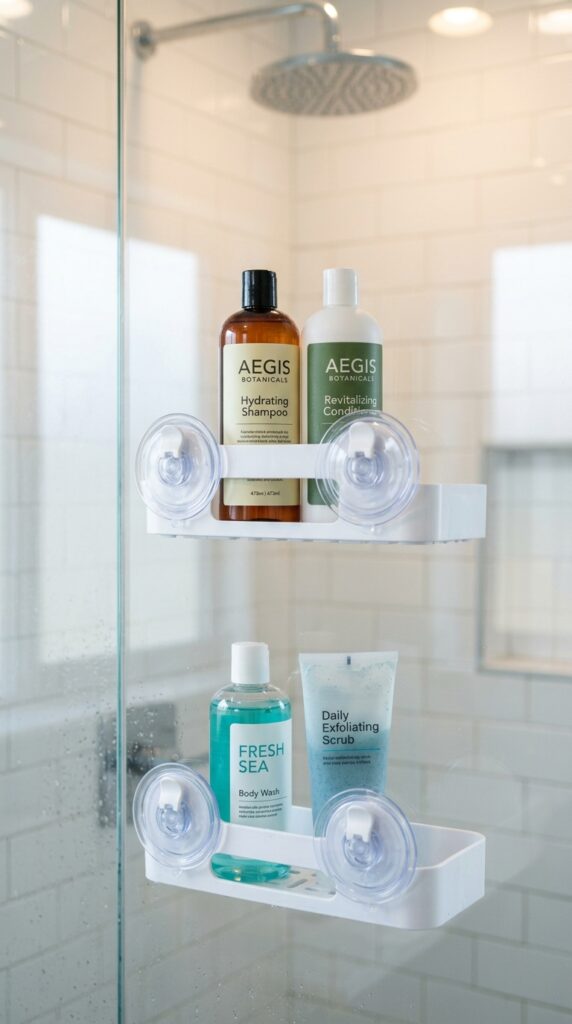
Vibe: Minimal — suction shelves on glass leave no trace on the wall and no clutter on the floor.
Why it works: In a small shower enclosure — particularly one with a glass panel or door — mounting anything to the glass seems counterintuitive, but glass is actually the most stable suction surface in a bathroom. Industrial-grade suction cup shelves (with a locking lever mechanism rather than a simple push-to-attach system) hold 15–25 pounds of product reliably on smooth glass surfaces and can be repositioned without any marks or damage. This matters enormously in a rented tiny bathroom where tile drilling is prohibited or in a shower where the tile layout doesn’t accommodate fixed shelf installation between grout lines.
How to get it: Clean the glass surface with rubbing alcohol before attaching the suction cup — any soap residue or hard water mineral on the glass dramatically reduces suction strength. Press the suction cup flat against the glass and engage the locking lever with the shelf unloaded, then load products once the suction is confirmed. Check the lock weekly and re-attach if any air has crept into the seal.
Shop The Look
| Product |
| Suction cup shower shelf glass mount locking |
| Suction cup hook bathroom heavy duty chrome |
| Glass cleaner streak free bathroom |
| Refillable shower pump bottle white set |
| Suction shelf basket wire chrome |
13. Recessed Shelving Built Into the Shower Wall
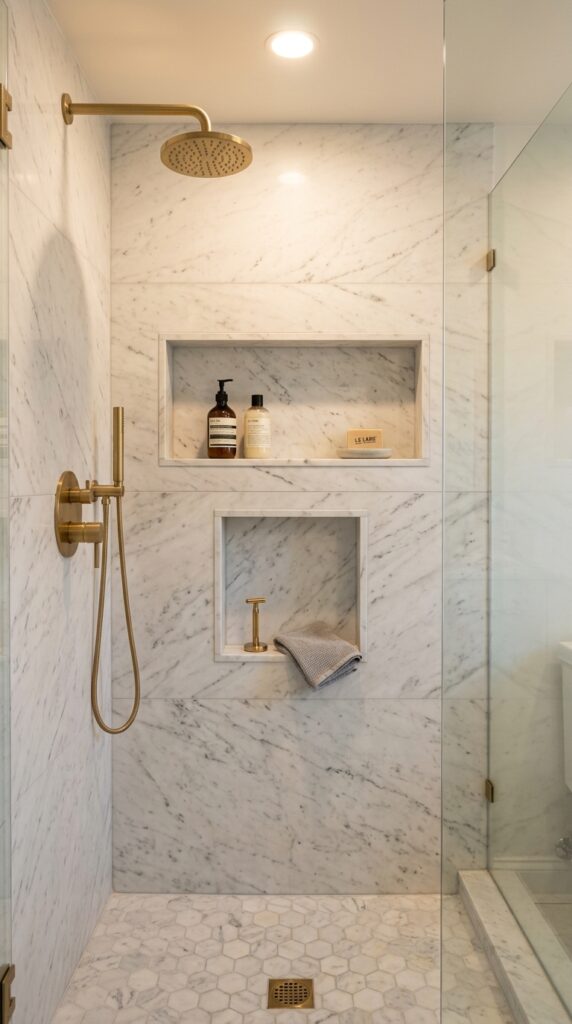
Vibe: Spa-like — a recessed niche stores everything the shower needs without adding anything to the room.
Why it works: A recessed shower niche is architecturally the cleanest possible shower storage — it exists within the wall plane rather than projecting from it, meaning the shower’s spatial volume is completely uncompromised by its presence. Tiling the niche in the same material as the surrounding wall makes it appear as a shadow in the wall rather than an inserted object. Two niches at different heights serve different functional zones: a shoulder-height niche for products used standing (shampoo, body wash) and a hip-height niche for products used lower (shaving items, soap). The recessed depth (3.5 inches in a standard stud wall) is sufficient for all standard shower product sizes.
How to get it: Recessed niches must be cut between studs during the construction or renovation phase before tile is installed — they cannot be added after tiling without removing the tile. Specify the niche dimensions to fit between studs (maximum 14.5 inches wide for standard 16-inch-on-center framing) and line the interior with a waterproofing membrane before tiling. A niche pre-form kit ($30–60) simplifies the waterproofing step significantly.
💡 Quick Win: A single recessed niche installed during a bathroom renovation adds approximately $200–400 to the project cost — the single highest-return storage investment available in a shower renovation.
Shop The Look
| Product |
| Shower niche pre-form waterproof insert kit |
| Marble tile 4×12 subway shower wall white |
| Niche shelf tile trim edge brass |
| Razor holder wall mount magnetic |
| Shower waterproofing membrane tape seam |
14. Towel Bar Stacked Double Height
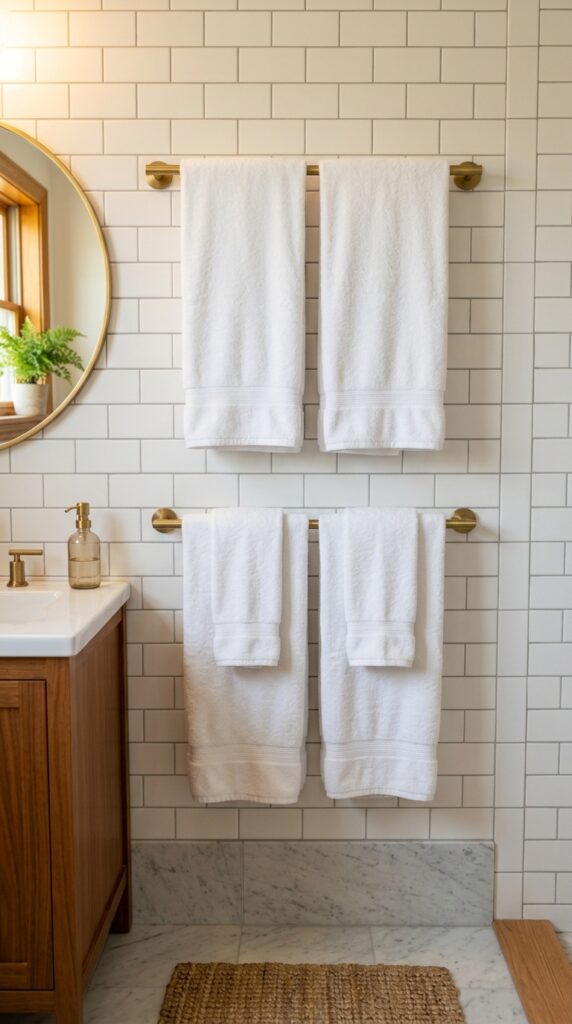
Vibe: Efficient — two towel bars where one used to be doubles the room’s towel capacity without using a single additional inch of wall width.
Why it works: A standard single towel bar mounted at 48 inches from the floor leaves 18–30 inches of usable wall space above it entirely empty — space that a second towel bar can occupy without any clearance problem. Stacking two towel bars on the same wall section at 14-inch vertical separation (enough for a full bath towel to hang from the upper bar without touching the lower bar) doubles the hanging capacity of that wall section. In a tiny bathroom where towel storage is a perpetual challenge, this doubles the functional output of an existing installation without requiring any additional floor space or new wall locations.
How to get it: Mount the upper bar with its center at 62–64 inches from the floor (allowing a full bath towel to hang clear of the lower bar below) and the lower bar at 48 inches. Use the same finish and manufacturer for both bars to ensure the hardware reads as a deliberate double installation rather than two mismatched bars.
Shop The Look
| Product |
| Brushed brass towel bar 24 inch bathroom |
| Towel bar mounting hardware kit anchors |
| White bath towel set luxury 4 pack |
| Level tool small magnetic bubble |
| Towel bar extender double arm wall mount |
15. Vanity Drawer Organizer Inserts for Product Categories
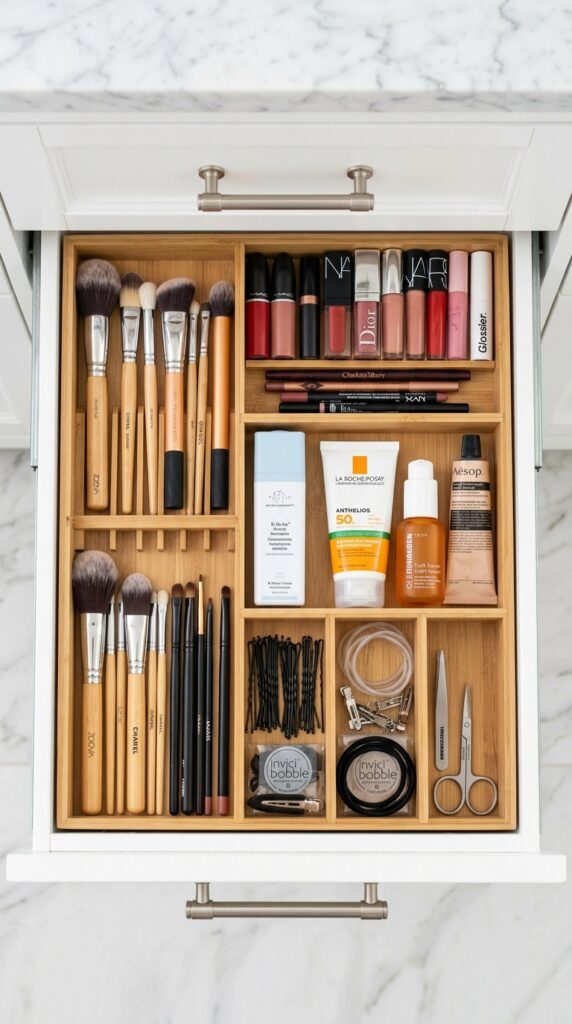
Vibe: Satisfying — a properly divided vanity drawer is one of those organizational systems you open just to look at.
Why it works: An undivided bathroom vanity drawer is a high-entropy system — items of different sizes, weights, and shapes migrate to the front, mix together, and require searching to find anything. A divided organizer insert converts the same drawer into a categorical system where every item has a designated zone. The principle is containment within a contained space: the drawer’s total volume doesn’t change, but the organizational resolution of that volume improves dramatically. Bamboo or acrylic inserts with varied compartment sizes (narrow for thin items like brushes and bobby pins, wider for bottles) accommodate the dimensional variety of bathroom products without wasted space in any compartment.
How to get it: Measure the interior drawer dimensions (width, depth, height clearance with drawer closed) before purchasing inserts — most standard vanity drawers are 20–22 inches wide and 18–20 inches deep, but custom or European vanities vary significantly. Adjustable divider systems (individual divider bars that press between the drawer walls) are more flexible than fixed-compartment inserts and can be reconfigured when product categories change.
💡 Quick Win: Remove everything from one bathroom vanity drawer, discard anything expired or unused, and reinsert only what remains with a simple bamboo divider set ($12–20). This single drawer edit takes 20 minutes and typically recovers 40% of the drawer’s effective capacity.
Shop The Look
| Product |
| Bamboo drawer organizer insert adjustable bathroom |
| Acrylic drawer divider set adjustable |
| Makeup brush holder insert round slots |
| Drawer liner non-slip cut to fit bathroom |
| Stackable acrylic container small organizer |
16. Wall-Mounted Hairdryer and Tool Holder
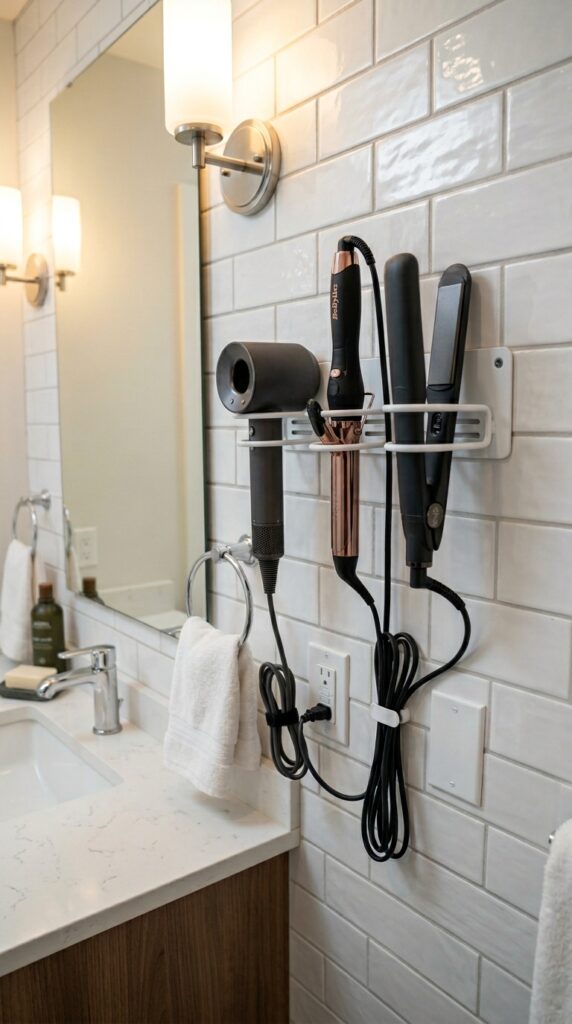
Vibe: Practical — hair tools stored on the wall cool faster, live longer, and take up zero counter space.
Why it works: Hair styling tools — hairdryer, curling iron, flat iron — are among the most space-consuming items in a tiny bathroom and among the most poorly stored. Left on a counter, they occupy significant surface area and retain heat that can damage nearby surfaces and products. Stored in a drawer, they cool slowly and tangle their cords. A wall-mounted holder keeps each tool in a ventilated cradle that allows complete airflow around the barrel for rapid cool-down, while keeping all three tools off every horizontal surface permanently. The vertical wall mounting also places the tools at hand level for direct use without lifting from a counter or drawer.
How to get it: Install the holder beside the mirror at the height where you naturally hold the tools when using them — typically 48–54 inches from the floor — so the workflow from holder to mirror and back is a single motion. Use a wall anchor rated for 10 pounds minimum (even though the tools weigh less, a hair-tool holder experiences lateral pulling forces during removal that exceed static weight load).
Shop The Look
| Product |
| Wall mount hair tool organizer 3 holder white |
| Cord winder cable organizer clip bathroom |
| Adhesive wall hook for cord management |
| Heat resistant mat hair tool rest silicone |
| Hair tool storage bag travel case backup |
17. Toilet Tank Tray for Countertop Overflow
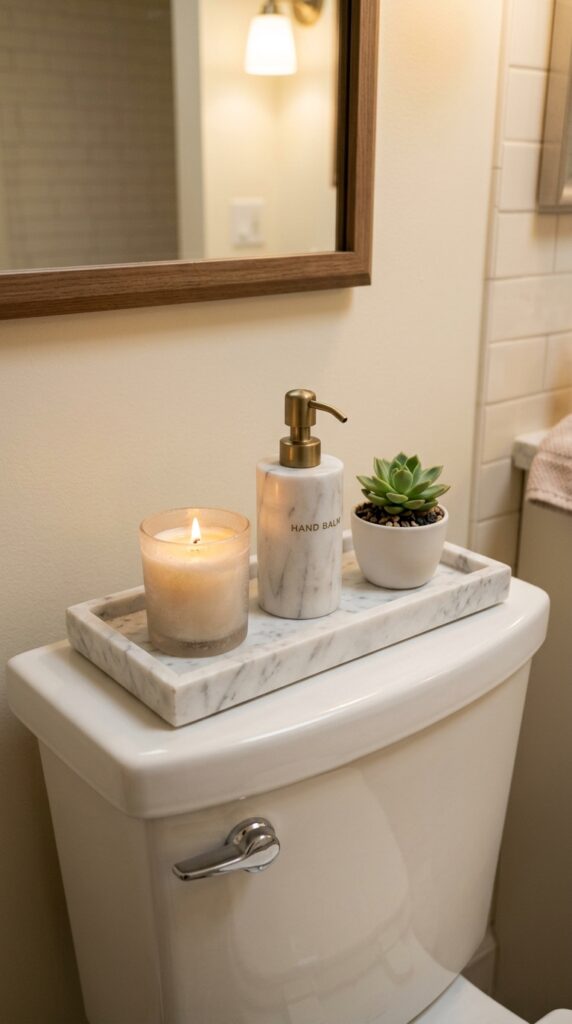
Vibe: Styled — the toilet tank is the only flat surface in a tiny bathroom most people forget to use.
Why it works: The toilet tank top is a flat, horizontal surface typically 7–9 inches deep and 14–18 inches wide — equivalent in area to a small nightstand — that most bathrooms leave completely bare or covered with a single item placed without thought. A slim tray (1–2 inches deep, sized to fit the tank top width) frames this surface and transforms it from a forgotten utilitarian ledge into a composed display area. The tray performs a containment function — it visually organizes the three items placed within it into a single composed object rather than three separate items — and provides a slight raised edge that prevents items from being knocked off during flushing vibration.
How to get it: Measure the tank top dimensions carefully — tanks vary significantly in width and depth, and a tray that overhangs the tank edge reads as oversized and awkward. Choose a tray in a material that matches the bathroom’s accent palette: white marble for a classic or neutral bathroom, concrete for an industrial palette, warm wood for an organic or Japandi scheme.
Shop The Look
| Product |
| Marble tray bathroom vanity slim rectangle |
| Small succulent live plant bathroom 2 inch |
| Hand lotion pump dispenser marble lid |
| Taper candle holder small bathroom |
| Concrete finish tray bathroom countertop |
18. Shower Caddy on a Tension Pole From Floor to Ceiling
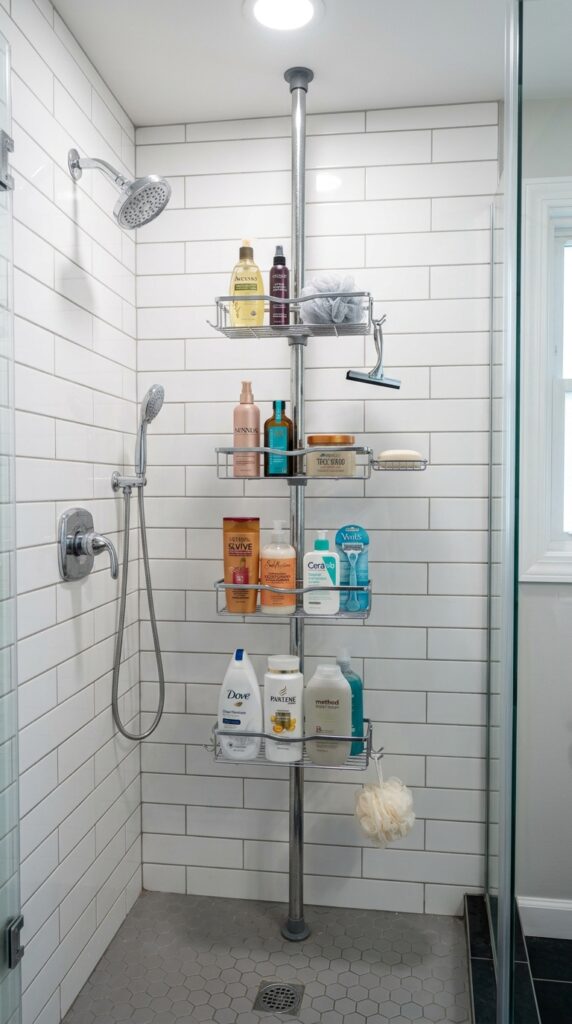
Vibe: Functional — a tension pole caddy converts unused shower airspace into a four-level product library.
Why it works: A tension pole shower caddy (a spring-loaded vertical pole that presses between floor and ceiling without any mounting) converts the vertical air column of a shower corner into a multi-level product organization system. The four adjustable shelves can be positioned at any height along the pole, accommodating different product heights from tall shampoo bottles to short soap bars. Unlike suction shelves or fixed wall niches, the tension pole caddy requires no installation, leaves no wall damage, and can be repositioned or removed entirely — making it the best choice for renters and for shower configurations where wall mounting is impractical.
How to get it: Extend the tension pole to firm floor-to-ceiling contact before loading any products — an under-tensioned pole will collapse under weight. Recheck and tighten the tension mechanism monthly, as the spring mechanism gradually relaxes and requires periodic adjustment to maintain the holding friction that keeps the pole upright.
Shop The Look
| Product |
| Tension pole shower caddy floor to ceiling chrome |
| Shower caddy shelf insert rust proof |
| Adjustable shower hook caddy attachment |
| Rust proof shower product holder basket |
| Non-slip pad shower floor caddy grip |
19. Bathroom Counter Riser for Vertical Counter Organization
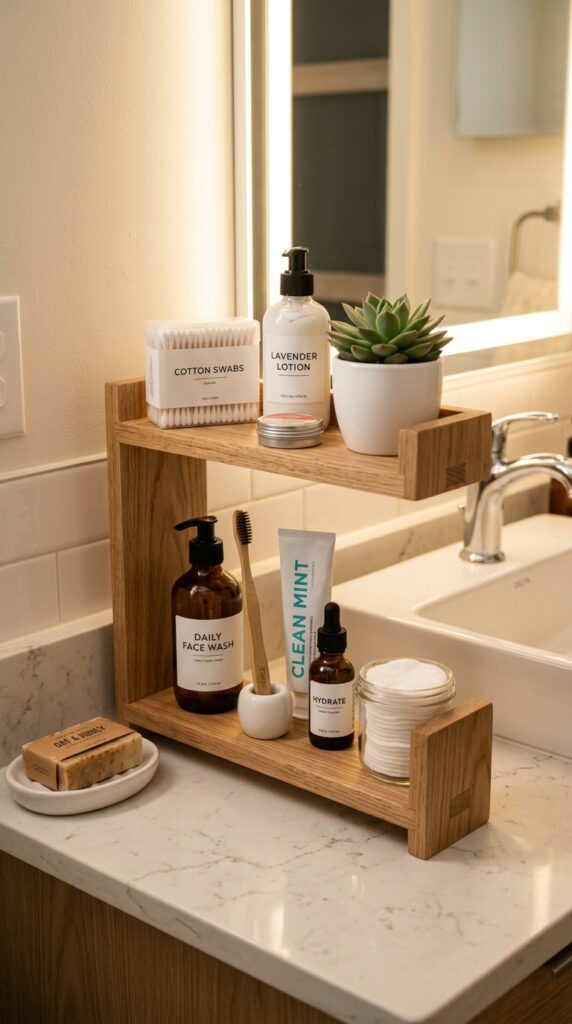
Vibe: Organized — a counter riser doubles the usable surface of a tiny bathroom counter without expanding its footprint.
Why it works: A bathroom counter riser (a two-tier shelf organizer that sits directly on the counter surface) converts a single-level counter into a two-level storage system by using the vertical space above the counter that would otherwise be unused. Items placed on the upper tier are elevated 4–6 inches, freeing the counter surface beneath for a second storage layer — in practical terms, a 12-inch-wide riser on a 24-inch counter creates the equivalent of 24 inches of counter space from 12 inches of footprint. The riser also organizes items categorically by height (daily items on lower level, less-frequent items elevated) creating a visual hierarchy that reduces counter searching.
How to get it: Choose a riser no wider than 50% of the total counter width — this leaves open counter space on at least one side of the riser for active-use items. The open counter space beside the riser is intentional: it’s where daily items are placed during use and cleared for cleaning, which prevents the entire counter from becoming permanently cluttered.
💡 Quick Win: A standard kitchen spice rack ($15–25) repurposed as a bathroom counter riser achieves the same organizational function with identical visual result — kitchen and bathroom counter riser requirements are dimensionally identical.
Shop The Look
| Product |
| Two tier counter riser organizer white oak |
| White ceramic soap dish bathroom minimal |
| Counter organizer acrylic two tier |
| Small plant air plant no soil bathroom |
| Spice rack repurposed counter organizer |
20. Hidden Storage Inside a Hollow Ottoman or Bench
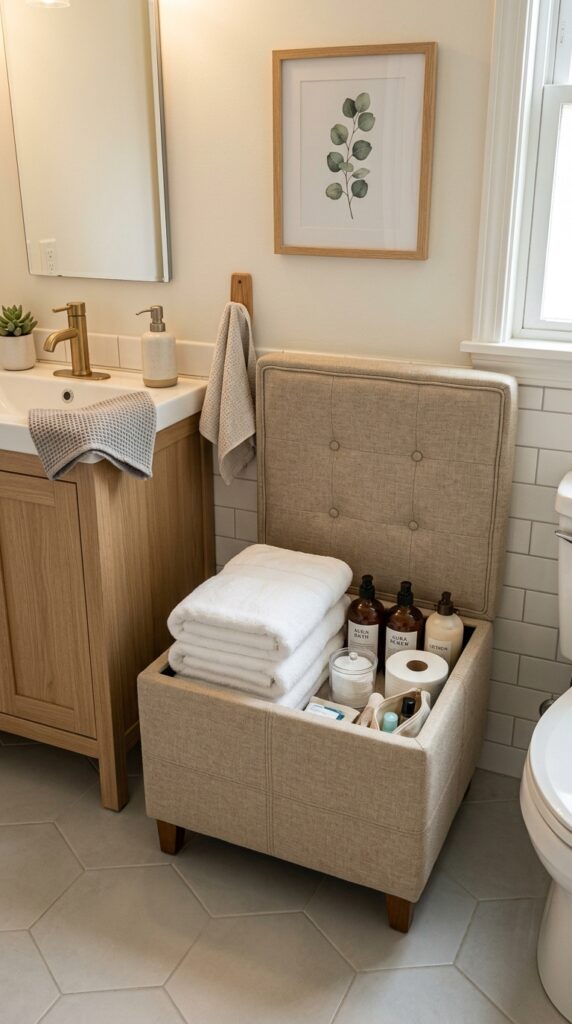
Vibe: Warm — a storage ottoman in a bathroom is the one piece of furniture that looks like it belongs and works harder than it looks.
Why it works: A small storage ottoman (14–18 inches square) in a bathroom serves three simultaneous functions: it provides a seating surface for drying and dressing, a storage container for backup towels and supplies inside its hollow interior, and a styling object that introduces upholstery warmth into an otherwise hard-surfaced room. The ottoman’s closed top reads as a design element — a small tray on the lid converts it into a display surface — while the interior conceals everything from bathroom overflow to toilet paper backup without any visible storage. The critical specification is moisture-resistant fabric or faux leather exterior — genuine fabric will mildew in a humid bathroom environment.
How to get it: Specify a storage ottoman in a faux leather, vinyl, or polyester microfiber that resists moisture — avoid genuine cotton or linen upholstery in a bathroom context. Line the interior with a thin waterproof liner before storing towels inside to prevent any condensation from the exterior transferring to the stored textiles.
Shop The Look
| Product |
| Small storage ottoman waterproof fabric bathroom |
| Waterproof ottoman liner interior tray |
| White guest towel set foldable small |
| Decorative tray for ottoman top styling |
| Backup supply storage bag waterproof small |
21. Magnetic Spice Jars Repurposed for Cotton Products
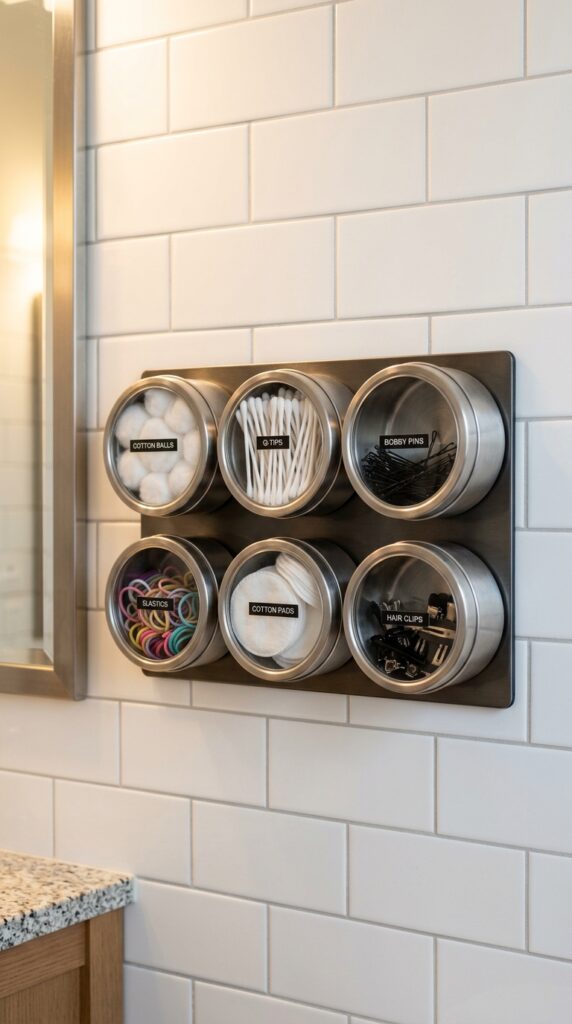
Vibe: Precise — seeing exactly what’s in every container from across the room is the organizational system that makes daily routines feel effortless.
Why it works: Magnetic spice jar systems — a wall-mounted magnetic panel with individual round containers that attach magnetically — are designed for kitchen spice organization but translate perfectly to the bathroom’s equivalent: cotton balls, cotton swabs, bobby pins, hair ties, and small personal care items. The containers hold these items visibly (clear lids reveal contents without opening), accessibly (one-handed removal), and off every horizontal surface simultaneously. Mounted at eye level beside the vanity mirror, the grid of magnetic containers also functions as a design element — the stainless steel and clear lids create a clean, graphic wall feature rather than a visible storage problem.
How to get it: Mount the magnetic panel with a level and appropriate wall anchors — the panel holds significant combined weight when all containers are loaded and needs secure wall attachment rather than adhesive strips alone. Clean the magnet face of each container before first use to ensure full magnetic contact with the panel without any dust reducing the holding strength.
Shop The Look
| Product |
| Magnetic spice jar set clear lid stainless steel |
| Magnetic wall panel bathroom mount |
| Cotton ball container refillable bathroom |
| Cotton swab dispenser refillable clear |
| Bobby pin organizer set mini magnetic |
22. Fold-Down Wall Shelf for Temporary Counter Space
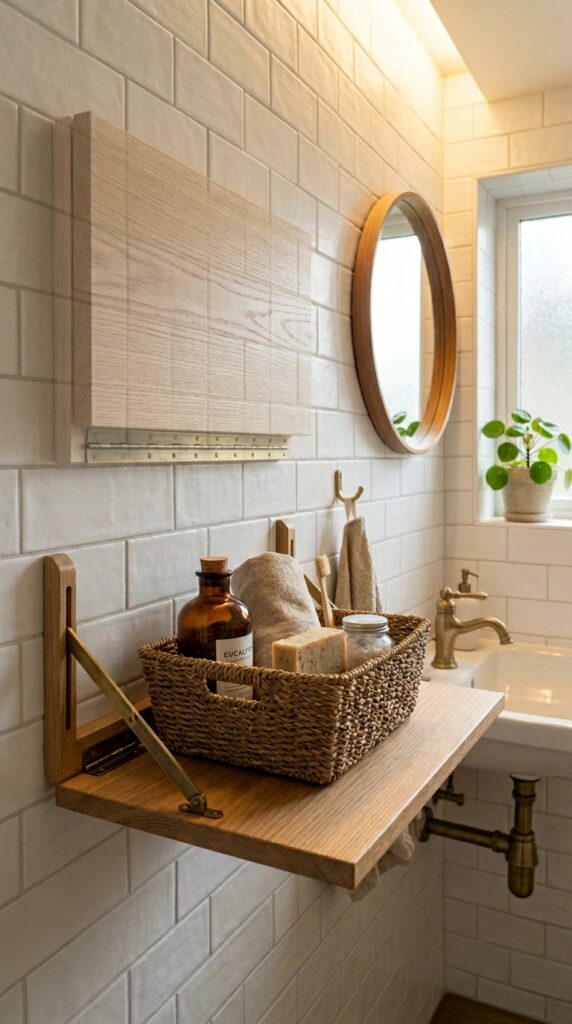
Vibe: Clever — a fold-down shelf gives you counter space precisely when you need it and nothing when you don’t.
Why it works: A fold-down wall shelf (mounted to the wall on a piano hinge or drop-leaf bracket) provides supplementary counter or staging surface that appears on demand and disappears completely when not in use — folding flat against the wall to a depth of 1.5 inches. In a tiny bathroom where permanent counter space is insufficient for tasks like grooming, applying skincare, or laying out supplies, a fold-down shelf provides the surface area needed without the permanent footprint that a fixed shelf or counter extension would require. Folded up against the wall, it is nearly invisible.
How to get it: Mount the shelf at the same height as the vanity counter (32–34 inches from floor) so that when folded down, it creates a continuous extended counter surface at the same working height. Use a heavy-duty piano hinge or two drop-leaf supports rated for 15 pounds minimum — the shelf experiences significant downward force when items are placed on its outer edge.
Shop The Look
| Product |
| Fold down wall shelf bracket drop leaf support |
| Piano hinge stainless steel 12 inch bathroom |
| White oak shelf board 12×24 bathroom |
| Wall anchor toggle bolt set heavy duty |
| Fold down shelf wall bracket chrome set of 2 |
23. Clear Acrylic Drawer and Shelf Organizers
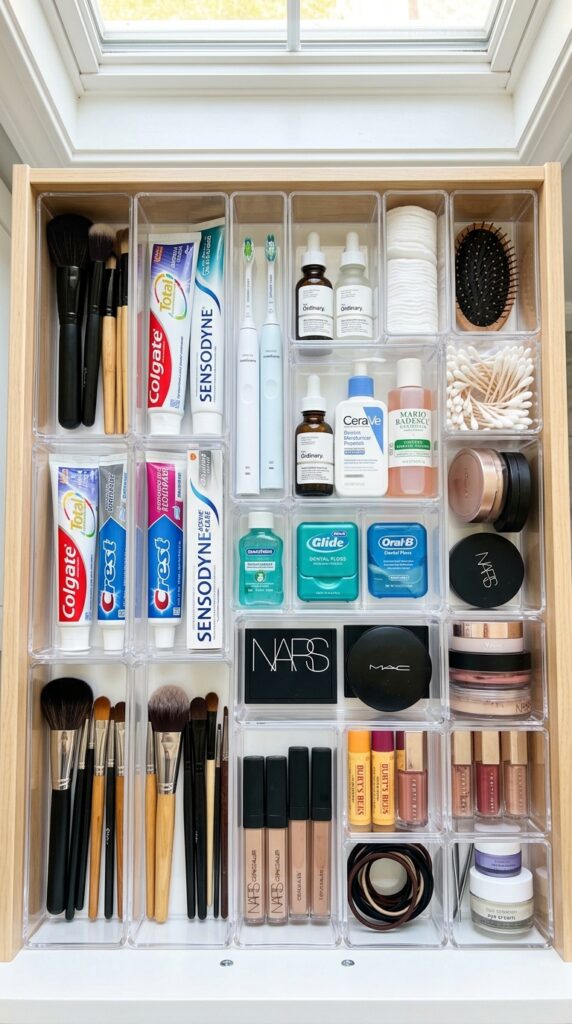
Vibe: Clear — when everything is visible without being touched, the bathroom routine becomes genuinely effortless.
Why it works: Clear acrylic organizers work on a principle that opaque containers do not: total visual accessibility without physical access. Every item is visible from above and from the side simultaneously — no opening, no searching, no digging. In a bathroom drawer where 20–30 different small items compete for accessibility, this complete visibility reduces daily friction by eliminating the unconscious time spent searching for items you know are there but cannot locate. The acrylic material also reflects light internally, brightening the drawer interior and making items even more visible than they would be in colored containers.
How to get it: Purchase acrylic organizers in a single set with multiple sizes rather than individual pieces — sets are designed to pack together without gaps, using the available drawer volume efficiently. Measure the drawer interior (not the exterior dimensions) before ordering — the acrylic containers should fit snugly together without sliding within the drawer when it is opened and closed.
💡 Quick Win: A single acrylic three-drawer organizer ($20–35) placed on the bathroom counter replaces an entire drawer’s worth of scattered countertop items — the three small drawers within it hold the day’s essentials vertically and accessibly without using significantly more counter space than the items would occupy scattered.
Shop The Look
| Product |
| Clear acrylic drawer organizer set bathroom |
| Acrylic makeup organizer 3 drawer countertop |
| Stackable acrylic bin set small 4 pack |
| Acrylic divider adjustable drawer bathroom |
| Label maker clear tape for acrylic containers |
24. Shower Niche Light for Functional and Aesthetic Storage
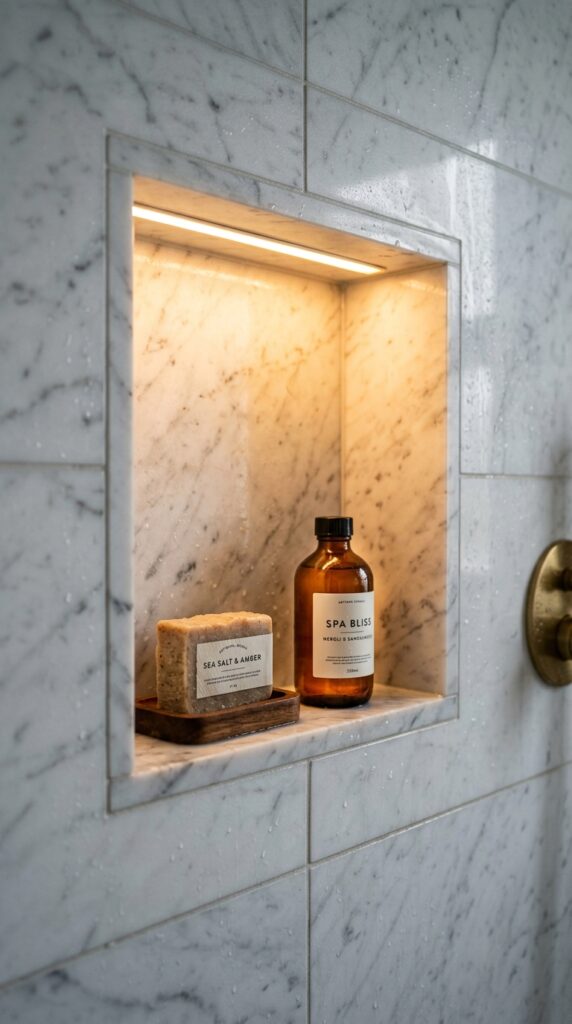
Vibe: Spa-like — a lit shower niche turns functional storage into a feature the bathroom was built around.
Why it works: A standard recessed shower niche is a purely functional storage void — useful but visually unremarkable. Adding a waterproof LED strip light along the interior top edge of the niche transforms it into an illuminated display, making the niche the visual focal point of the shower wall. The warm light (2700K) creates a halo effect around the stored products that reads as intentional hotel-quality design rather than a storage solution. This upgrade also has a practical benefit: the niche interior is fully lit, making product identification immediate even in a steamy shower where visibility is reduced.
How to get it: Specify an IP67-rated LED strip (fully submersion-proof, not just splash-resistant) for any shower application — the niche interior experiences direct water exposure from steam and splash even though it’s recessed. Adhere the strip to the inside top edge of the niche with waterproof silicone adhesive and run the wire through a drilled hole in the niche side wall to an exterior waterproof junction box.
Shop The Look
| Product |
| Waterproof LED strip light IP67 warm white |
| LED strip connector waterproof bathroom |
| Shower niche tile insert marble white |
| Waterproof junction box shower electrical |
| LED dimmer switch low voltage bathroom |
25. Over-Door Towel Bar Behind the Bathroom Door
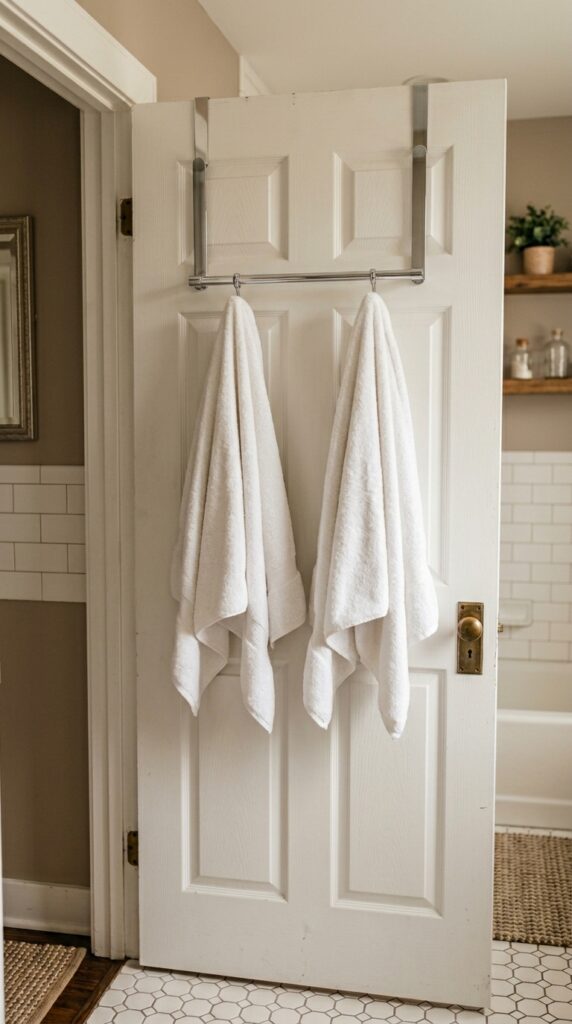
Vibe: Efficient — hanging towels on the back of the door puts them exactly where they’re needed after a shower and out of the way before.
Why it works: An over-door towel bar (using the door’s top edge as the mounting point rather than any screws into the door surface) converts the back of the bathroom door into a two-towel storage and drying station. This location has specific practical advantages: it places towels at arm’s reach from the shower exit, allows the towels to hang fully extended for proper drying, and positions them out of the visual field when the bathroom door is open (since the back of the door faces the wall). The hook-over mounting system requires no tools, no drilling, and no permanent modification — essential for rented bathrooms.
How to get it: Choose a bar with at least three hook positions (left, center, right on the door top edge) rather than just two — three-point contact distributes the bar’s weight more evenly across the door top and prevents the bar from tilting when towels are loaded asymmetrically.
Shop The Look
| Product |
| Over door towel bar hook mount double rail |
| White bath towel set 600gsm luxury 4 pack |
| Over door hook bar triple mount chrome |
| Towel clip holder clamp bathroom |
| Door top protector pad non scratch mount |
26. Labeling System for Uniform Containers
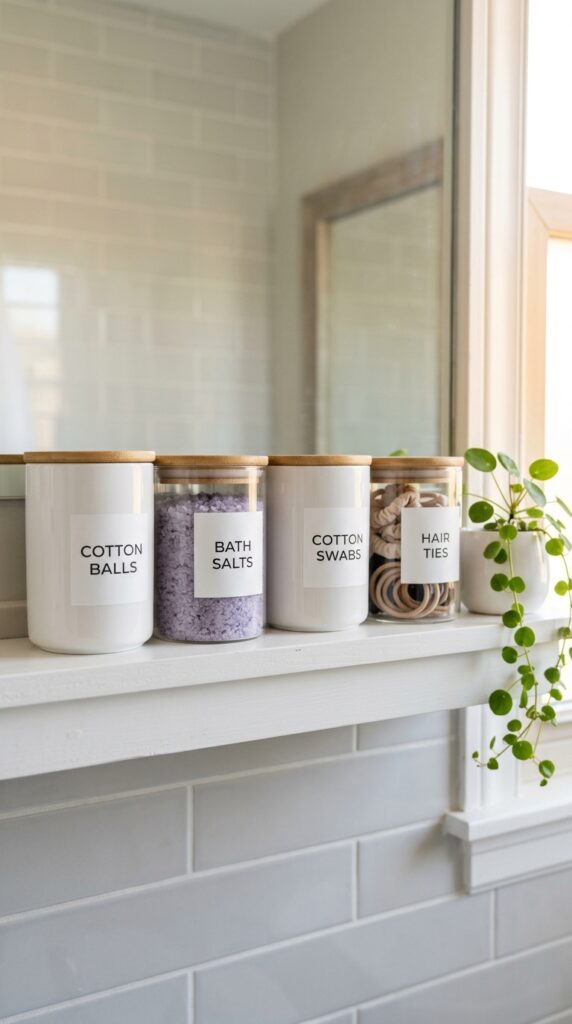
Vibe: Cohesive — when every container speaks the same visual language, the shelf reads as one designed object instead of a collection of things.
Why it works: Visual coherence in bathroom organization comes from uniformity — when all containers share the same material (all white ceramic, all clear glass, all natural rattan) and are labeled consistently, the shelf reads as a system rather than an accumulation. The label serves a dual function: it makes the system immediately navigable (no opening containers to identify contents) and it signals that the organization is intentional rather than accidental. A consistent labeling style (one font, one size, one placement position across all containers) is as important as the container material uniformity — mixed label styles undermine the visual coherence that makes the system work aesthetically.
How to get it: Print labels on a home printer using a clear label sheet in a single clean sans-serif font (Inter, Helvetica, or similar) at consistent size — avoid handwritten labels on a system this organized, which read as mismatched. Apply labels at the same height on each container’s front face.
💡 Quick Win: A label maker ($25–40) produces professional-quality waterproof labels in seconds and pays for itself the first time a uniform container set makes a bathroom shelf look designed rather than collected.
Shop The Look
| Product |
| White ceramic bathroom container set 6 piece |
| Clear glass jar set with lid bathroom storage |
| Label maker thermal waterproof bathroom |
| Clear label sheet printer compatible waterproof |
| Shelf liner adhesive white bathroom |
27. Under-Sink Pull-Out Drawer System
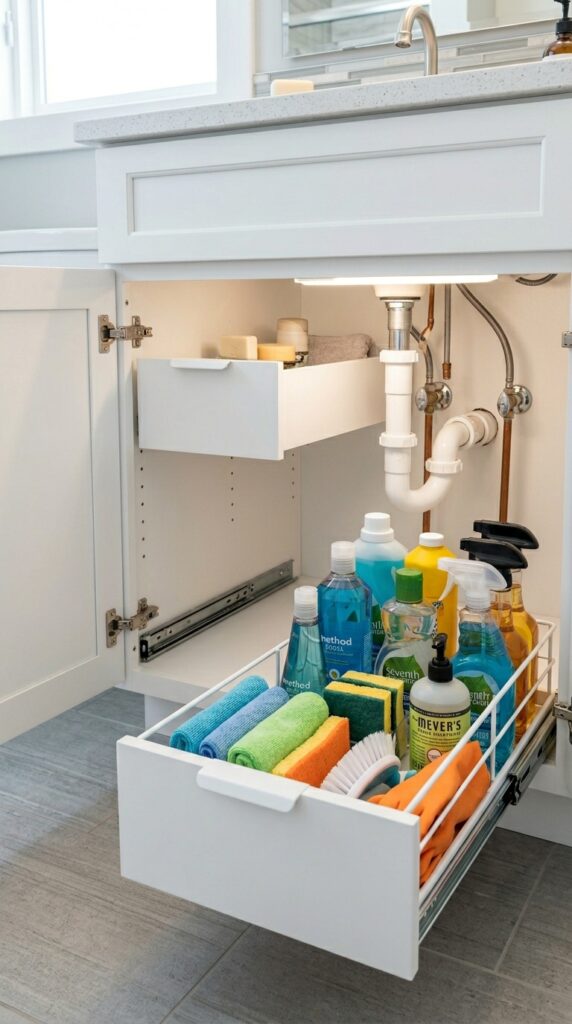
Vibe: Practical — pull-out drawers under the sink make the back of the cabinet as accessible as the front for the first time.
Why it works: Under-sink bathroom cabinets are among the most poorly utilized storage spaces in residential design — the plumbing pipes in the center create an obstruction that forces most items to the front, leaving the back of the cabinet inaccessible and effectively unused. Pull-out drawer inserts mounted on smooth-glide slides on either side of the pipe obstruction convert the back half of the cabinet from dead zone to active storage: pulling the drawer extends it completely out of the cabinet, bringing the back of the drawer (and everything stored in it) to the front of the opening for full visibility and access.
How to get it: Measure the under-sink cabinet interior carefully around the plumbing pipe positions before purchasing pull-out systems — some configurations have pipes positioned off-center, requiring asymmetric drawer sizing. Drawer systems with adjustable width (expandable side walls) are the most versatile option for non-standard plumbing configurations.
Shop The Look
| Product |
| Under sink pull out drawer organizer bathroom |
| Cabinet pull out slide rail system 18 inch |
| Under sink pipe cutout organizer |
| Cabinet organizer tray adjustable width |
| Under sink liner waterproof mat |
28. Vertical Towel Ladder Against a Narrow Wall
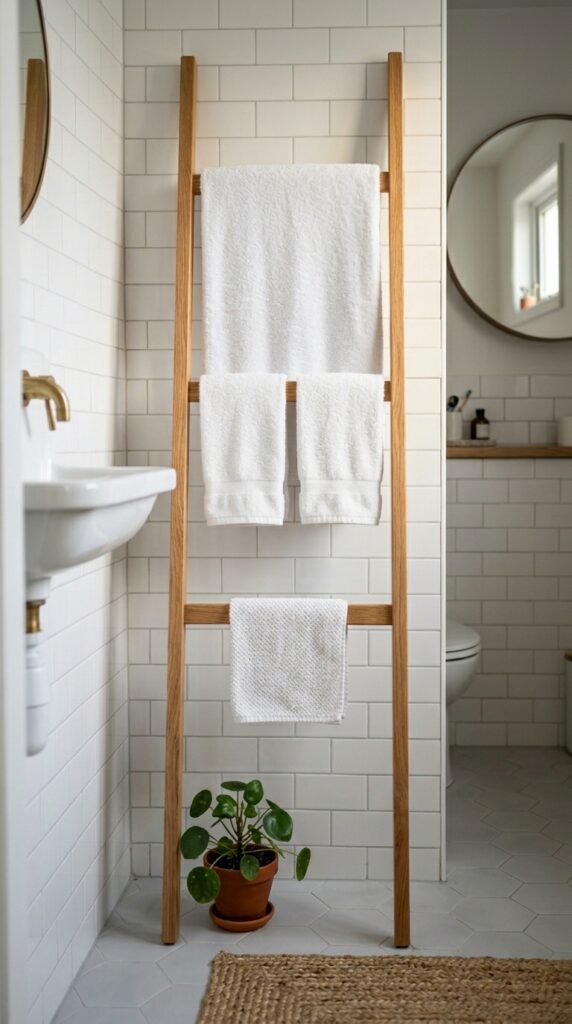
Vibe: Resolved — a towel ladder against a narrow wall turns a problem space into the bathroom’s warmest corner.
Why it works: A narrow wall section (under 24 inches wide) in a tiny bathroom is typically too small to mount a standard towel bar and too narrow for any freestanding furniture — it reads as a spatial leftover rather than a design opportunity. A slim towel ladder (18 inches wide, 5 feet tall) leans against this wall using only 3–4 inches of floor depth at the base, providing four to five towel-hanging positions on its rungs without any wall mounting, any tools, or any floor footprint beyond the ladder’s base width. The leaned position means the top of the ladder projects 8–10 inches from the wall at the top, creating a slight forward angle that actually improves towel ventilation — towels dry faster than they do hung flat against a wall.
How to get it: Choose a ladder in solid teak or white oak rather than pine or bamboo composites — single-species solid wood handles the repeated moisture exposure of towels being hung wet without warping at the joints. Place a small rubber mat under each of the ladder’s two feet to prevent slipping on tile or polished concrete floors.
💡 Quick Win: A decorative towel ladder ($45–80 at most home retailers) delivers more visual warmth and more towel storage than a standard towel bar at a comparable price — and it can move to the next bathroom when you do.
Shop The Look
| Product |
| Teak towel ladder 5 foot bathroom natural |
| White oak decorative ladder towel holder |
| Non-slip rubber foot pad set furniture |
| Linen hand towel set natural grey 4 pack |
| Small plant pot basket base bathroom |
How to Start Your Tiny Bathroom Storage Transformation
The single most important first move is to install a recessed medicine cabinet in place of a flat mirror — or to add a surface-mount medicine cabinet if recessing isn’t possible. This one change conceals an entire bathroom’s worth of daily-use products (medicine, skincare, grooming tools) behind a mirrored surface that simultaneously functions as the vanity mirror, doubles the room’s perceived depth through reflection, and frees every inch of counter space below it. It is the only bathroom storage intervention that solves three problems with one installation. Budget $80–250 for a quality unit and one afternoon for installation.
The most common mistake in tiny bathroom storage is buying too many individual organizational products without first editing what needs to be stored. A bathroom organized around 40 items will always feel cluttered regardless of the quality of the storage system — 25 items with no organizational system will feel more manageable. Before purchasing a single basket or shelf, remove every item from the bathroom and group them by category. Discard anything expired, duplicated, or stored in the bathroom out of habit rather than genuine use frequency. The items remaining after that edit are the ones the storage system needs to serve — and the number is almost always smaller than expected.
Three items under $50 that create immediate tiny bathroom storage impact: a set of three matching seagrass baskets ($18–28) that unify an open shelf’s visual noise overnight; a dark charcoal grout colorant pen ($12–18) applied to light-grouted tile that makes the floor read as a more unified surface; and a single tension rod under the sink ($6–10) that immediately frees the entire cabinet floor by hanging spray bottles overhead.
A single-weekend transformation — medicine cabinet swap, under-sink tension rod, drawer organizer inserts, and rolling cart in the toilet gap — costs $120–280 and creates more usable storage than most bathrooms currently have. A full renovation-level storage overhaul (recessed niches, built-in vanity drawers, full-wall mirrored cabinetry) is a four-to-eight-week project at $2,000–6,000, depending on the degree of custom installation involved.
Frequently Asked Questions About Tiny Bathroom Storage Solutions
What is the most effective storage solution for a bathroom under 40 square feet?
The recessed medicine cabinet is the single most effective tiny bathroom storage solution because it uses the wall cavity space that already exists — adding zero depth to the room — while concealing a complete bathroom’s supply of daily-use products behind a functional mirror surface. In a bathroom under 40 square feet, where every inch of floor and counter space is visually significant, a storage solution that adds capacity without adding physical presence is uniquely valuable. A 24×36-inch recessed medicine cabinet holds approximately the same volume as a 12-inch-deep countertop organizer while occupying none of the counter, none of the wall projection, and none of the visual field when closed.
What color containers work best for tiny bathroom organization?
Uniform white ceramic or clear acrylic are the two most effective container choices for tiny bathroom organization — white ceramic reads as intentional and warm, while clear acrylic provides total content visibility without any visual opacity. Both choices work because they reduce visual noise: a shelf of mismatched product packaging in various colors reads as cluttered even when it is technically organized, while the same items decanted into uniform white or clear containers reads as calm and deliberate. Natural rattan and seagrass baskets in a consistent size are the best choice for larger item categories (towels, backup supplies) because their organic texture adds warmth without the visual weight of solid-colored containers.
How much does it cost to add meaningful storage to a tiny bathroom?
A no-installation, renter-safe tiny bathroom storage upgrade — over-toilet ladder shelf, door organizer, tension rod under sink, and drawer organizer inserts — costs $80–160 total and can be implemented in one weekend. A semi-permanent upgrade adding floating shelves, a medicine cabinet, and a wall-mounted hair tool holder runs $200–450 including installation materials. A renovation-level storage improvement with recessed shower niches, custom under-sink pull-outs, and full-wall mirrored cabinetry sits at $1,500–5,000 depending on the scope of tile work and cabinetry custom-fitting involved.
Can I add storage to a tiny bathroom without drilling into tile?
Yes — several of the most effective tiny bathroom storage solutions require no tile drilling: over-door and over-toilet systems use door and tank edges as mounting points; tension rods press between walls or cabinet interiors without wall contact; suction-cup shelves and hooks mount to smooth tile or glass without drilling; adhesive-mounted hooks and strips (Command brand, rated for bathroom humidity) hold lightweight items on tile without damage; and freestanding units (rolling carts, ladder shelves, tension pole caddies) require no wall contact at all. A complete no-drill tiny bathroom storage system using these approaches can achieve nearly equivalent storage capacity to a drilled installation — the main limitation is weight capacity per item, since drilled anchors hold significantly more than adhesive alternatives.
Which area of a tiny bathroom is most often wasted and how do I fix it?
The vertical space above 60 inches — from the top of standard eye-level storage to the ceiling — is the most consistently wasted zone in tiny bathroom design. Most storage systems stop at eye level out of habit rather than necessity, leaving 12–36 inches of usable wall space above them empty. The fix is simple: extend every existing storage system (floating shelves, cabinet stacks, wall organizers) as close to the ceiling as the room allows, storing infrequently used items in the higher positions. A step stool ($20–35) kept elsewhere in the home provides sufficient access to ceiling-height shelves — the slight inconvenience of occasional step stool use is a reasonable trade-off for the significant additional storage capacity gained.
Ready to Create Your Dream Tiny Bathroom Storage Space?
These 28 solutions cover the full range of what makes a tiny bathroom genuinely organized — from the foundational architectural moves like recessed niches and medicine cabinets that add capacity without adding presence, to the small-object systems like magnetic strips and drawer organizers that resolve the daily chaos of countertop accumulation, to the vertical thinking and door-and-gap strategies that recover space most bathrooms never knew they had. Every transformation in a tiny bathroom starts with one decision made well — not a shopping list, but a single solution chosen for your specific room’s biggest problem and implemented completely before moving to the next. Today, measure the gap beside your toilet, the depth of your under-sink cabinet, and the empty wall above your top shelf — those three measurements will tell you exactly where your bathroom’s storage potential is waiting. When the system is complete and every item has a home and nothing lives on the counter that doesn’t belong there, the bathroom stops feeling like a storage problem and starts feeling like the smallest room in the house that somehow always has exactly what you need. Pin the solutions that solved a specific problem you recognized — those are the ones worth acting on first.