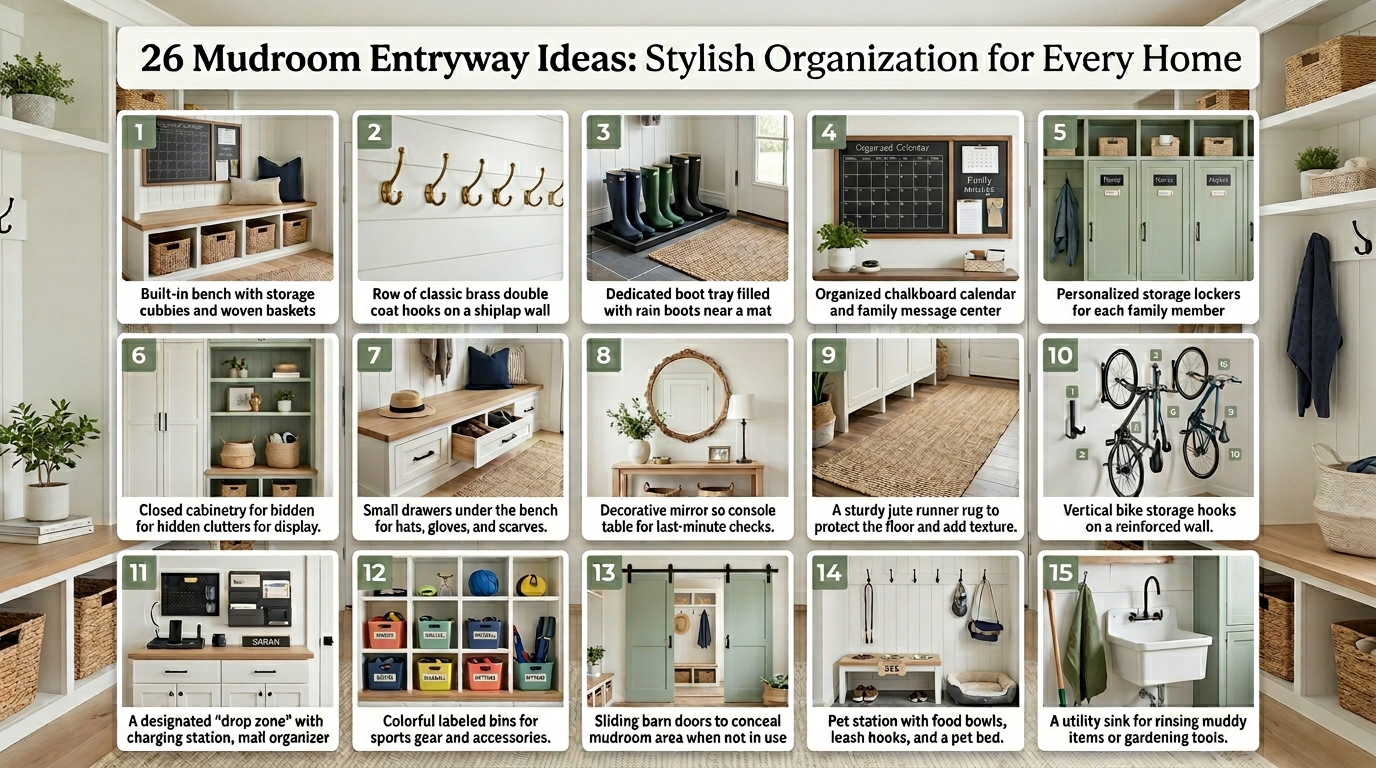
A mudroom entryway is a dedicated transition zone between the outdoors and the interior of your home — typically outfitted with storage for coats, shoes, bags, and gear. This article delivers exactly 26 mudroom entryway ideas, ranging from compact bench-and-hook setups to full built-in locker systems, with real design detail and product suggestions for every look.
There’s something deeply satisfying about a mudroom that works. It’s the first thing you feel when you drop your bag after a long day — that quiet order, everything in its place, no scrambling for keys or tripping over shoes. The best mudroom entryways aren’t just functional; they set the emotional tone for the whole home. A warm lantern, a runner in earthy stripes, hooks at exactly the right height — small decisions that compound into a space that genuinely makes life easier.
Here are 26 ideas worth saving — and stealing.
Why Stylish Organization Works So Well in the Mudroom Entryway
The mudroom entryway as a dedicated design zone is a relatively modern concept rooted in early American farmhouse planning, where a back entry served as a buffer between muddy fields and clean living spaces. Today, the style has evolved into a hybrid of utilitarian Shaker design and contemporary warmth — defined by purposeful storage, honest materials, and a refusal to choose between good-looking and hard-working.
The materials and colors that define a well-designed mudroom lean grounded and tactile. Think warm white or creamy greige on walls, shiplap or tongue-and-groove paneling, unfinished white oak or warm hickory on bench tops, matte black or brushed brass hardware, and natural fiber baskets in seagrass or rattan. Accent colors tend to be drawn from the outdoors — dusty sage, slate blue, terracotta, deep charcoal — rather than anything trend-chasing.
Mudroom design is trending hard right now for a reason: after years of open-plan living, people are craving defined zones again. The entryway became a battleground during the pandemic — school bags, work gear, groceries, and pet leashes all competing for the same 12 square feet. The result is a generation of homeowners who finally want a real solution, not a coat rack from a big-box store.
Small spaces can absolutely achieve this look, with one caveat: prioritize vertical space first. A single tall locker or floor-to-ceiling hook panel does more organizing work than a wide, low bench that eats square footage. In a narrow entry, the rule is: one anchor piece, then layer accessories around it. Don’t try to do everything — do one thing exceptionally well.
| Element | Trait 1 | Trait 2 |
| Philosophy | Function-forward beauty | Order creates calm |
| Materials | Shiplap, white oak, rattan | Matte black metal, linen |
| Color palette | Warm white, greige, slate | Dusty sage, deep charcoal |
26 Mudroom Entryway Ideas: Stylish Organization That Actually Works
1. Shiplap Accent Wall with Painted Wainscoting
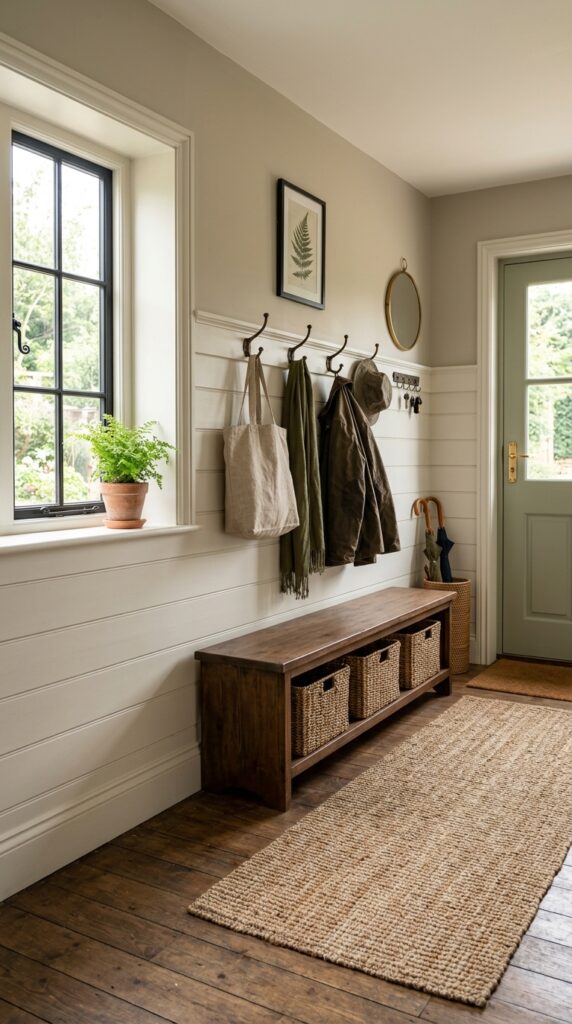
Vibe: Still and unhurried — the kind of wall that makes a narrow entry feel like it was always meant to be there.
Why it works: Shiplap wainscoting creates a strong horizontal rhythm that anchors the eye and keeps the wall from feeling like a blank obstacle. The contrast between a painted lower panel and a warmer wall color above — even when both are neutrals — gives the space layered visual weight without any decoration. The texture of the horizontal boards also hides scuffs and handprints far better than flat drywall.
How to get it: Install shiplap panels to chair-rail height (around 36–42 inches), then paint the lower portion in a slightly cooler tone like Benjamin Moore “White Dove” and the upper wall in Sherwin-Williams “Accessible Beige.” The two-tone break reads as intentional architectural detail, not an afterthought.
💡 Quick Win: Peel-and-stick shiplap panels cost under $2 per square foot on Amazon and require no special tools — an entire wainscoting wall can be done in a single afternoon.
🛍️ Shop the Look — Amazon Product Ideas
| # | Product Search Phrase | Why It Fits |
| 1 | Peel and stick shiplap wall panels white | Instant texture, no nails |
| 2 | Matte black double coat hooks farmhouse | Hardware to anchor wall |
| 3 | Jute braided area rug runner beige | Grounds the entryway floor |
| 4 | Woven seagrass rectangular basket bin | Tucked-away clutter storage |
| 5 | White chalk paint quart interior walls | Clean crisp painted finish |
2. Built-In Locker-Style Cubbies with Bench
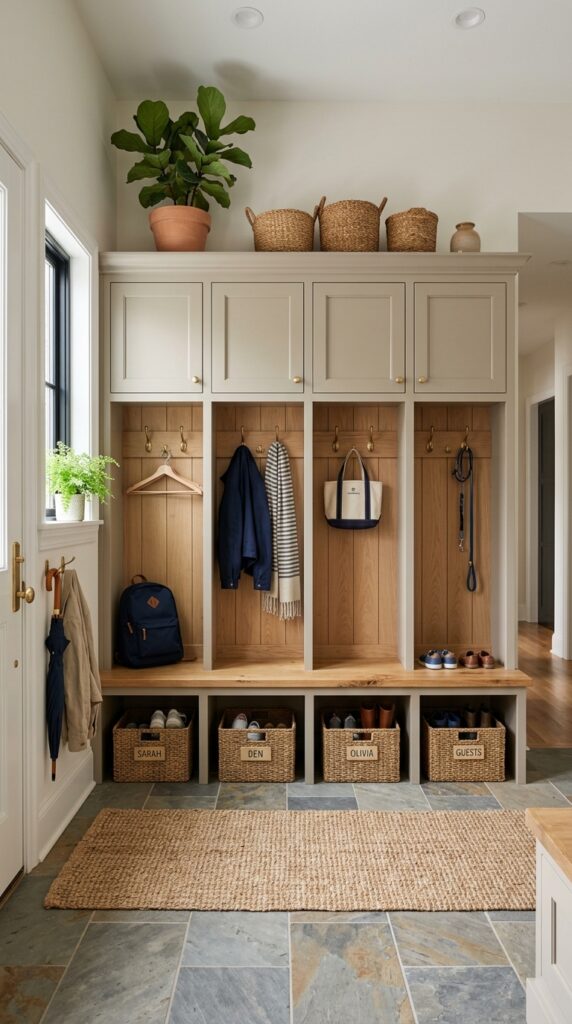
Vibe: Orderly and generous — like every person in the household finally has their own corner of the world.
Why it works: The locker layout applies the principle of visual zoning: each person’s belongings live within a vertical column, eliminating the horizontal sprawl that makes entryways feel chaotic. Upper cabinet doors hide the visual clutter of hats and scarves, the middle hook section handles daily-use bags, and the bench doubles as lift-top storage for shoes or sports gear. The result is a wall that looks intentional from every angle.
How to get it: IKEA’s PAX wardrobe system is the most accessible starting point — frame it out with trim, add a custom face frame, and paint everything the same color for a built-in look at a fraction of custom cost. Add an unfinished white oak bench top cut to width from a home improvement store for warmth.
🛍️ Shop the Look — Amazon Product Ideas
| # | Product Search Phrase | Why It Fits |
| 1 | White entryway storage bench with cubbies | Anchor furniture piece |
| 2 | Lift top storage bench mudroom | Hidden shoe storage |
| 3 | Labeled canvas bin cubby organizer | Per-person categorization |
| 4 | Brushed brass cabinet knob set | Hardware for cohesion |
| 5 | White oak veneer shelf board natural wood | Bench top surface material |
3. Statement Pendant Light Over the Entry Bench
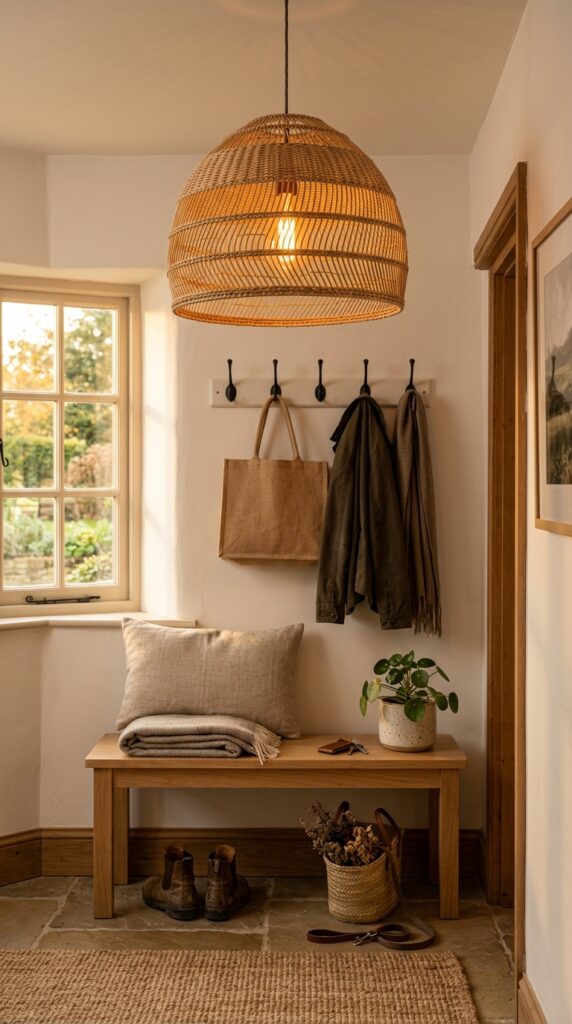
Vibe: Sun-warmed and surprisingly intimate for a space most people treat as purely practical.
Why it works: Pendant lighting over a bench creates a dedicated “landing zone” — the light pools downward and visually defines the space as intentional, not incidental. The principle at play is light behavior: warm amber light from a natural rattan shade casts softer shadows than overhead recessed lighting and makes the adjacent wall colors glow rather than flatten. It also shifts the visual weight upward, which draws the eye up in a low-ceiling entry.
How to get it: Hang the pendant so the bottom of the shade lands at approximately 6.5 feet from the floor — low enough to feel intimate, high enough to clear a standing adult. Choose a shade diameter of at least 18 inches so it reads as a statement rather than an afterthought.
💡 Quick Win: Swag-style pendant lights with a plug-in cord eliminate the need for an electrician — hook the cord along the ceiling with adhesive cable clips and plug into a standard outlet.
🛍️ Shop the Look — Amazon Product Ideas
| # | Product Search Phrase | Why It Fits |
| 1 | Rattan woven pendant light boho farmhouse | Signature lighting piece |
| 2 | Plug-in swag pendant light kit ceiling | No electrician required |
| 3 | Edison vintage LED bulb warm 2700K | Amber warm light source |
| 4 | Adhesive ceiling cable clip cord hider | Clean cord management |
| 5 | Linen bench cushion neutral tan | Soft landing zone texture |
4. Slate Tile Flooring with a Bordered Runner
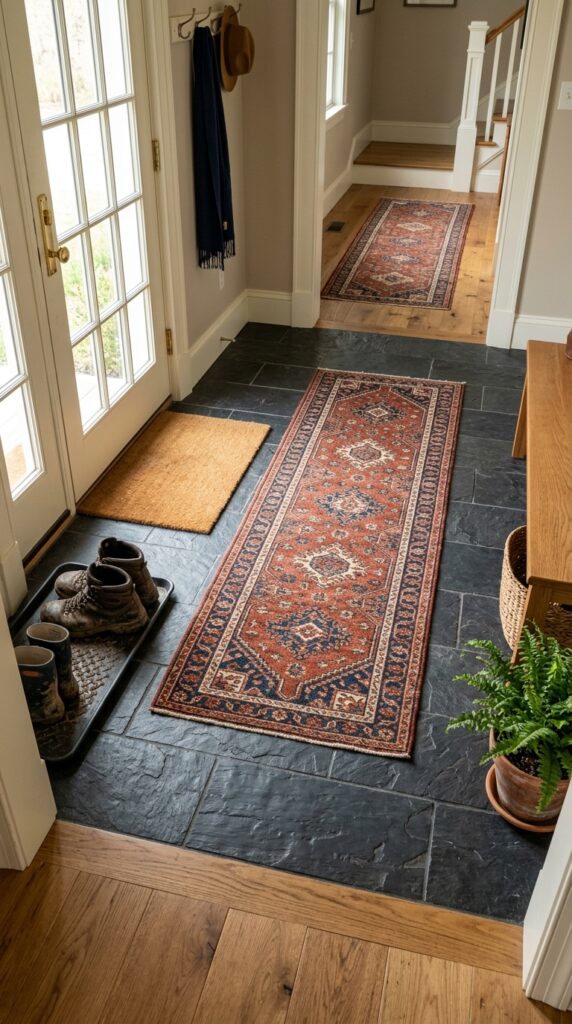
Vibe: Raw and grounded, with just enough pattern to pull the eye from entry to interior.
Why it works: Slate tile is the right material for a mudroom floor because its natural cleft surface — the uneven, textured face of split stone — hides dirt and provides grip underfoot without being visually loud. Layering a bordered runner on top introduces softness and color while defining the walking path. The contrast between hard, natural stone and a woven textile is a classic texture-layering technique that prevents the space from reading as purely utilitarian.
How to get it: Opt for a slate tile in 12×24 inch format laid in a staggered offset pattern rather than a grid — it reads more contemporary and hides grout lines better. Keep grout color close to the tile color (dark gray on dark slate) to maintain visual continuity.
🛍️ Shop the Look — Amazon Product Ideas
| # | Product Search Phrase | Why It Fits |
| 1 | Bordered wool runner rug geometric rust navy | Layered pattern over tile |
| 2 | Boot tray entryway mud room large | Mud containment at entry |
| 3 | Dark gray grout sanded tile grout charcoal | Invisible grout lines |
| 4 | Non-slip rug pad runner thin | Keeps runner in place |
| 5 | Indoor outdoor doormat mud scraper coir | First line of defense |
5. Sage Green Cabinetry with Warm White Walls
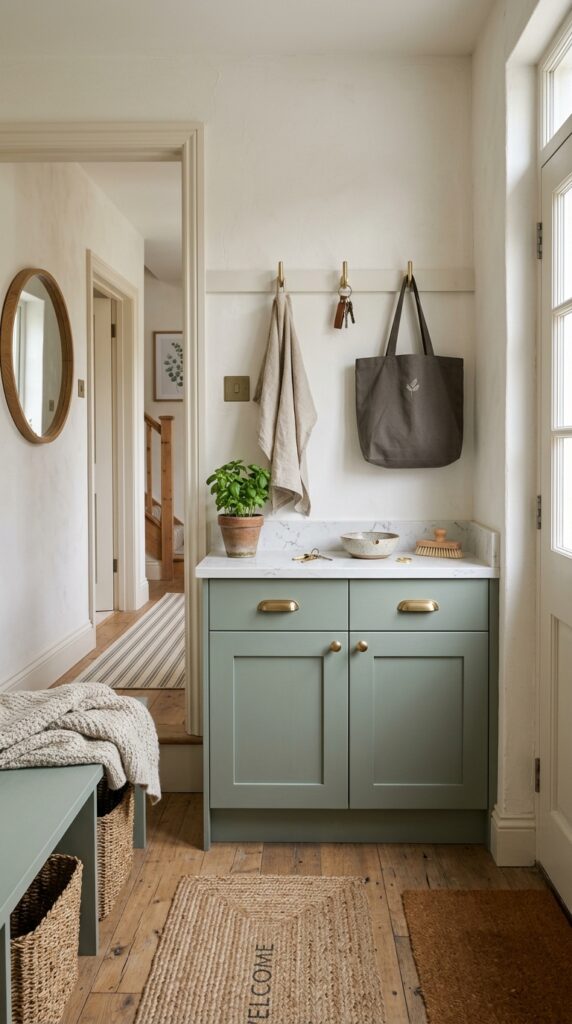
Vibe: Hushed and collected — like a kitchen that decided to become a sanctuary.
Why it works: Dusty sage sits in the green-gray spectrum in a way that feels both earthy and sophisticated — it absorbs light softly rather than bouncing it, which gives the space a sense of calm rather than energy. The contrast principle here is color temperature: warm white walls push the sage forward without competing with it, and brushed gold hardware bridges the warm and cool tones. Cabinet color is the single highest-impact change in a built mudroom.
How to get it: Farrow & Ball “Mizzle” and Benjamin Moore “Aganthus Green” are both excellent dusty sage options with warm undertones that prevent the cabinet from reading as minty or clinical. Apply in a satin or semi-gloss finish to allow for wipe-down cleaning.
💡 Quick Win: Chalk paint in a sage tone (Annie Sloan “Antibes Green” lightened with white) adheres to existing cabinets without sanding — a single quart covers most small mudroom built-ins.
🛍️ Shop the Look — Amazon Product Ideas
| # | Product Search Phrase | Why It Fits |
| 1 | Sage green chalk paint furniture cabinet | Color transformation shortcut |
| 2 | Brushed gold cabinet pull bar handle | Warm hardware accent |
| 3 | Small ceramic catch all tray entry | Key and wallet landing spot |
| 4 | White marble look contact paper shelf liner | Counter surface protection |
| 5 | Mini potted succulent indoor plant set | Low-maintenance natural accent |
6. Floating Wood Shelves with Decorative Baskets
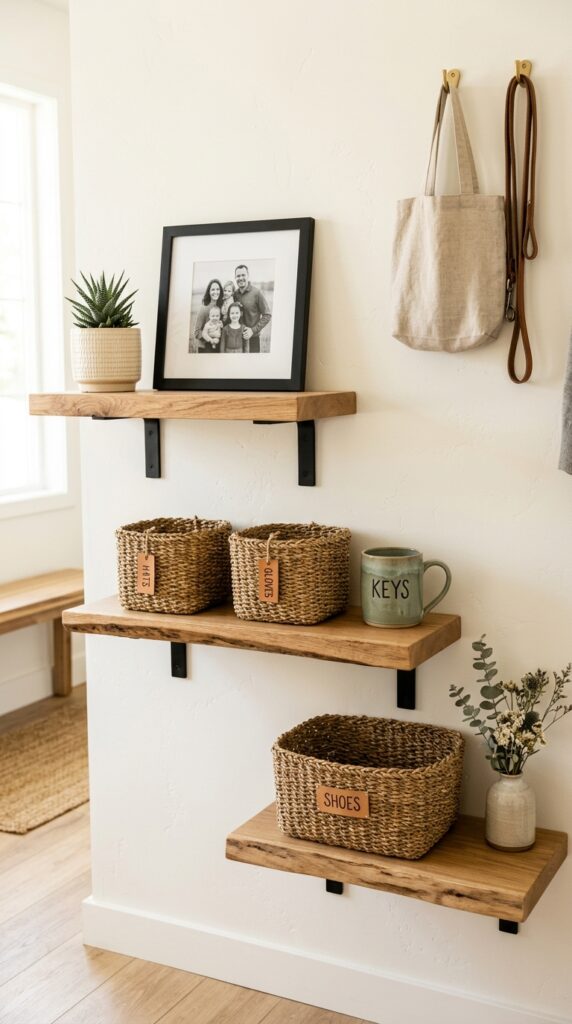
Vibe: Layered without being cluttered — the kind of shelf arrangement that looks effortless but isn’t.
Why it works: Floating shelves introduce storage without visual mass — they give the wall breathing room that closed cabinets don’t. Staggering the shelves at different heights (rather than aligning them horizontally) creates visual movement and mirrors the asymmetry you’d see in a well-curated gallery wall. The woven baskets do dual duty: they corral clutter inside while adding texture to the exterior face of the shelf.
How to get it: Style shelves using the rule of thirds — one-third hard items (a small plant, a framed photo), one-third basket storage, one-third open breathing room. Never fill every inch. The empty space is doing as much work as the objects.
🛍️ Shop the Look — Amazon Product Ideas
| # | Product Search Phrase | Why It Fits |
| 1 | Floating wall shelf white oak natural wood | Main structural element |
| 2 | Seagrass rectangular basket with handles | Concealed clutter storage |
| 3 | Matte black floating shelf bracket industrial | Hardware visible as detail |
| 4 | Small ceramic planter indoor succulent pot | Natural organic accent |
| 5 | Black and white minimalist wall art print | Personal touch anchor |
7. Dark Moody Navy Entry with Brass Accents
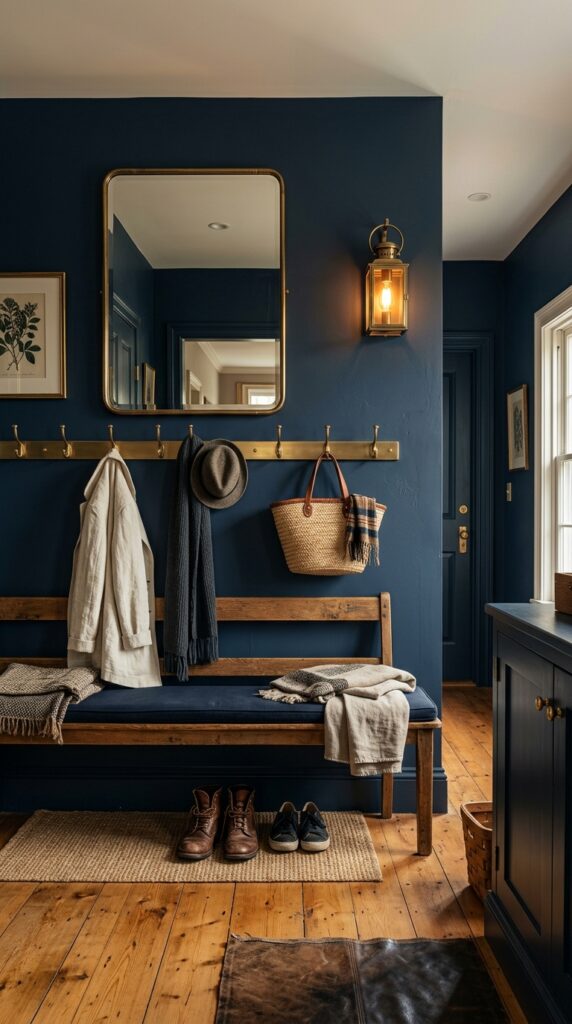
Vibe: Rich and theatrical — a small entry that refuses to be overlooked.
Why it works: Dark paint in a small space does the opposite of what most people fear — it collapses the walls inward in a way that feels intentional and intimate rather than cramped. The design principle is visual weight: dark hues create a cocoon effect that actually makes the space feel more defined. Brass hardware glows against navy in a way it simply can’t against a pale wall, and warm wood floors prevent the palette from feeling cold.
How to get it: Benjamin Moore “Hale Navy” and Sherwin-Williams “Naval” are the two industry benchmarks for this look — both have warm undertones that read as sophisticated rather than stark. Apply in a flat or matte finish to eliminate glare and enhance the depth of the color.
🛍️ Shop the Look — Amazon Product Ideas
| # | Product Search Phrase | Why It Fits |
| 1 | Brushed brass coat hook single entry wall | Hero hardware in brass |
| 2 | Arched brass mirror entryway wall decor | Reflective light amplifier |
| 3 | Navy wall paint sample card interior | Color verification before commit |
| 4 | Leather handled wicker storage basket | Warm textural contrast |
| 5 | Brass wall sconce plug in warm light | Mood lighting, no wiring |
8. Wall-Mounted Bike and Sports Gear Storage
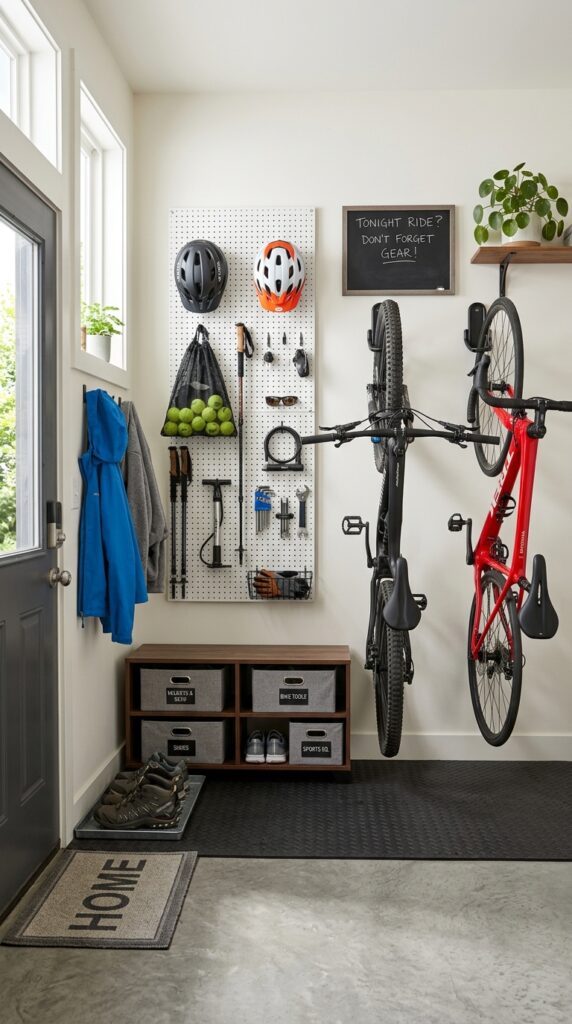
Vibe: Efficient and athletic — the energy of a gear room, with the order of a design magazine.
Why it works: Vertical bike storage recovers the floor space that a parked bike would otherwise consume — and floor space in a mudroom is almost always the scarcest resource. The key design principle is proportion: wall-mounted gear storage works only when the wall anchoring it is visually reinforced, either with a contrasting paint color or a pegboard panel that frames the zone and makes it look deliberate rather than improvised.
How to get it: Install a 4-foot-wide white pegboard panel first as the organizing framework, then mount bike hooks and accessory hooks through the board at custom heights. The pegboard unifies everything visually and allows the configuration to change as your gear evolves.
💡 Quick Win: A single wall-mounted vertical bike hook ($25–$40 on Amazon) and two hours of drilling is the fastest floor-to-wall storage conversion in any mudroom — immediately reclaims 4–6 square feet of floor.
🛍️ Shop the Look — Amazon Product Ideas
| # | Product Search Phrase | Why It Fits |
| 1 | Vertical wall mount bike hook heavy duty | Primary space-saving solution |
| 2 | White pegboard panel with hardware kit | Flexible gear organizer base |
| 3 | Helmet wall hook sports gear organizer | Safety gear off the floor |
| 4 | Heavy duty rubber floor mat garage entry | Protects floor under bikes |
| 5 | Mesh hanging storage bag sports equipment | Ball and gear containment |
9. Minimalist Japandi-Inspired Entry Bench
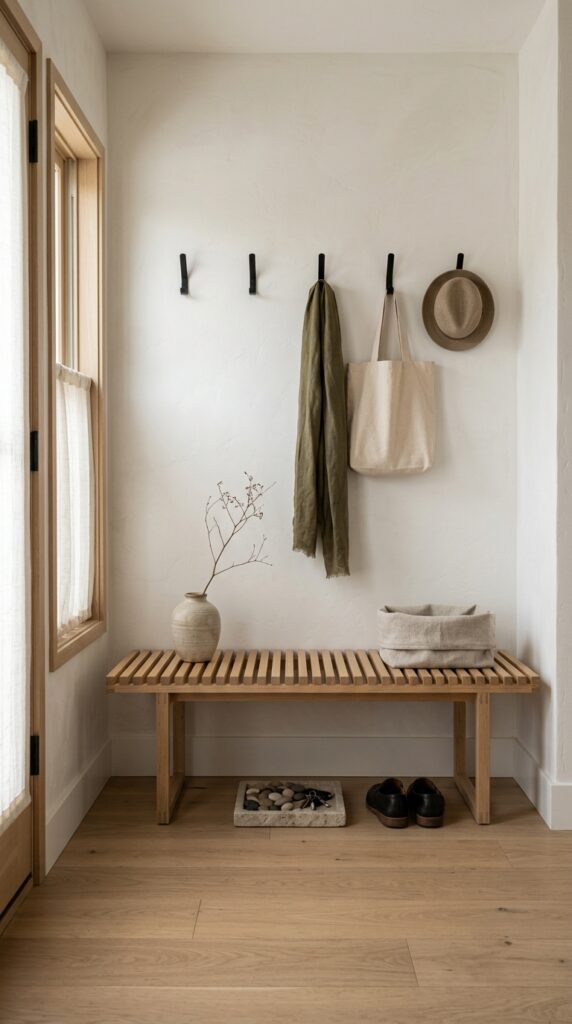
Vibe: Hushed and deliberate — every object chosen, nothing extra tolerated.
Why it works: Japandi design applies the principle of negative space as a design element: the emptiness around a slatted bench reads as intentional composition rather than incomplete decorating. The slatted profile serves both form and function — it’s lighter visually than a solid bench, and the gaps prevent trapped moisture and debris from accumulating. Low furniture proportions make ceilings feel higher by comparison.
How to get it: Look for benches with a seat height of 16–18 inches and legs in a raw or lightly-oiled wood finish rather than stained or lacquered. Avoid upholstered tops in a mudroom context — they’re nearly impossible to keep clean. A simple slatted teak or white oak top is timeless and durable.
🛍️ Shop the Look — Amazon Product Ideas
| # | Product Search Phrase | Why It Fits |
| 1 | Slatted wood entry bench natural oak minimal | Core Japandi furniture piece |
| 2 | Matte black minimal wall hook single arm | Clean line wall hardware |
| 3 | Ceramic bud vase wabi sabi textured neutral | Quiet organic accent |
| 4 | Dried pampas grass stem neutral decor | Natural sculptural element |
| 5 | Flat river stone tray entry shoe mat | Grounding floor detail |
10. Painted Brick Wall with Industrial Hooks
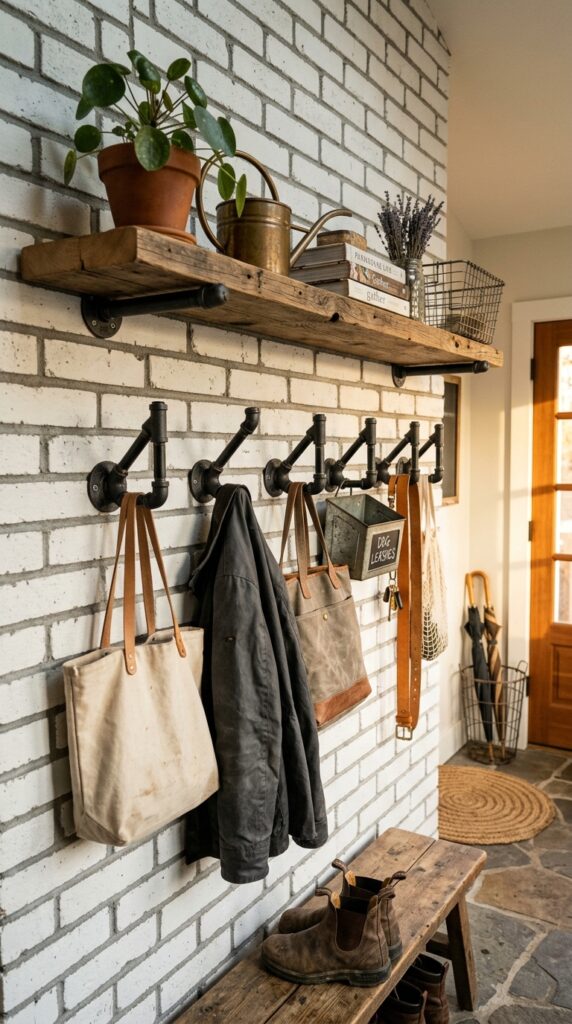
Vibe: Raw and well-used, in the best possible way — a wall that looks like it has a story.
Why it works: Painted brick retains its texture while accepting a unifying color — it reads as a deliberate architectural feature rather than an exposed wall that wasn’t worth finishing. The contrast between the rough-edged brick and smooth iron pipe hooks plays on the industrial farmhouse tension between raw and refined. A continuous reclaimed wood shelf across the top anchors the hooks as a single composed unit rather than individual hanging spots.
How to get it: Paint brick using a masonry roller — it gets into the mortar texture without leaving brush marks. Use a masonry primer first on any brick that hasn’t been previously painted. Iron pipe hooks can be DIY-fabricated with plumbing components from a hardware store for under $8 each.
💡 Quick Win: Pre-assembled iron pipe coat hooks in a 3-hook bar format cost $20–$35 on Amazon and mount with standard drywall anchors — no plumbing knowledge required.
🛍️ Shop the Look — Amazon Product Ideas
| # | Product Search Phrase | Why It Fits |
| 1 | Iron pipe coat hook wall mount industrial | Statement hook hardware |
| 2 | Reclaimed wood floating shelf rustic | Top shelf above hooks |
| 3 | Masonry primer white spray interior brick | Prepares brick for paint |
| 4 | Metal label holder basket tag clip | Industrial organization detail |
| 5 | Canvas tote bag heavy duty natural | Everyday bag on display |
11. Floor-to-Ceiling Mirror for Small Entryways
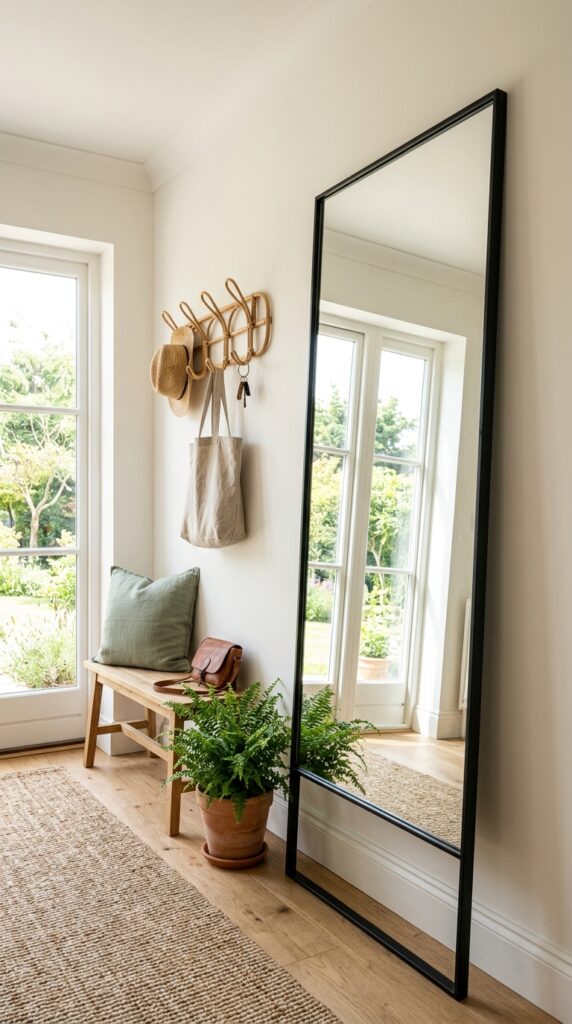
Vibe: Luminous — a narrow hall that somehow breathes.
Why it works: A floor-to-ceiling mirror exploits the illusion technique of light duplication: it doubles the perceived depth of the space by reflecting the opposite wall, and bounces natural light further into what is often the darkest part of a home. The key is scale — a mirror that reaches toward the ceiling reads as architectural, not merely decorative. Thin metal frames (especially in matte black) keep the visual weight minimal so the mirror doesn’t compete with the reflected space.
How to get it: Look for mirrors measuring at least 65 inches tall — anything shorter reads as furniture rather than architecture. Lean against the wall rather than mounting if you’re renting or want flexibility. Position it opposite the primary light source (a window or door) for maximum reflection effect.
🛍️ Shop the Look — Amazon Product Ideas
| # | Product Search Phrase | Why It Fits |
| 1 | Floor to ceiling leaner mirror matte black frame | Primary space-expanding piece |
| 2 | Over door full length mirror thin gold | Alternative mount style |
| 3 | Mirror hanging kit wall anchor heavy duty | Safe wall mounting hardware |
| 4 | Small rattan hook rack wall-mounted 3 hook | Companion storage piece |
| 5 | Single stem eucalyptus vase entry decor | Reflective accent in mirror |
12. Colorful Tile Accent Floor Inset
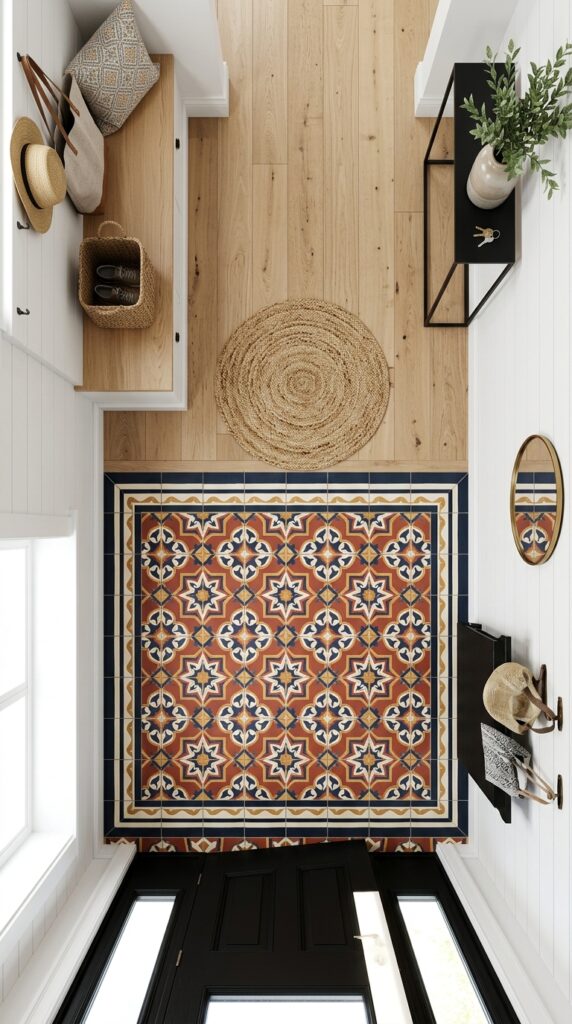
Vibe: Joyful and sun-warmed, a small square of personality that changes how you feel the moment you step inside.
Why it works: A tile inset at the threshold is a layout technique that defines the entry zone without requiring a physical barrier — it’s zone definition through material change rather than walls or furniture. The eye reads the different material as a distinct space, creating a visual “welcome mat” that’s permanent and architectural. Encaustic cement tiles in a geometric pattern bring the same energy as expensive custom work at a fraction of the cost.
How to get it: Plan a tile inset of 24×36 inches minimum — smaller than that and the pattern won’t read at a glance. Use a contrasting border tile in a solid color to frame the patterned field and give it a finished, intentional edge.
💡 Quick Win: Peel-and-stick encaustic-look vinyl tile from Amazon can create this same inset effect without mortar, setting time, or a trowel — peel the perimeter with a utility knife for a custom-sized inset.
🛍️ Shop the Look — Amazon Product Ideas
| # | Product Search Phrase | Why It Fits |
| 1 | Encaustic cement look peel stick tile geometric | Decorative floor inset |
| 2 | Terracotta border tile trim strip | Defines inset edge cleanly |
| 3 | White oak luxury vinyl plank flooring | Adjacent field flooring |
| 4 | Tile grout pen terracotta color refresh | Revives or adds color to grout |
| 5 | Non-slip floor mat woven entry indoor | Companion mat on wood section |
13. Chalkboard Wall for Messages and Lists
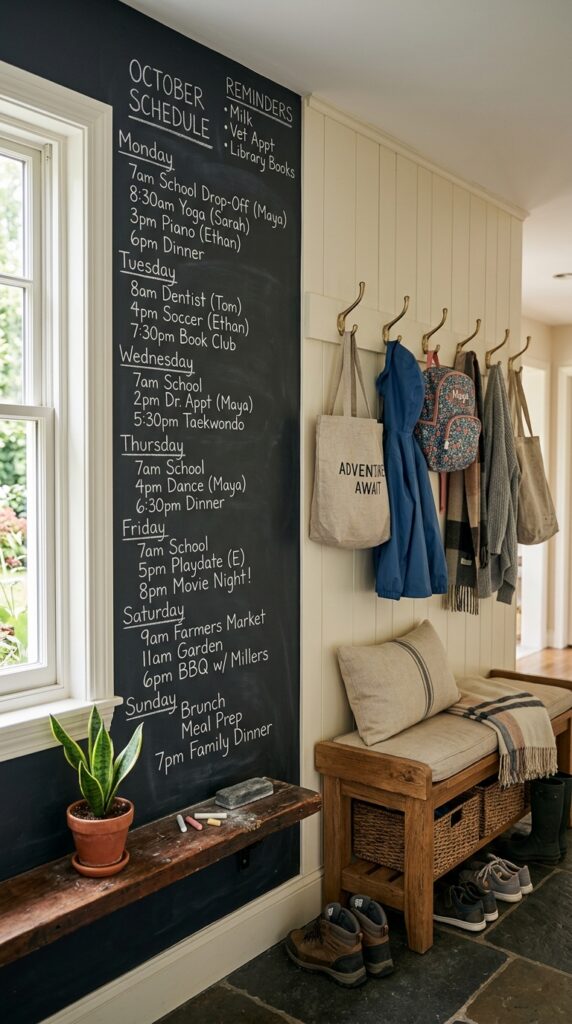
Vibe: Warm and alive — a wall that talks back.
Why it works: A chalkboard wall is a functional surface that earns its visual presence through constant use — it’s one of the few decorative choices that actually improves the experience of being in the space rather than just its appearance. From a design standpoint, dark chalkboard paint behaves like a moody accent wall, adding depth and drama while remaining completely purposeful. A narrow wooden ledge at the base (to hold chalk and an eraser) converts it from paint to furniture.
How to get it: Apply chalkboard paint in two to three thin coats using a foam roller for a smooth, even surface. Once dry, “season” the board by rubbing the flat side of chalk across the entire surface and erasing it — this prevents ghosting when you write your first real message.
🛍️ Shop the Look — Amazon Product Ideas
| # | Product Search Phrase | Why It Fits |
| 1 | Chalkboard paint quart black interior walls | Creates the wall surface |
| 2 | Chalk marker white liquid chisel tip | Bold readable lettering |
| 3 | Wood ledge narrow wall shelf chalk tray | Chalk and eraser storage |
| 4 | Liquid chalk eraser board cleaner cloth | Clean surface maintenance |
| 5 | Brass wall hook 5 piece set entry | Adjacent functional hardware |
14. Herringbone Brick-Pattern Accent Wall in Terracotta
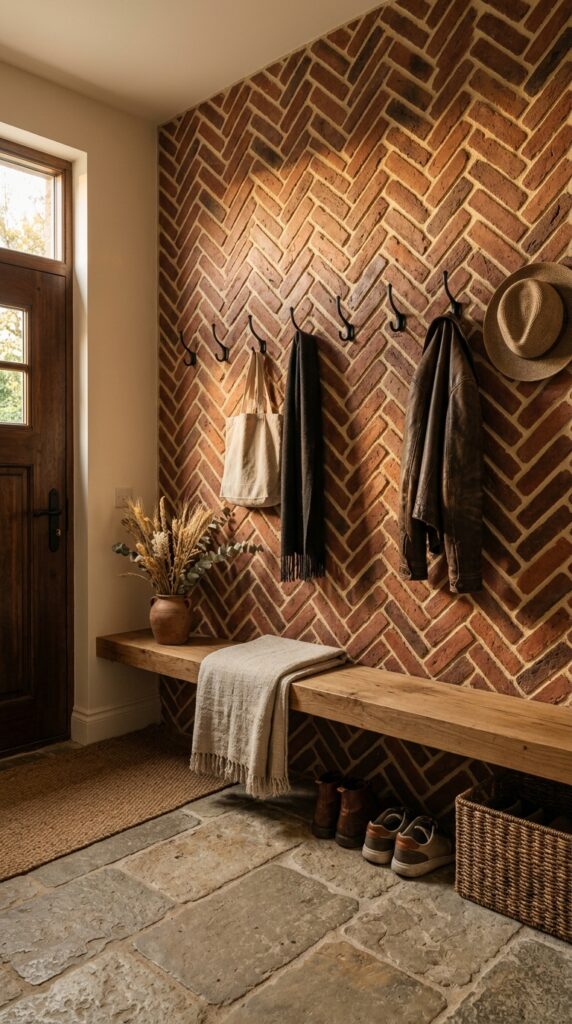
Vibe: Earthy and sun-baked — like the entryway of a Spanish hacienda reimagined for a modern home.
Why it works: Herringbone orientation adds directional energy to brick that a running bond pattern lacks — the diagonal angles naturally draw the eye along the length of the wall rather than across it, making the entry feel deeper. Terracotta brick reads immediately as handmade and warm, connecting the space to natural, earthen materials in a way that no painted surface can replicate. The material’s thermal mass also naturally absorbs temperature fluctuation, which makes the entry feel more stable than drywall.
How to get it: Thin brick veneer (also called brick slip) is the practical version — 1/2-inch-thick sections of real brick adhered directly to drywall with mortar adhesive. No structural modification required. Lay the herringbone pattern at a 45-degree angle using a chalk line as your guide.
💡 Quick Win: Peel-and-stick thin brick veneer panels in terracotta tones are available for $3–$5 per square foot and create a herringbone wall in a single day with no mess.
🛍️ Shop the Look — Amazon Product Ideas
| # | Product Search Phrase | Why It Fits |
| 1 | Terracotta peel stick brick wall panel | Herringbone material shortcut |
| 2 | Natural linen throw blanket warm sand | Soft contrast over bench |
| 3 | Matte black minimal coat hook 4 pack | Hardware against warm brick |
| 4 | Dried botanicals pampas clay pot arrangement | Earth tones organic accent |
| 5 | Cream grout sanded tile masonry | Mortar color between bricks |
15. Pegboard Organizer with Custom Hooks and Bins
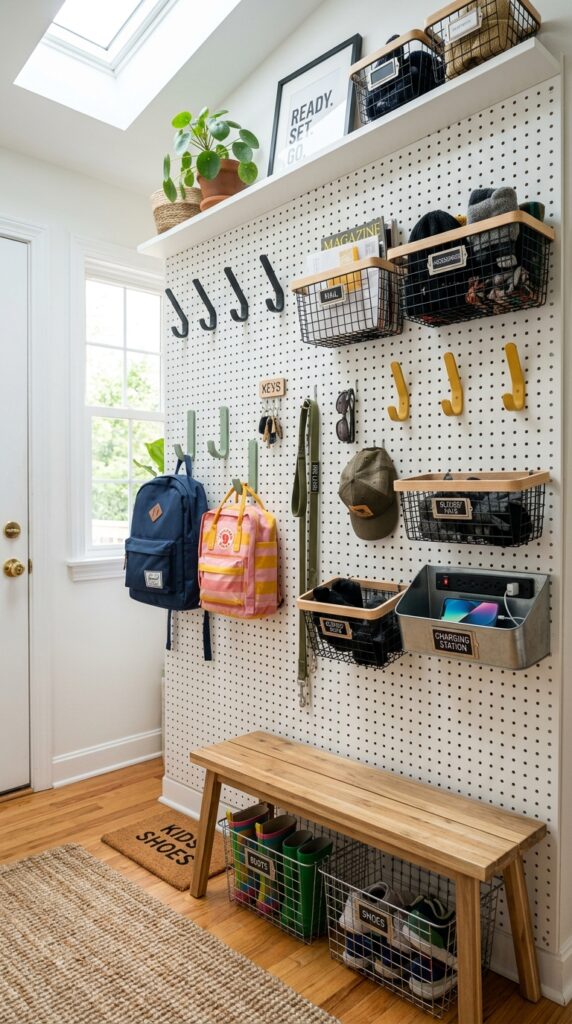
Vibe: Active and sorted — a wall that operates like a well-run team.
Why it works: The pegboard’s genius is its infinite reconfigurability — it applies the design principle of adaptive systems, meaning the layout can evolve as the household’s needs change without requiring new holes in the wall. Color-coding hooks by family member or category (sports gear = yellow, school = blue) creates a visual filing system that anyone, including young children, can understand and maintain independently.
How to get it: Frame the pegboard panel with a 1×4 pine border painted the same color — it transforms the panel from a tool-storage hack into something that looks designed. Mount the frame using French cleats so the entire panel can be removed or repositioned in minutes.
🛍️ Shop the Look — Amazon Product Ideas
| # | Product Search Phrase | Why It Fits |
| 1 | White pegboard wall panel organizer kit | Base system foundation |
| 2 | Pegboard hook assortment metal multi-size | Flexible hanging points |
| 3 | Wire mesh pegboard basket insert small | Bin storage at any height |
| 4 | Metal label holder clip tag organizer | Readable category system |
| 5 | French cleat wall mounting system wood | Secure removable mount |
16. Built-In Window Seat with Under-Storage Drawers
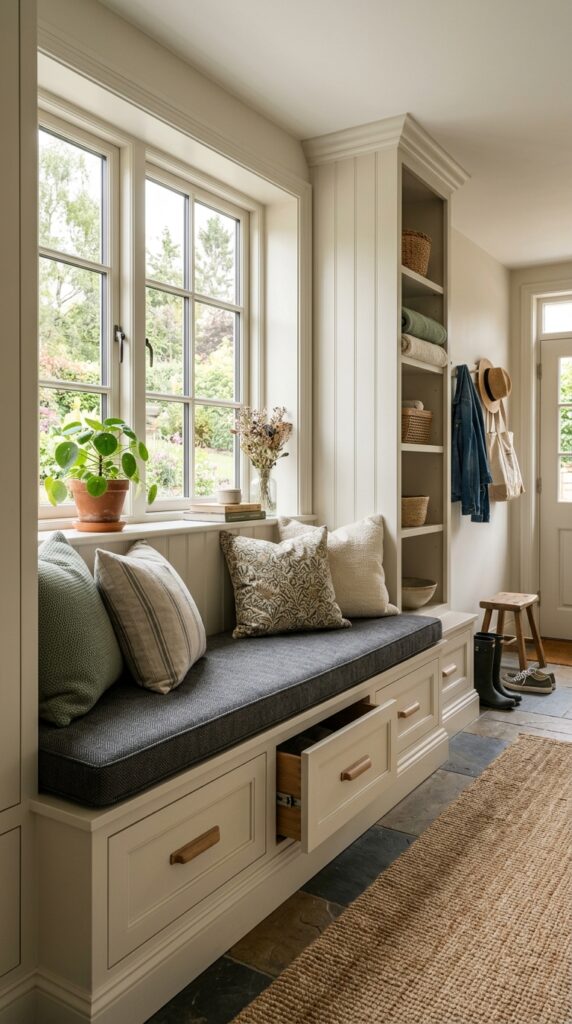
Vibe: Generous and grounded — a seat that says “stay for a moment” even in a pass-through space.
Why it works: A built-in window seat is the single highest-value piece of furniture in a mudroom because it performs three functions simultaneously: bench seating, hidden storage in the drawers, and visual connection to the outdoors through the window above. The upholstered seat softens the often-hard material palette of an entry, and performance fabric (such as Sunbrella or a high-rub-count woven) handles the mud and moisture that would destroy standard upholstery in weeks.
How to get it: Specify a seat height of 18 inches exactly — standard bench height — and use full-extension drawer slides with soft-close mechanisms in the base. The seat depth should be 20–22 inches minimum for comfortable sitting.
🛍️ Shop the Look — Amazon Product Ideas
| # | Product Search Phrase | Why It Fits |
| 1 | Storage bench drawers entryway window seat | Ready-made version of look |
| 2 | Performance herringbone fabric upholstery yard | Durable seat covering |
| 3 | Full extension soft close drawer slides pair | Quality drawer mechanism |
| 4 | Throw pillow cover charcoal woven textured | Layered seat styling |
| 5 | Tongue and groove wall panel kit white | Side panel detail material |
17. Rope Basket Collection as Mudroom Storage Wall
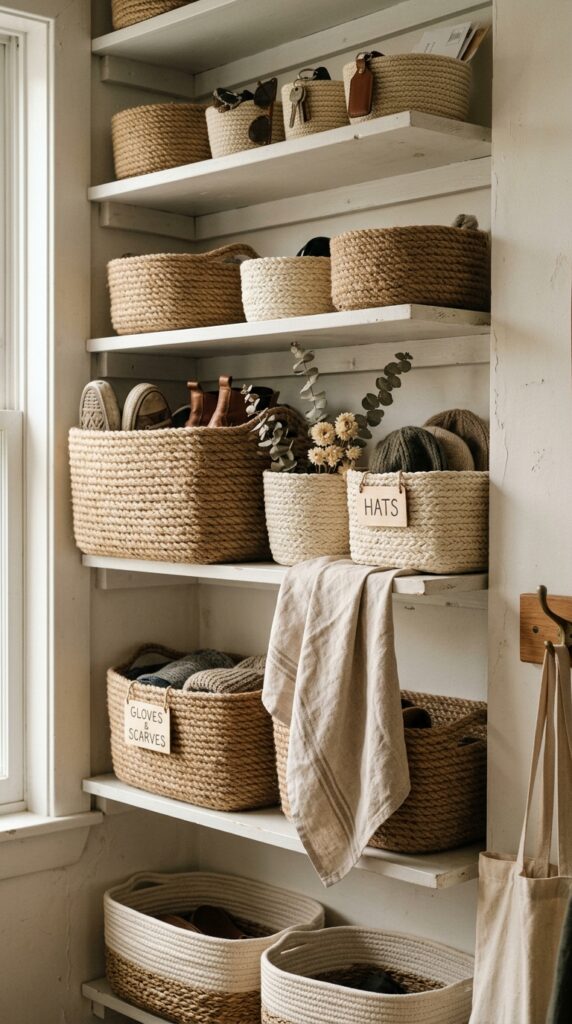
Vibe: Layered and sun-warmed, like a market stall curated by someone with excellent taste.
Why it works: A basket collection wall works because repetition of a single material in varied scales and forms creates visual rhythm without visual noise — the design principle of variation within unity. Each basket reads as part of a family rather than a mismatched collection. The open tops allow air circulation (important for shoes and damp hats), and the natural material absorbs rather than reflects light, preventing the wall from feeling busy.
How to get it: Use three basket sizes — large (for shoes and bags), medium (for scarves and hats), and small (for keys and sunglasses) — and stick to one material family: all rope, all seagrass, or a close blend of the two. Mixing linen and rattan baskets immediately reads as less intentional.
💡 Quick Win: A set of three matching seagrass baskets with handles costs $20–$35 on Amazon and immediately upgrades an open cubby shelf from chaotic to curated.
🛍️ Shop the Look — Amazon Product Ideas
| # | Product Search Phrase | Why It Fits |
| 1 | Seagrass storage basket with handles large | Primary shoe and bag storage |
| 2 | Rope woven round basket medium natural | Hat and scarf organizer |
| 3 | Small seagrass catch-all basket tray | Accessories catchall |
| 4 | White painted wood cubby shelf unit | Storage basket structure |
| 5 | Chalkboard label tag clip basket organizer | Identification by category |
18. Vintage Farmhouse Bench with Chippy Paint
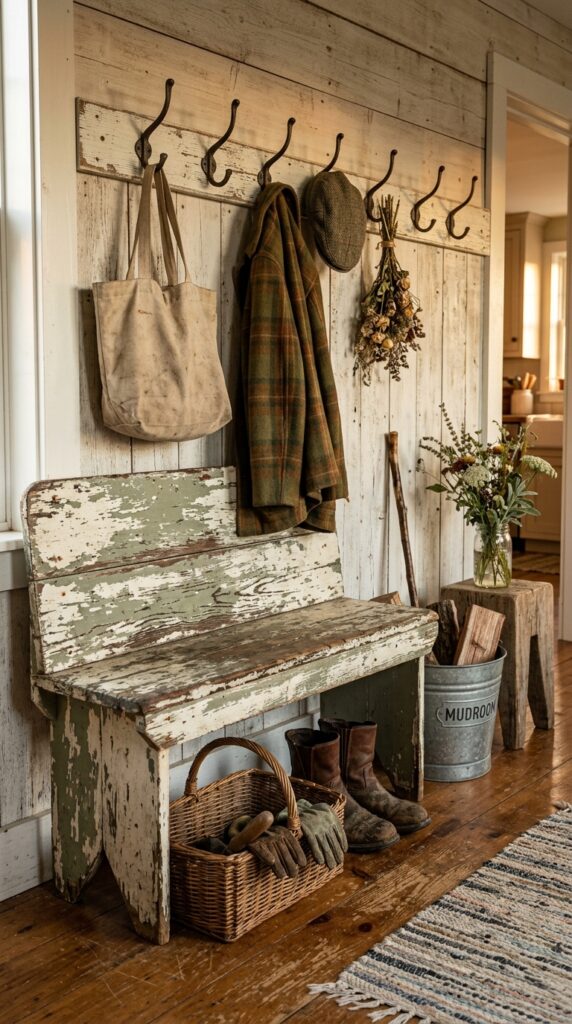
Vibe: Nostalgic and grounded — the bench that looks like it’s been in the family for a hundred years.
Why it works: A chippy-paint bench succeeds through authentic imperfection — the worn edges reveal layers of previous paint, which communicate history and character that no new piece can fake. The design principle is patina: aged surfaces catch light differently than smooth ones, creating micro-shadows and highlights that make objects feel dimensional and real. It contrasts beautifully against crisp white walls, preventing the space from feeling too polished.
How to get it: The “chippy paint” effect can be authentically replicated with a wax resist technique: apply a candle wax layer over a base coat of sage green, then paint white on top. Once dry, lightly sand the raised edges — the wax prevents the topcoat from adhering, creating a believable chip wherever the wax sat.
🛍️ Shop the Look — Amazon Product Ideas
| # | Product Search Phrase | Why It Fits |
| 1 | Distressed painted wood entryway bench white | Aged farmhouse anchor piece |
| 2 | Wrought iron vintage double hook wall | Rustic hardware above bench |
| 3 | Galvanized metal bucket small farmhouse decor | Vintage container accent |
| 4 | Chalk paint wax finish clear furniture | DIY patina protection |
| 5 | Mason jar small clear glass set | Simple rustic vase option |
19. Narrow Console Table as Entryway Catch-All
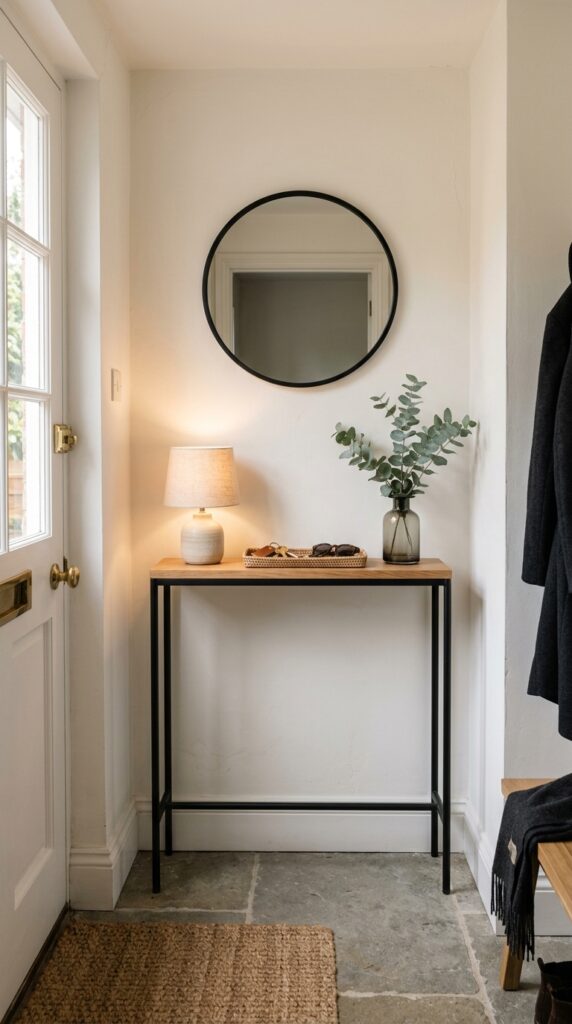
Vibe: Composed and deliberate — a narrow table that does three jobs without taking up any real space.
Why it works: A console table at 10–12 inches deep is the definitive small-space solution: it provides a surface without projecting into the room, and its open underside creates the visual illusion of more floor than a bench with a closed base would. The design principle at work is negative space and visual weight — a thin-legged iron console reads as near-transparent compared to a chunky storage bench, keeping a narrow entry from feeling blocked.
How to get it: Prioritize depth over width when sizing a console for a small mudroom — 10 inches deep is the magic number for slipping past without catching your hip. Style the top with a single tray to contain daily-drop items; a tray frames the objects and prevents them from reading as clutter.
🛍️ Shop the Look — Amazon Product Ideas
| # | Product Search Phrase | Why It Fits |
| 1 | Narrow console table black iron 10 inch deep | Core space-saving furniture |
| 2 | Decorative catchall tray entry table leather | Contains daily drop items |
| 3 | Small ceramic table lamp linen shade warm | Entry surface lighting |
| 4 | Eucalyptus stem narrow glass bud vase | Organic accent on table |
| 5 | Wall mirror small above console table round | Reflection partner piece |
20. Wallpaper Accent Panel for Visual Impact
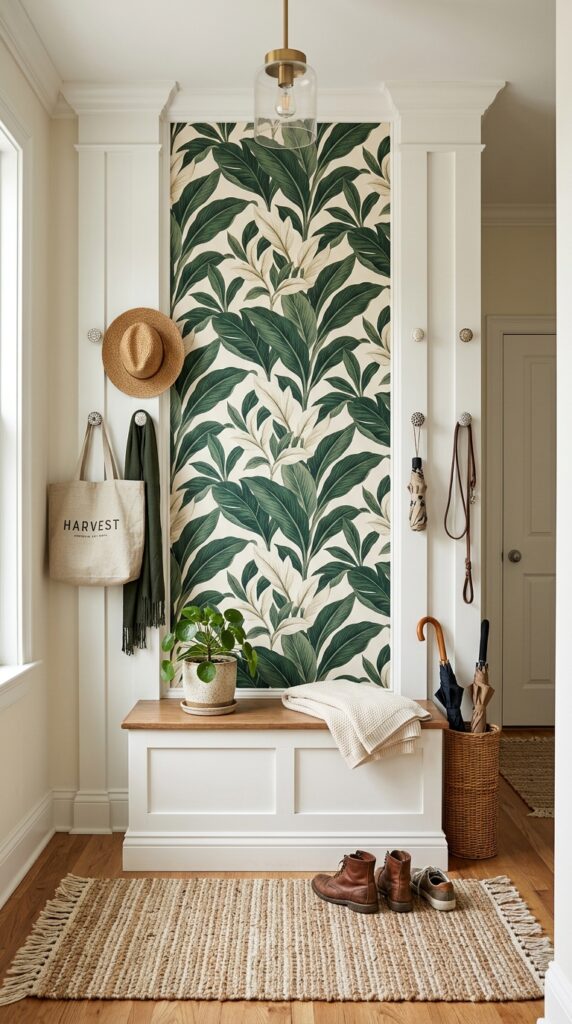
Vibe: Lively and confident — a wall that announces itself without overstaying its welcome.
Why it works: A wallpaper panel framed by architectural trim is a controlled application of pattern — it gets the visual drama of a bold print without wallpapering yourself into a room that feels overwhelming or dated. The trim frame turns the wallpaper into a picture rather than a surface, giving it the contained energy of art. Botanical patterns, specifically large-scale leaf prints, are the dominant choice for this application because they bring the outdoors in — appropriate for an entry that connects exterior to interior.
How to get it: Install simple 1×4 trim boards as a rectangular frame first, then paper only the inset. This approach also makes future changes easy — remove the paper from the panel without touching the rest of the walls.
💡 Quick Win: Peel-and-stick botanical wallpaper requires no paste and no professional — a single 2×6-foot panel from a removable wallpaper brand like Chasing Paper creates this exact effect for under $60.
🛍️ Shop the Look — Amazon Product Ideas
| # | Product Search Phrase | Why It Fits |
| 1 | Peel and stick botanical leaf wallpaper panel | Removable statement surface |
| 2 | White MDF trim board decorative molding 1×4 | Frame that contains pattern |
| 3 | Ceramic round knob hook entry wall | Detail hardware on pilasters |
| 4 | Shaker style storage bench white entry | Anchor furniture under panel |
| 5 | Woven cotton runner rug 2×6 neutral | Floor grounding element |
21. Compact Drop Zone with Charging Station
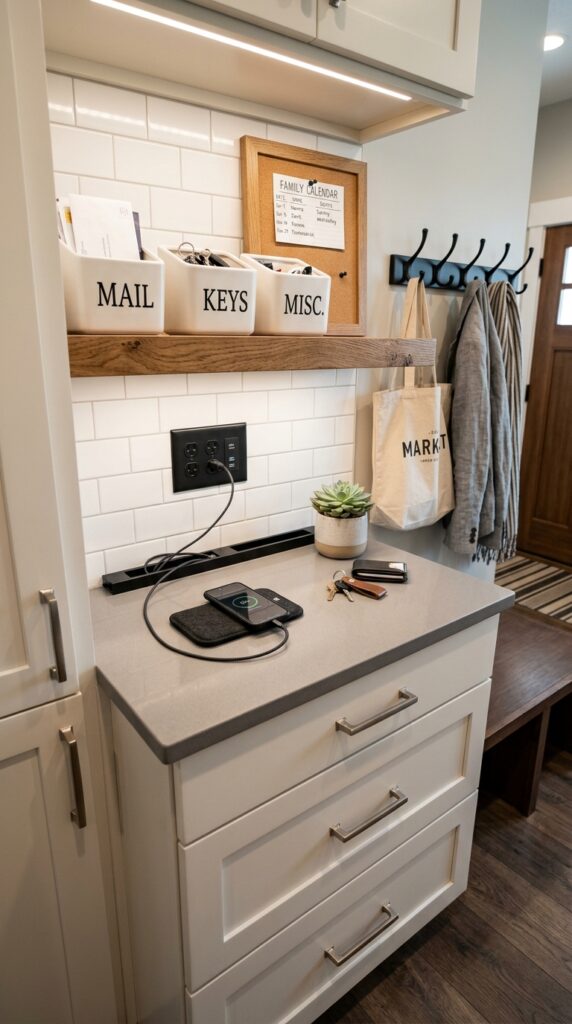
Vibe: Efficient and purposeful — a tiny system that stops the daily chaos cold.
Why it works: The drop zone concept works through designated landing spots for every daily-carry item — keys, phone, wallet, bag — which eliminates the entropy of items scattered across every horizontal surface in the house. Placing a charging station within the drop zone creates a natural behavior loop: plug in when you arrive, pick up when you leave. The design principle is habit architecture — designing physical space to encourage automatic behaviors rather than relying on memory.
How to get it: A wireless charging pad built flush into a shallow drawer unit top requires only a router cutout and a hidden cable through the back — a DIY-friendly modification for any existing console or cabinet.
🛍️ Shop the Look — Amazon Product Ideas
| # | Product Search Phrase | Why It Fits |
| 1 | Wall mount USB charging station outlet entry | Power access at drop zone |
| 2 | Small labeled ceramic bin set organizer | Per-item landing spot |
| 3 | Magnetic key holder wall mount matte black | Key organization point |
| 4 | Wireless charging pad slim countertop mount | Phone charging surface |
| 5 | Mini corkboard insert frame wall organizer | Notes and cards display |
22. Open Coat Closet Converted to Display Storage
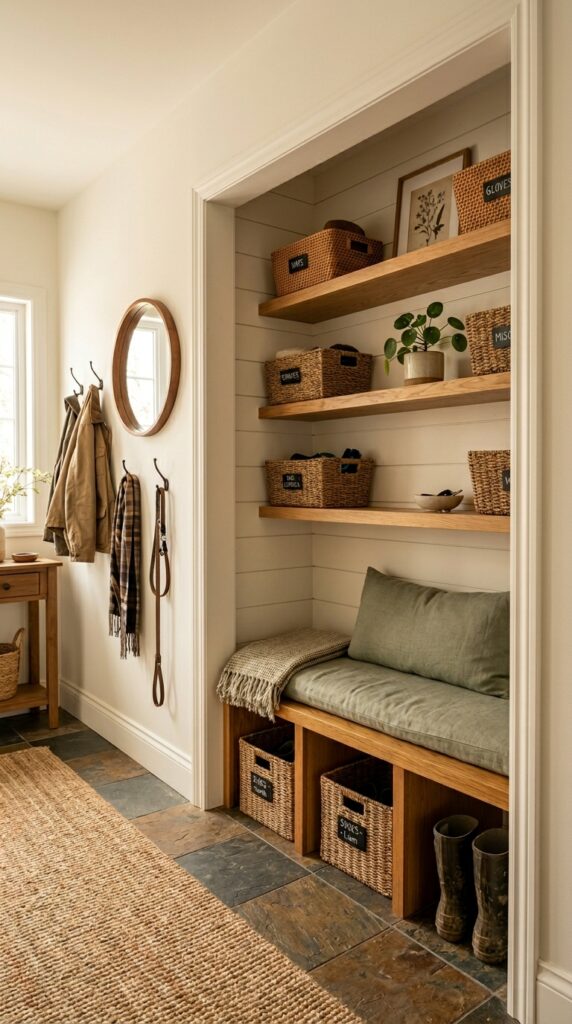
Vibe: Open and welcoming — a closet that finally got to show off instead of hiding.
Why it works: Removing a closet door is one of the highest-ROI modifications in an entry space. The closed door was eating square footage visually and physically — it required swing clearance, blocked light, and made the storage feel inaccessible. Open storage forces more intentional organization (nothing can be hidden), which creates the social incentive to keep the space tidy. Adding shiplap inside the closet box makes the space feel finished rather than exposed.
How to get it: Remove the door and hinges, fill the hinge holes with wood filler, and install 3/4-inch birch plywood shelves using a French cleat system inside the closet. Paint the interior an accent color slightly deeper than the surrounding wall for contrast.
🛍️ Shop the Look — Amazon Product Ideas
| # | Product Search Phrase | Why It Fits |
| 1 | Adjustable closet shelf system customizable | Interior structure for open closet |
| 2 | White shiplap panel interior accent wall | Back wall of open closet |
| 3 | Woven seagrass bin cube organizer labeled | Open face storage baskets |
| 4 | French cleat shelf mounting system | Adjustable shelf support |
| 5 | Mini framed art print botanical small | Interior accent decoration |
23. Farmhouse Laundry-Mudroom Combo
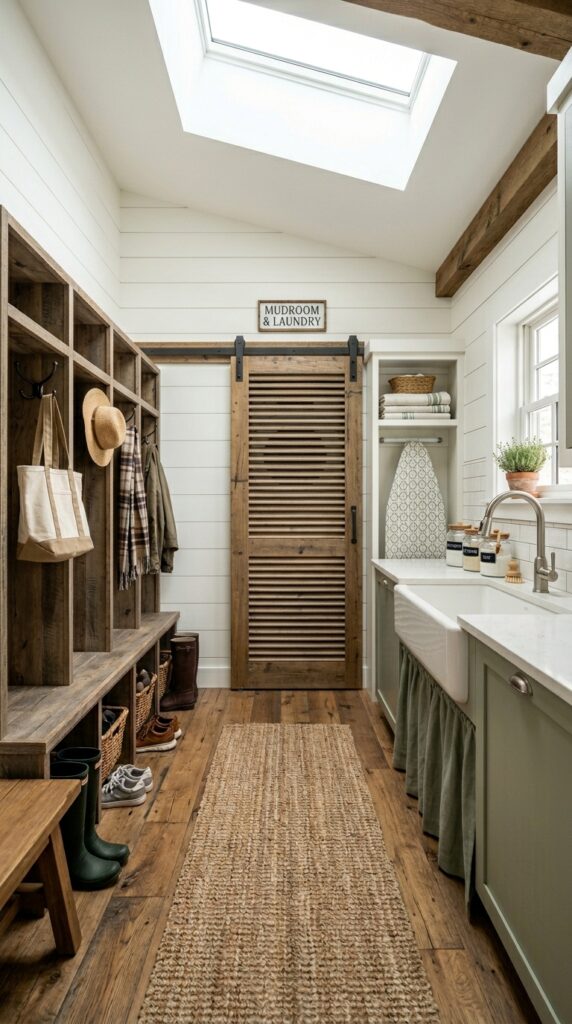
Vibe: Sun-warmed and surprisingly serene for a room that works this hard.
Why it works: Combining the mudroom and laundry functions into one room is the most spatially efficient layout decision a homeowner can make — the utility sink serves both dirty-hands washing and laundry pre-treating, the built-in lockers house laundry per person, and the same tiled floor handles both mud and water spillage. The barn-wood sliding door in front of the washer/dryer stack solves the visual problem: when the doors are closed, the room reads as a beautiful farmhouse entry.
How to get it: Specify a barn-style sliding door at least 4 inches wider than the washer/dryer stack opening on each side — you need overlap for it to fully hide the appliances. Tongue-and-groove barn-wood doors are available as pre-made kits that simply mount to a standard hardware rail.
🛍️ Shop the Look — Amazon Product Ideas
| # | Product Search Phrase | Why It Fits |
| 1 | Sliding barn door kit interior farmhouse wood | Hides washer dryer stack |
| 2 | Glass jar dispenser set laundry detergent | Decanted laundry supplies |
| 3 | Apron front farmhouse utility sink white | Dual-purpose wash station |
| 4 | Subway tile peel stick backsplash white | Behind-sink surface |
| 5 | Herb grow kit indoor windowsill pot | Living accent on sink window |
24. Bold Black Front Door Entry with Dramatic Contrast
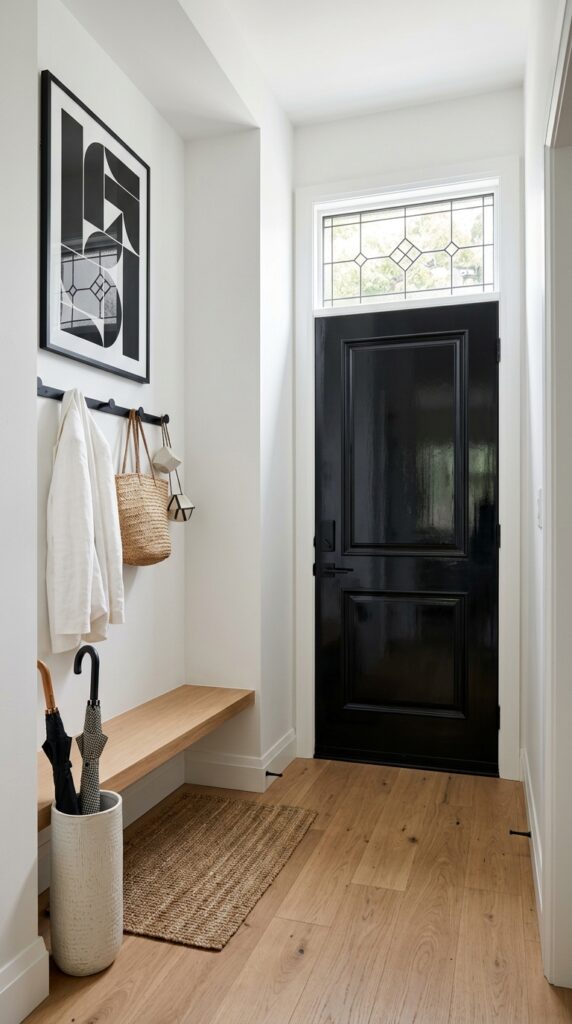
Vibe: Crisp and self-assured — a first impression that costs nothing to maintain.
Why it works: A high-gloss black door is the single most powerful statement in an entryway because it plays on contrast with maximum efficiency — the glossy black reflects light back into the space while the matte white walls absorb it, creating the maximum light-dark contrast ratio possible with just two colors. The design principle is focal point reinforcement: everything in the entry should point toward the door as the arrival moment, not compete with it.
How to get it: Paint the interior face of the door in the same high-gloss black as the exterior for a cohesive effect — use Rust-Oleum “Ultra Cover Gloss Black” or Benjamin Moore “Black Beauty” in a full gloss finish. A single can of spray paint in gloss black covers an average interior door with a glass-smooth finish.
💡 Quick Win: Swapping a builder-grade brushed nickel door knob for a matte black lever handle costs $25–$45 and immediately elevates the black door palette.
🛍️ Shop the Look — Amazon Product Ideas
| # | Product Search Phrase | Why It Fits |
| 1 | Matte black lever door handle interior | Hardware completing black palette |
| 2 | Oversized black and white graphic art print | Statement art beside door |
| 3 | Ceramic tall umbrella stand white | Practical sculptural entry piece |
| 4 | Matte black single arm coat hook modern | Minimal hook rail hardware |
| 5 | High gloss black spray paint interior wood | Door finish application |
25. Vertical Shiplap with a Pop of Painted Color
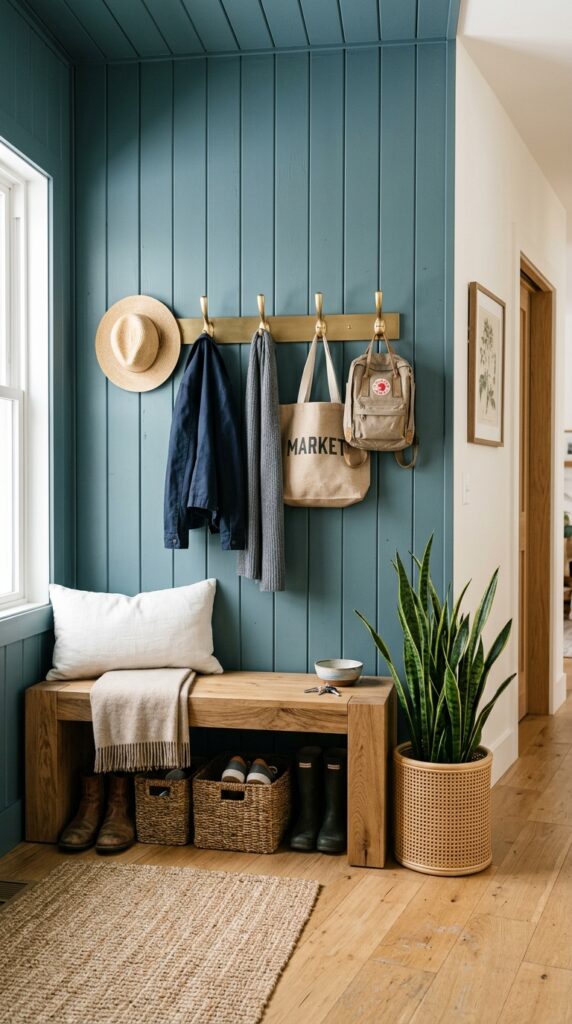
Vibe: Fresh and grounded — a color that feels brave but settles in like it was always there.
Why it works: Vertical shiplap does something horizontal shiplap doesn’t — it draws the eye upward, making ceilings feel higher. This is a proportion trick that works especially well in entry spaces with standard 8-foot ceilings. Applying a saturated color to vertical shiplap amplifies the height illusion because the color creates depth along the board grooves, and the vertical shadow lines reinforce the upward direction. Brass hardware against a dusty teal is a color theory pairing — analogous warmth against a cool base.
How to get it: Sherwin-Williams “Aegean Teal” and Benjamin Moore “Beau Green” are the two best-performing dusty teal tones for this look — both read as saturated but not neon, and they respond beautifully to warm light. Apply in an eggshell finish so the texture of the boards remains visible.
🛍️ Shop the Look — Amazon Product Ideas
| # | Product Search Phrase | Why It Fits |
| 1 | Vertical shiplap wood wall panel tongue groove | Vertical orientation texture |
| 2 | Teal dusty blue green wall paint sample chip | Color-match paint reference |
| 3 | Brushed brass hook rail 4 hook entry | Warm hardware on cool wall |
| 4 | Snake plant indoor potted rattan basket | Low maintenance green accent |
| 5 | Natural oak floating bench entry modern | Warm wood against teal |
26. Maximalist Gallery Wall Entry with Personal Touches
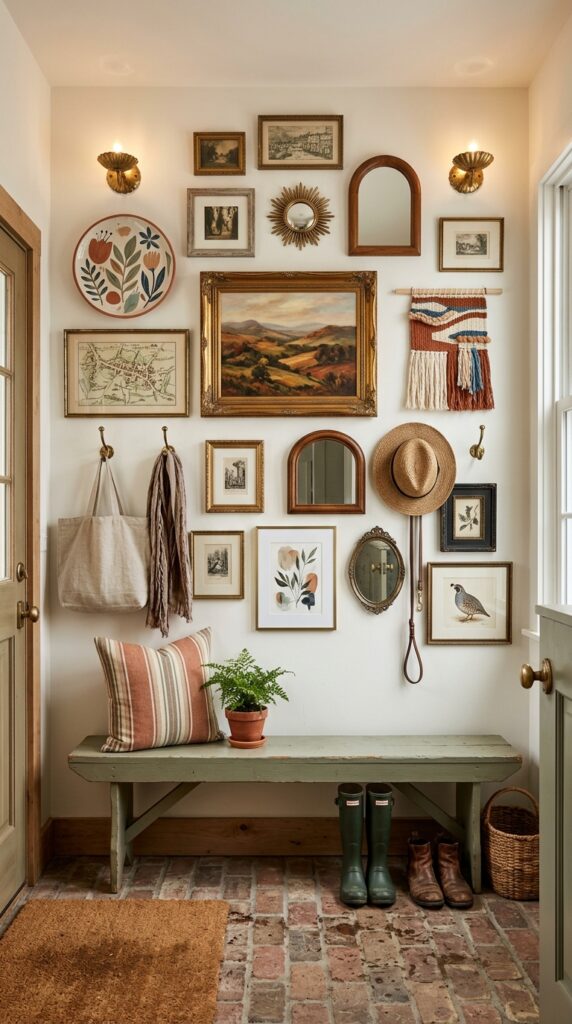
Vibe: Personal and layered — an entryway that tells you everything important about who lives there before you even step inside.
Why it works: A gallery wall succeeds in a mudroom when the arrangement follows one strict rule: a unified color palette across all the frames and art, even when the styles vary wildly. This is the design principle of color as connector — terracotta, sage green, and warm cream threading through every print holds a diverse collection together visually. Mixing flat art with dimensional objects (a ceramic plate, a woven textile, a small convex mirror) creates depth that flat frames alone can’t achieve.
How to get it: Lay the full arrangement on the floor first and photograph it before committing to wall holes. Start by nailing the largest piece at eye-center, then work outward, keeping a consistent 2-inch gap between all items regardless of their size. The consistent gap is the invisible glue that makes a maximalist arrangement look curated rather than cluttered.
🛍️ Shop the Look — Amazon Product Ideas
| # | Product Search Phrase | Why It Fits |
| 1 | Gallery wall frame set mixed sizes brass wood | Cohesive frame collection |
| 2 | Ceramic decorative plate abstract botanical | Dimensional gallery wall element |
| 3 | Woven wall hanging textile art boho | Texture in gallery mix |
| 4 | Small convex mirror brass decorative wall | Light-reflecting gallery accent |
| 5 | Picture hanging strip heavy duty damage free | No-hole gallery mounting |
How to Start Your Mudroom Entryway Transformation
Your single first move: Paint the walls. Not buy furniture, not install hooks — paint. Choose one direction for the entire space (warm white like Benjamin Moore “White Dove” for a light and airy feel, or a deeper tone like Sherwin-Williams “Naval” for drama) and apply it before anything else enters the room. Wall color is the invisible backdrop that either unifies everything you add later or fights it — get this right first and every subsequent choice becomes easier.
The most common mistake: Buying furniture before measuring clearance. The most frequent mudroom disaster is a bench that blocks the door swing, or hooks positioned so close to the entry that a hanging coat brushes every person who walks past. Measure the full door swing radius and mark it on the floor with tape before purchasing a single piece of furniture. Everything must live outside that arc.
Three items under $50 for immediate impact: A set of 5 matte black wall hooks mounted in a horizontal rail ($22–$35), a seagrass runner in a natural tan ($28–$45 for a 2×6 foot size), and a small ceramic tray in a warm neutral tone for key drop ($12–$20). These three items alone — hooks, rug, tray — create a functional and intentional entry for under $100 total.
Realistic expectations: A weekend is enough time to paint, install hooks, and add textiles. A full mudroom transformation with built-in storage, new flooring, and lighting takes 4–8 weeks and realistically costs $800–$2,500 for a starter built-in system (using IKEA as a base) up to $8,000–$15,000 for a fully custom built-in with tile, cabinetry, and lighting.
Frequently Asked Questions About Mudroom Entryways
What’s the difference between a mudroom and an entryway?
An entryway is any transition space between outdoors and indoors — it’s a location. A mudroom is a functional designation: an entry specifically outfitted to handle the debris, moisture, and gear that comes in from outside. A mudroom always has an entryway; an entryway doesn’t always function as a mudroom. The key difference is dedicated storage — coat hooks, shoe storage, a bench, and often a utility sink or tile floor that can handle water and mud without damage.
What color should I paint a mudroom entryway?
The most versatile choices are warm whites with yellow or pink undertones (Benjamin Moore “White Dove,” Sherwin-Williams “Alabaster”) which make the space feel larger and brighter, or deep moody tones like navy or charcoal (Sherwin-Williams “Naval,” Benjamin Moore “Black Beauty”) which create drama and hide dirt on the walls. Avoid cool grays with blue undertones — they read as cold and institutional in a space that should feel welcoming. The best test: look at a paint sample in the actual entry at different times of day before committing.
How much does it cost to build a mudroom?
A basic mudroom refresh using hooks, a bench, and a rug can cost as little as $150–$400. A semi-custom setup using IKEA PAX units customized with trim and paint typically runs $800–$2,500 installed. A fully custom built-in mudroom with tile flooring, cabinetry, and electrical for lighting starts at $5,000 and commonly reaches $12,000–$20,000 for a full-wall system. Labor typically accounts for 40–60% of custom costs, so DIY capability significantly affects the final number.
Can I create a mudroom in an apartment or rental?
Yes — with freestanding furniture and removable solutions. A freestanding entryway locker (available from IKEA or Target for $100–$350), a peel-and-stick removable shiplap wall panel, over-door hook bars, and a seagrass rug require no permanent modifications and can be fully removed when you leave. The restriction is flooring — you can’t tile, but you can layer rubber-backed runners and a large rubber boot tray to create the same functional zones as a tiled mudroom floor.
What type of flooring is best for a mudroom entryway?
Natural slate tile is the gold standard — its cleft surface hides dirt, provides grip, and withstands water and temperature fluctuation. Porcelain tile in a stone look-alike pattern offers similar performance at lower cost and is nearly indistinguishable at a glance. Luxury vinyl plank (LVP) in a 20-mil wear layer rating is the best option for a DIY installation — it’s waterproof, scratch-resistant, and warm underfoot compared to stone. Avoid hardwood in the immediate drop zone — even engineered hardwood will show moisture damage from wet boots over time.
Ready to Create Your Dream Mudroom Entryway?
From the texture layering of shiplap and rattan to the functional precision of a pegboard system and charging station, these 26 mudroom entryway ideas cover the full range of material choices, color strategies, layout approaches, and small-space solutions. Transformation doesn’t require doing everything at once — in fact, starting with one well-chosen piece (a great set of hooks, the right paint color, a runner that grounds the space) is not just acceptable, it’s the smarter approach. Today, pick up a set of matte black wall hooks and a seagrass runner — two items that cost under $80 combined and will make your entryway look composed and intentional by tonight. When the right system is finally in place, the mudroom stops being the stressful room and becomes the room that sets the tone for your whole home: calm, ordered, and exactly yours. Save your favorite ideas from this list now — the shiplap accent wall and the sage green cabinetry ideas tend to disappear from boards fast.