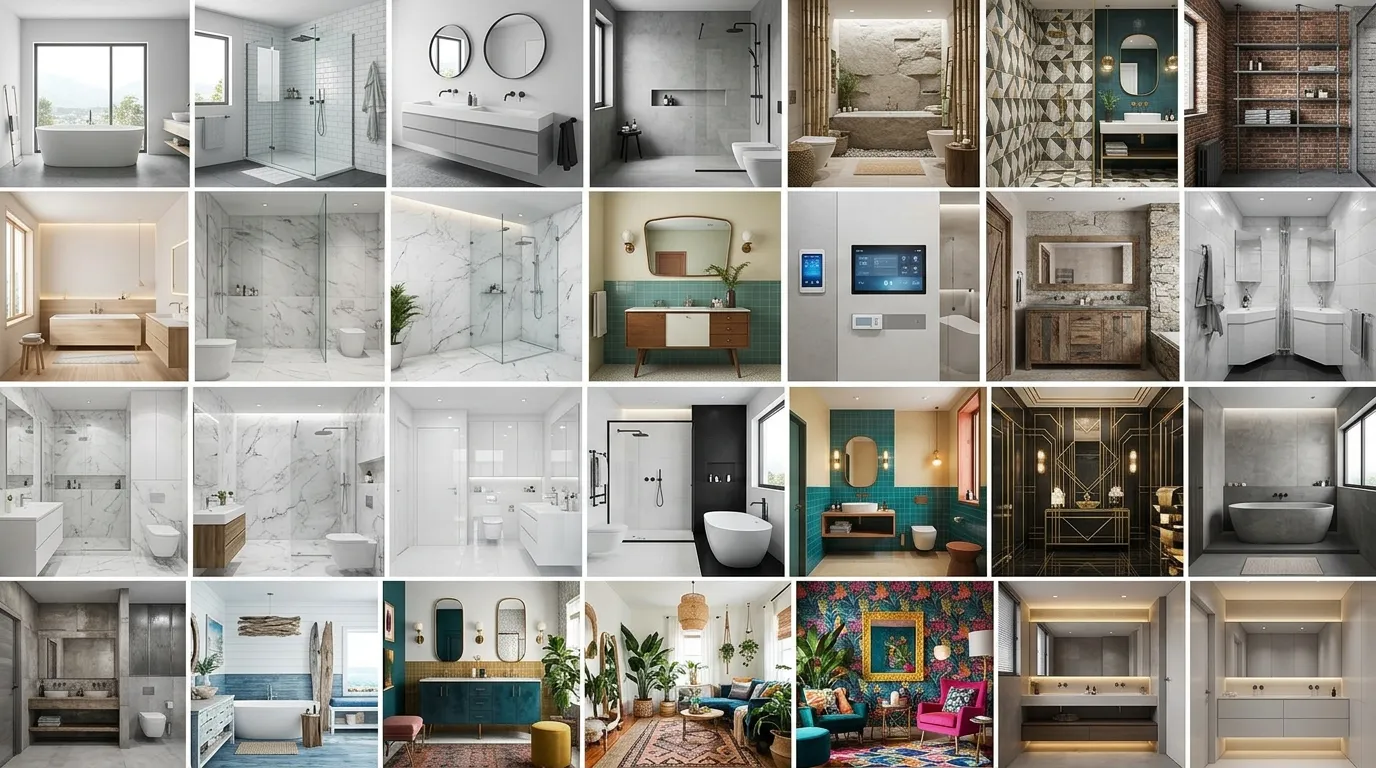
Modern bathroom design is a style defined by clean lines, purposeful restraint, and a commitment to function as a form of beauty — rooms where every fixture, surface, and shadow has a reason to exist. This article delivers exactly 28 modern bathroom ideas spanning color, material, lighting, layout, and more, so you can find the precise look that fits your space and your life.
There’s a stillness to a well-executed modern bathroom that feels almost architectural. Morning light moving across matte stone, a single matte-black faucet rising from a slab counter, no clutter, no noise — just a room that communicates confidence. This style doesn’t shout. It breathes. Here are 28 ideas worth saving — and stealing.
Why Modern Bathroom Design Works So Well
Modern bathroom design emerged in the early 20th century from the Bauhaus movement and International Style architecture — philosophies that rejected ornamentation in favor of honesty of materials and clarity of form. Unlike minimalism, which leans toward the austere, modern design allows warmth and texture as long as they serve the overall composition. It distinguishes itself from contemporary design (which simply means “of the moment”) by adhering to a specific design language rooted in geometry, symmetry, and structural expression.
The material palette is precise and tactile. Warm whites and soft greiges anchor walls, while deep tones like warm charcoal, matte black, and smoked slate appear in fixtures and accents. Surfaces favor honed Calacatta marble, large-format porcelain, unpolished concrete, and matte terrazzo. Hardware finishes run toward brushed brass, matte black, and warm gunmetal. Natural materials — unfinished white oak, linen, and travertine — soften the geometry without undermining it.
The style surged in popularity post-2020 as homeowners spent more time at home and began investing in private spaces that feel restorative. Pinterest search data shows “modern bathroom” queries up significantly in recent years, driven partly by the wellness movement — a desire to make the bathroom function more like a spa. Sustainability has also played a role, with the modern aesthetic’s preference for durable, natural materials aligning with eco-conscious buying habits.
Small bathrooms can absolutely achieve this style. The secret is restraint: choose one hero material (a fluted tile, a bold vanity), let walls and floors stay quiet, and resist the urge to style every surface. Scale fixtures to the room — an oversized round mirror can make a powder room feel twice its actual size.
Style at a Glance
| Element | Trait 1 | Trait 2 |
| Philosophy | Form follows function | Restraint over ornamentation |
| Materials | Honed stone, unfinished oak, matte porcelain | Brushed brass, matte black hardware |
| Color palette | Warm white, greige, soft charcoal | Dusty taupe, slate, warm black |
28 Modern Bathroom Design Ideas
1. Warm White Walls with a Charcoal Grout Grid

Vibe: Grounded. This is the bathroom that feels assembled with intention — no detail overlooked, no surface random.
Why it works: The interplay of tonal contrast is doing all the heavy lifting here. Warm white porcelain tiles read as a nearly seamless surface, but the charcoal grout introduces a grid that adds visual structure without introducing a second material. It’s a classic design move — using negative space (grout) to create pattern. The grid geometry reinforces the modern style’s love of order.
How to get it: Choose a large-format tile (at minimum 24″×24″) in a matte or satin finish rather than polished — polished tiles show water spots and read as dated. Specify a sanded grout in a warm charcoal tone, such as Mapei Flexcolor CQ in “Storm.” The grout joint width matters: 1/8″ gives a refined grid, 1/4″ reads bolder.
💡 Quick Win: Regrout existing white tile in a darker tone before spending a penny on new tile. It costs under $100 in materials and transforms the look of an average bathroom overnight.
🛍️ Shop the Look — Amazon Product Ideas
| # | Product Search Phrase | Why It Fits |
| 1 | Matte white large format porcelain tile 24×24 | Core tile surface |
| 2 | Charcoal sanded tile grout unsanded grout joint | Dark grid contrast |
| 3 | Brushed nickel rain shower head square modern | Hardware accent |
| 4 | White oak floating bathroom shelf | Warm wood shelf |
| 5 | White ceramic minimalist soap dish tray | Clean countertop accent |
2. Floating Vanity in Unfinished White Oak

Vibe: Sun-warmed. This vanity carries the quiet richness of natural wood without asking the room to become rustic.
Why it works: Floating furniture is a defining element of modern design — it creates visual lightness by revealing the floor plane below and making even a small bathroom feel less boxed-in. The white oak introduces warmth and organic texture that prevents the space from reading as cold or clinical. The wood grain’s natural variation does the decorating so nothing else has to.
How to get it: Source a slab-door floating vanity with a minimal reveal (the gap between the drawer and door face should be no more than 1/8″). Seal white oak with a water-based matte finish like Rubio Monocoat — it penetrates rather than coats, preserving the raw look while protecting against moisture. Wall-mount brackets must be anchored into studs.
🛍️ Shop the Look — Amazon Product Ideas
| # | Product Search Phrase | Why It Fits |
| 1 | Floating wall-mounted bathroom vanity wood grain | Core vanity piece |
| 2 | Brushed brass bathroom faucet single hole | Hardware accent |
| 3 | Matte white undermount rectangular bathroom sink | Integrated sink |
| 4 | Water-based matte wood sealer interior | Wood protection |
| 5 | Trailing pothos plant small pot bathroom | Organic accent |
3. Backlit LED Mirror Over a Slab Counter

Vibe: Luminous. The halo of light behind this mirror transforms a purely functional object into the room’s visual anchor.
Why it works: Backlit mirrors solve two problems simultaneously — they provide even, flattering task lighting (eliminating harsh shadows from overhead fixtures) and they create the perception of a glowing surface that expands the room’s visual depth. The wall seems to recede behind the light. This is a technique borrowed directly from hospitality design, where lighting atmosphere is treated as a primary design element.
How to get it: Choose a mirror with a color temperature of 3000K–3500K (labeled “warm white”) rather than 4000K or above, which renders skin tones blue. Mirrors with integrated dimmer switches — typically controlled via a touch sensor on the mirror face — allow you to shift from task lighting at full brightness to ambient mood lighting at 20%.
💡 Quick Win: A backlit mirror from Amazon (search “LED bathroom mirror with anti-fog 36 inch”) installs in under two hours with basic electrical knowledge and costs $150–$250 — far less than a lighting renovation.
🛍️ Shop the Look — Amazon Product Ideas
| # | Product Search Phrase | Why It Fits |
| 1 | LED backlit bathroom mirror anti-fog dimmable | Hero lighting element |
| 2 | Wall-mounted bathroom faucet matte black | Clean wall hardware |
| 3 | Ribbed ceramic bud vase matte neutral | Textured accent |
| 4 | Linen hand towels set of 2 neutral | Soft texture layer |
| 5 | Quartz bathroom countertop remnant slab | Seamless stone surface |
4. Fluted Tile Accent Wall Behind the Freestanding Tub

Vibe: Hushed. Fluted texture catches light in a way that’s deeply tactile without introducing another color or pattern.
Why it works: Vertical fluting is one of the most effective ways to add architectural dimension to a flat surface. Each ridge and groove creates a micro-shadow at different times of day as light moves across the wall, making the surface appear alive. The texture layers beautifully with a smooth, sculptural freestanding tub — the contrast between the animated wall and the clean tub profile creates visual tension that draws the eye and holds it.
How to get it: Fluted tile is available in ceramic, porcelain, and stone. For a modern look, specify a matte bone or putty tone in a 4″×12″ or 4″×16″ format, set vertically with tight 1/16″ grout joints. Install floor-to-ceiling without a border or cap tile — any interruption breaks the architectural continuity.
🛍️ Shop the Look — Amazon Product Ideas
| # | Product Search Phrase | Why It Fits |
| 1 | Fluted ceramic wall tile matte white vertical | Accent wall texture |
| 2 | Freestanding oval soaking tub modern white | Hero bath piece |
| 3 | Concrete candle holder modern bathroom | Raw textured accent |
| 4 | Marble bathroom tray rectangle | Tub deck styling |
| 5 | Dried pampas grass bundle small ceramic vase | Organic natural accent |
5. Matte Black Fixtures Against Warm White

Vibe: Crisp. Matte black fixtures are the punctuation marks in a modern bathroom — precise, deliberate, and impossible to ignore.
Why it works: The principle at work here is tonal contrast — placing a very dark finish against a very light ground creates visual clarity that reads as sophisticated rather than stark. Matte finishes (rather than polished) are critical: they absorb light rather than reflecting it, which gives the hardware a grounded, architectural quality. Polished black would look hard and aggressive; matte black reads as considered.
How to get it: Commit to matte black across every hardware element — faucet, towel bar, toilet paper holder, and cabinet pulls. Mixing finishes in a modern bathroom almost always looks accidental. Paint the walls in a warm white (Benjamin Moore “White Dove” OC-17 reads as warm rather than stark) to prevent the room from feeling cold.
💡 Quick Win: Swap existing chrome drawer pulls for matte black bar pulls — available on Amazon for under $30 for a set of eight — and the entire vanity reads as updated without a renovation.
🛍️ Shop the Look — Amazon Product Ideas
| # | Product Search Phrase | Why It Fits |
| 1 | Matte black bathroom faucet single hole modern | Core fixture finish |
| 2 | Matte black bathroom towel bar 24 inch | Matching hardware |
| 3 | Matte black cabinet bar pulls set of 8 | Vanity hardware |
| 4 | White marble soap dispenser pump bottle | Stone accent |
| 5 | Round frameless mirror matte black frame | Mirror hardware match |
6. Terrazzo Floor with a Monochrome Palette

Vibe: Layered. Terrazzo gives a flat floor a quiet complexity that rewards a second look.
Why it works: Terrazzo is experiencing a major design revival because it solves a specific problem — it introduces pattern and variation without disrupting the room’s palette. The small, randomized chips of stone embedded in a cement matrix create a visual noise that’s rich but never busy. In a monochrome bathroom, this kind of controlled texture is essential to prevent the room from reading as blank.
How to get it: Choose terrazzo tile (rather than poured terrazzo, which requires a professional) in a 24″×24″ format with chips in tones no more than two steps from the background. Warm white backgrounds with pale gray and putty chips maintain the modern palette without going clinical. Seal terrazzo before grouting — the porous matrix stains easily.
🛍️ Shop the Look — Amazon Product Ideas
| # | Product Search Phrase | Why It Fits |
| 1 | Terrazzo porcelain tile 24×24 white gray | Hero floor tile |
| 2 | Terrazzo tile sealer penetrating stone | Surface protection |
| 3 | Round natural jute bath mat | Organic floor accent |
| 4 | White cotton waffle-weave bath towels | Soft layering |
| 5 | White porcelain toothbrush holder set bathroom | Matching accessories |
7. Vertical Stacked Stone Feature in a Walk-In Shower

Vibe: Raw. A stone shower wall carries the weight of something geological — something older and more permanent than the rest of the room.
Why it works: Ledger stone panels are a material-forward design move that delivers maximum textural impact with minimal pattern distraction. The stacked vertical orientation emphasizes the room’s ceiling height and creates strong shadow lines that shift dramatically with changing light. Natural stone’s tonal variation means no two panels are identical, giving the wall an organic quality that tile can only approximate.
How to get it: Install stacked ledger panels (sold in 6″×24″ interlocking sheets) over a waterproof membrane rated for wet areas — standard cement board is not sufficient in a shower. Choose a linear drain rather than a center drain so water management doesn’t fight the stone’s natural texture. Use a matching grout in a tone one shade lighter than the stone for a seamless read.
💡 Quick Win: A single wall of peel-and-press ledger stone panel (available on Amazon for around $40/sq ft) applied to a dry bathroom accent wall — not a wet area — creates the same look without waterproofing concerns.
🛍️ Shop the Look — Amazon Product Ideas
| # | Product Search Phrase | Why It Fits |
| 1 | Stacked ledger stone panel wall tile greige | Feature wall material |
| 2 | Brushed brass shower arm and rain head | Warm hardware finish |
| 3 | Linear shower floor drain stainless steel | Clean floor drainage |
| 4 | Waterproof shower membrane board | Wet area substrate |
| 5 | Eucalyptus bundle shower hook hanging | Spa aromatherapy accent |
8. Slim Slab Countertop Extended as a Shelf

Vibe: Still. A continuous slab creates the kind of surface that makes you want to touch it — seamless, cool, and immovable.
Why it works: Extending the countertop past the sink to form a ledge or shelf is a modern design move that eliminates the visual clutter of separate storage pieces. Instead of floating shelves, a towel bar, and a toiletry organizer all competing for attention, one material plane handles everything. The rule of proportion matters here: the countertop profile should be no thicker than 1.5 inches for a modern look — anything thicker reads as heavy.
How to get it: Work with a stone fabricator to cut a single slab that runs from the vanity into the shelf zone. The cantilevered portion needs to be anchored with threaded rod into the wall stud — a task requiring a fabricator or experienced installer. Honed (not polished) quartz in a warm white or soft greige maintains the modern palette.
🛍️ Shop the Look — Amazon Product Ideas
| # | Product Search Phrase | Why It Fits |
| 1 | Honed quartz bathroom countertop white modern | Seamless stone surface |
| 2 | Small white ceramic trinket dish minimal | Counter styling accent |
| 3 | Sage bundle smudge organic dried | Natural textural accent |
| 4 | Linen washcloth set neutral | Soft surface texture |
| 5 | Floating bathroom shelf heavy duty no bracket | Shelf hardware alternative |
9. Smoked Glass Shower Partition

Vibe: Moody. Smoked glass introduces a quiet drama that ordinary clear glass simply cannot match.
Why it works: Clear glass shower enclosures are functional but visually inert. Smoked or bronze-tinted glass does something different — it creates a layer of visual mystery, implying separation without fully enclosing. When backlit by a window, smoked glass glows from within, making it an active visual element rather than a passive partition. The frameless installation is non-negotiable for the modern look — even thin black frames interrupt the floating quality.
How to get it: Specify 3/8″ or 1/2″ tempered glass in a gray smoke or European bronze tint from a glass fabricator. For frameless enclosures, the glass is supported by low-profile floor channels and ceiling clips — the thicker the glass, the more stable the panel without additional hardware. Pair with matte black clamps and hinges to maintain the palette.
🛍️ Shop the Look — Amazon Product Ideas
| # | Product Search Phrase | Why It Fits |
| 1 | Frameless glass shower door pivot smoked bronze | Tinted glass enclosure |
| 2 | Matte black shower door handle towel bar | Hardware finish |
| 3 | Dark stone porcelain floor tile 12×24 | Moody floor surface |
| 4 | Folding teak shower bench minimal | Wet area seating |
| 5 | Matte black toilet paper holder recessed wall | Integrated hardware |
10. Warm-Toned Zellige Tile as an Accent Band

Vibe: Grounded. Zellige carries centuries of craft in its irregular glaze — it warms a modern bathroom without softening its edges.
Why it works: Using handmade tile as a single band rather than a full-field installation keeps the modern palette intact while introducing the material richness that prevents a bathroom from feeling sterile. A band at eye level — roughly 36 to 48 inches from the floor — acts like a datum line, a horizontal element that anchors the room and gives the eye something to rest on. The variation in zellige’s glaze means every tile catches light differently, creating a slow, shifting warmth.
How to get it: Apply the zellige band as a 6-inch-tall horizontal stripe using a 2″×4″ or 4″×4″ format tile. Run it continuously across the wall, including behind fixtures where possible — interruptions read as an afterthought. Install with unsanded grout in a tone close to the warm side of the tile, around 1/16″ joint width.
💡 Quick Win: A single square foot of zellige tile (around $25–$45/sq ft) can create a small but impactful backsplash behind a pedestal sink that reads as fully designed.
🛍️ Shop the Look — Amazon Product Ideas
| # | Product Search Phrase | Why It Fits |
| 1 | Zellige terracotta handmade wall tile 4×4 | Artisan accent tile |
| 2 | Brass wall-mounted bathroom faucet vintage modern | Warm metal finish |
| 3 | Small potted aloe vera ceramic pot | Living organic accent |
| 4 | Raw linen hand towel single | Natural textile |
| 5 | Unsanded grout warm tone bathroom | Tight joint grout |
11. Double Vanity with Negative Space Between Sinks

Vibe: Calm. Generosity of counter space reads as luxury more reliably than any expensive material.
Why it works: The deliberate negative space between two sinks applies the design principle of visual breathing room — allowing a counter to read as uncrowded rather than cramped. Most double vanities fail because they pack two sinks as close as possible, leaving no functional or visual pause. By placing sinks at opposite ends and styling the center as an intentional zone, the vanity gains the proportions of furniture rather than fixture.
How to get it: In a standard 72-inch double vanity, position undermount sinks no closer than 30 inches from center to center. Choose flat-panel (slab) drawer fronts with no applied molding or raised detail — the simpler the door profile, the more modern the result. A lacquer finish in warm gray (like Benjamin Moore “Thunder” in lacquer) creates a furniture-quality look.
🛍️ Shop the Look — Amazon Product Ideas
| # | Product Search Phrase | Why It Fits |
| 1 | 72 inch double bathroom vanity flat panel gray | Wide modern vanity |
| 2 | Undermount rectangular bathroom sink 21×14 | Clean integrated sink |
| 3 | Matte brass bathroom faucet single hole | Warm metal finish |
| 4 | Trailing pothos ceramic pot modern | Center greenery styling |
| 5 | Stone resin soap dispenser pump gray | Matching counter accessories |
12. Concealed Storage with Recessed Niche Shelving

Vibe: Seamless. A recessed niche that disappears into the wall is one of the most satisfying details in modern design — organized but invisible.
Why it works: Surface clutter is the fastest way to undermine a modern bathroom’s visual calm. A recessed niche solves storage without adding visual weight — it takes space from within the wall rather than projecting into the room. When tiled to match the surrounding field tile on three sides and the floor, the niche reads as an aperture cut into the wall rather than an added element. The result is storage that serves without announcing itself.
How to get it: Frame the niche opening between two studs (typically a 14.5-inch interior width) and line it with tile on all five interior surfaces, matching the shower tile exactly. The depth should be no less than 3.5 inches (one stud bay) to be functional. Slope the floor tile of the niche by 1/8-inch-per-foot toward the shower to ensure drainage.
💡 Quick Win: A prefabricated tile-ready niche insert (search “Schluter KERDI-BOARD niche insert” on Amazon for $50–$90) eliminates framing and waterproofing guesswork — tile directly onto the foam substrate.
🛍️ Shop the Look — Amazon Product Ideas
| # | Product Search Phrase | Why It Fits |
| 1 | Recessed shower niche insert tile-ready foam | Prefab niche form |
| 2 | White ceramic bar soap minimalist | Clean niche accessory |
| 3 | Small glass dropper bottle bathroom storage | Styled product vessel |
| 4 | Eucalyptus stem fresh or preserved | Spa accent |
| 5 | Shower niche waterproofing membrane tape | Installation essential |
13. Soft Greige + Warm Brass — A Tonal Palette

Vibe: Layered. Greige and brass are the most naturally compatible pairing in modern design — they share the same warmth, just in different materials.
Why it works: Tonal palettes succeed by varying the temperature and finish of the same color family rather than introducing contrasting hues. Greige (a gray-beige blend) sits perfectly midway on the warm-neutral spectrum, allowing brass — which reads as warm gold — to feel like a logical extension rather than an accent. The key variable is brass finish: unlacquered living brass develops a natural patina over time and maintains the organic, imperfect quality that prevents a bathroom from feeling like a showroom.
How to get it: Paint walls in a greige with warm undertones — Sherwin-Williams “Accessible Beige” SW 7036 or Benjamin Moore “Pale Oak” OC-20 both read as warm rather than gray in bathroom lighting. Specify unlacquered or PVD brass for fixtures if you want the living patina; specify PVD for no maintenance. Avoid satin brass, which reads as golden-yellow and tips the palette toward ornate.
🛍️ Shop the Look — Amazon Product Ideas
| # | Product Search Phrase | Why It Fits |
| 1 | Unlacquered brass bathroom faucet centerset | Living brass hardware |
| 2 | Brass towel bar 24 inch warm gold | Matching bar finish |
| 3 | Travertine soap dish stone bathroom | Warm stone accent |
| 4 | Dried pampas stem small white vase neutral | Soft natural accent |
| 5 | Linen hand towel stripe warm neutral | Texture layering textile |
14. Statement Pendant Light Over a Freestanding Tub

Vibe: Romantic. A pendant over a soaking tub signals that this room is designed for lingering.
Why it works: Pendant lighting over a tub is a deliberate hospitality-design move — it frames the bathing experience as an event, not a task. The pendant’s globe form creates a downward pool of warm light that falls specifically on the tub, leaving the rest of the room in softer ambient shadow. This selective illumination creates dramatic contrast and the feeling of intimacy even in a large bathroom. Smoked glass diffuses the light source while adding a tonal warmth the rest of the room can echo.
How to get it: Hang the pendant at a minimum of 7 feet above the finished floor — electrical code requires this distance from a water source. Use a pendant on an adjustable cord so height can be fine-tuned. Hire a licensed electrician to run the circuit; bathroom ceiling electrical over a tub must be GFCI protected and rated for damp locations.
🛍️ Shop the Look — Amazon Product Ideas
| # | Product Search Phrase | Why It Fits |
| 1 | Smoked amber glass globe pendant light bathroom | Hero pendant fixture |
| 2 | Freestanding oval soaking bathtub modern white | Tub anchor piece |
| 3 | White marble bathtub caddy tray | Tub surface styling |
| 4 | Soy candle minimalist frosted glass jar | Ambient accent |
| 5 | Brass ceiling canopy pendant cord ceiling light | Coordinating canopy |
15. Open Wet Room with No Enclosure

Vibe: Expansive. A wet room is what happens when a bathroom stops trying to contain the shower and decides to become it.
Why it works: Removing the glass enclosure entirely applies the design principle of negative space at an architectural scale — the shower zone is defined by water management infrastructure (the drain location, the ceiling fixture, the slope of the floor) rather than a physical wall. The result is a bathroom that reads as significantly larger than its actual footprint. It’s a layout decision that cascades through everything else: tile, plumbing, and waterproofing all become design variables.
How to get it: A wet room requires full waterproofing of the floor and walls in the shower zone — not just the shower pan. The floor must be sloped in all directions toward a central or linear drain (minimum 1/4″ per foot slope). A ceiling-mounted rain showerhead is strongly preferred since a wall-mounted head on a hose risks spraying water outside the intended zone.
💡 Quick Win: You cannot DIY a full wet room conversion, but you can replicate the open aesthetic by removing a shower curtain and replacing your tub-shower combo with a standalone shower — even with a low-profile acrylic pan — and leaving it curtain-free.
🛍️ Shop the Look — Amazon Product Ideas
| # | Product Search Phrase | Why It Fits |
| 1 | Ceiling mount rain shower head 12 inch round | Wet room shower fixture |
| 2 | Linear shower drain stainless brushed nickel | Floor drainage solution |
| 3 | Teak wall-mounted soap holder shower | Natural wood niche |
| 4 | Polished concrete stool bathroom small | Wet zone bench alternative |
| 5 | Full bathroom waterproofing membrane roll | Wet room substrate |
16. Matte Black Tile Shower for a Bold Modern Look

Vibe: Dramatic. An all-black shower is the design equivalent of an absolute statement — committed and unwavering.
Why it works: Designing the shower as a single material enclosure — walls, floor, and ceiling in the same dark tile — creates a spatial effect known as dematerialization, where the room boundaries dissolve and only the quality of light and surface remain. The loss of visible corners and transitions makes the shower feel larger and more immersive than it is. A single contrasting element — here, a warm gold fixture — functions as a focal point with remarkable precision because everything else recedes.
How to get it: Choose a matte porcelain tile rated for both wall and floor use with a COF (coefficient of friction) of 0.60 or above for the floor surface — matte tile is inherently safer than polished, but verify the rating. Use a matching or tone-on-tone grout (charcoal black) to minimize joint visibility. Ensure adequate ventilation, as dark tile in a steam environment can show mineral deposits more visibly than light tile.
🛍️ Shop the Look — Amazon Product Ideas
| # | Product Search Phrase | Why It Fits |
| 1 | Matte black large format porcelain tile 24×48 | Full shower tile |
| 2 | Brushed gold rain shower head ceiling mount | Gold contrast fixture |
| 3 | Charcoal black tile grout sanded | Tone-on-tone grout |
| 4 | Matte black robe hook shower exterior | Exterior accent hook |
| 5 | White ceramic soap holder wall mount | Contrast accessory |
17. Wabi-Sabi Concrete Basin Sink

Vibe: Raw. A concrete sink carries the honest imperfection of craft — it announces itself as made, not manufactured.
Why it works: The wabi-sabi design philosophy (the Japanese aesthetic of embracing imperfection) pairs with modern design’s honesty of materials to produce objects that feel authentic at a time when most bathroom fixtures are identically extruded. A concrete vessel sink’s slight texture variation, the subtle tool marks on the rim, and the natural color shift across the surface are features, not flaws. These qualities create a focal point that no polished white ceramic sink can match.
How to get it: Source a handmade concrete sink from an artisan maker or look for concrete vessel sinks on platforms that carry independent makers. Seal the interior of the basin with a food-grade penetrating sealer (such as Buddy Rhodes Reactive Sealer) before use to prevent staining from soap and hard water. Pair with a wall-mounted faucet rather than a deck-mount to preserve the sculptural quality of the basin itself.
💡 Quick Win: A concrete-look ceramic vessel sink (search “concrete look ceramic vessel sink modern” on Amazon, around $80–$150) replicates the aesthetic without the maintenance requirements of real concrete.
🛍️ Shop the Look — Amazon Product Ideas
| # | Product Search Phrase | Why It Fits |
| 1 | Concrete vessel sink round modern gray | Artisan basin sink |
| 2 | Wall-mounted bathroom faucet brass single | Floating faucet |
| 3 | Concrete sealer penetrating stone sink | Basin protection |
| 4 | Small ceramic dish trinket tray | Counter accent |
| 5 | Dried grass stem bundle natural | Organic textural accent |
18. Slim Frameless Mirror Across the Full Vanity Width

Vibe: Luminous. A full-width mirror doesn’t just reflect — it doubles the room, and that is its entire function.
Why it works: The principle of reflection multiplication — using a mirror to visually extend space — is most effective when the mirror covers the largest possible area without interruption. A frameless mirror from wall to wall over a vanity eliminates the visual interruption of frames, brackets, and dead wall space between fixtures. The effect is that the room appears to have no back wall — just depth extending into the mirror plane.
How to get it: Order a custom-cut frameless mirror from a local glass shop, specifying polished edges (not raw edges) for a clean look and safety. Mount on mirror clips or construction adhesive rated for mirrors — standard adhesive off-gasses and can damage silvering. Maximum single-pane size for safe wall mounting is typically 48″×72″; larger installations require professional installation.
🛍️ Shop the Look — Amazon Product Ideas
| # | Product Search Phrase | Why It Fits |
| 1 | Frameless wall mirror 72 inch horizontal vanity | Full-width mirror |
| 2 | Mirror mounting clips stainless frameless | Invisible mounting hardware |
| 3 | Mirror mounting adhesive non-yellowing | Installation adhesive |
| 4 | Brushed brass double-hole bathroom faucet | Coordinating hardware |
| 5 | White marble contact paper countertop wrap | Budget stone alternative |
19. Sage Green Vanity in a White Bathroom

Vibe: Airy. Sage in a white room breathes like a plant — quietly alive, never demanding attention.
Why it works: Dusty sage — a gray-green with low saturation — works in a white bathroom because it sits in the muted middle ground between chromatic color and neutral. The eye reads it as color without being startled by it. This tonal restraint is a defining quality of modern color use: introducing hue at a low saturation level to create warmth and character without sacrificing the room’s calm. Flat-panel cabinet fronts in this tone avoid any period reference that might undermine the modern edit.
How to get it: Paint an existing vanity in a dusty sage using Benjamin Moore “Salamander” or Sherwin-Williams “Rosemary” SW 6187, both of which read as gray-influenced greens rather than bright or olive. Use a furniture-grade enamel (not wall paint) for durability in a moisture-rich environment. Remove and re-hang doors after painting rather than painting in place for a clean finish.
🛍️ Shop the Look — Amazon Product Ideas
| # | Product Search Phrase | Why It Fits |
| 1 | Sage green bathroom vanity 30 inch modern | Sage vanity piece |
| 2 | Brushed nickel bathroom cabinet pulls bar | Coordinating hardware |
| 3 | Glass apothecary jar bathroom counter storage | Clear storage vessel |
| 4 | White waffle weave hand towels set | Crisp white textile |
| 5 | Furniture enamel paint brush-on cabinet green | DIY vanity paint |
20. Travertine Tile — Warm Stone Meets Modern Form

Vibe: Organic. Travertine is geological time made visible on a bathroom wall — no two slabs identical, no surface entirely predictable.
Why it works: Running the same material across the floor and up a feature wall creates continuity — the eye moves fluidly from ground to wall without interruption, making the room feel larger and more composed. Travertine’s natural tonal variation in warm ivories and caramels introduces color without a paint choice, and its unfilled voids provide texture without requiring a second material. Honed (rather than polished) travertine is the modern finish — it reads as raw and natural rather than refined.
How to get it: Specify unfilled or minimally filled honed travertine in a 24″×24″ format, set in a stacked (horizontal) or offset (brick) pattern. Seal before and after grouting with a penetrating stone sealer. Avoid bleach-based cleaners, which strip natural stone sealers. Match grout to the stone’s warm ivory background tone for the most seamless appearance.
🛍️ Shop the Look — Amazon Product Ideas
| # | Product Search Phrase | Why It Fits |
| 1 | Honed travertine tile 24×24 unfilled natural | Core stone material |
| 2 | Penetrating stone tile sealer travertine | Natural stone protection |
| 3 | Matte black wall-hung toilet modern | Fixture contrast piece |
| 4 | White oak toilet paper holder wall mount | Warm wood accent |
| 5 | Framed minimalist line drawing bathroom art | Simple wall art |
21. Small Bathroom: Vertical Tile to Raise the Ceiling

Vibe: Tall. Rotating the tile 90 degrees costs nothing and adds an inch of perceived ceiling height for every foot of wall.
Why it works: Vertical line emphasis is a foundational small-space optical technique — the eye follows vertical grout lines upward before lateral ones, making a room read as taller before it reads as wide or deep. Standard subway tile (3″×6″) set vertically with thin grout lines is the most cost-effective way to apply this principle. The narrower and longer the tile format, the more pronounced the vertical emphasis.
How to get it: Set standard 3″×6″ subway tile in a running bond pattern oriented vertically, or use a 4″×16″ format for a more elongated line. Specify a grout tone close to the tile (near-match) to keep the lines subtle — contrasting grout amplifies the grid but can feel busy in small spaces. Carry the tile from the floor to the ceiling without chair rail or cap.
💡 Quick Win: In a powder room, one full wall of vertical tile behind the sink — even just the 4 or 5 square feet visible behind a pedestal sink — creates the ceiling-raising effect without tiling the entire room.
🛍️ Shop the Look — Amazon Product Ideas
| # | Product Search Phrase | Why It Fits |
| 1 | White subway tile 4×16 inch matte elongated | Vertical format tile |
| 2 | Small pedestal sink white modern compact | Compact sink solution |
| 3 | Round brass frame mirror 24 inch | Compact mirror |
| 4 | Brass wall sconce single bulb bathroom | Task lighting |
| 5 | Near-match white tile grout unsanded | Subtle grout tone |
22. Natural Linen and Cotton Textile Layering

Vibe: Restful. The right towels make a bathroom feel like a hotel you never want to leave.
Why it works: Textiles introduce the softest possible layer of texture — they don’t reflect light, they absorb it, which creates warmth in a room that might otherwise read as hard-surfaced and cold. Layering different weave structures (waffle, ribbed, plain linen) within the same tonal family creates visual richness without pattern complexity. This is the modern approach to textile decorating: not color, not print, but weave.
How to get it: Limit your towel palette to two or three tones within the warm white and cream family — off-white, linen natural, and pale sand work together effortlessly. Roll half the towels and fold the other half for varied geometry on open shelving. A Turkish cotton or linen-cotton blend is the most visually refined option and also drapes and rolls more attractively than pure terry.
🛍️ Shop the Look — Amazon Product Ideas
| # | Product Search Phrase | Why It Fits |
| 1 | Waffle weave cotton bath towel set cream | Textured weave towel |
| 2 | Linen cotton blend bath towel natural | Natural fiber towel |
| 3 | Ribbed cotton hand towel white | Ribbed texture textile |
| 4 | Floating bathroom shelf white oak open | Towel display shelf |
| 5 | Small succulent ceramic pot modern bathroom | Organic shelf accent |
23. Exposed Concrete Walls with Warm Accessories

Vibe: Raw. Bare concrete is the most honest surface in design — it shows every decision made in the pouring, and it asks you to meet it where it is.
Why it works: Exposed concrete introduces the most powerful material tension in modern bathroom design — structural material as finish material. Board-formed concrete (concrete poured against wood planks, which leave grain impressions) adds texture that reads as deliberately crafted rather than accidentally rough. The design principle at work is controlled juxtaposition: a cold, industrial surface paired with warm, natural accessories creates a tension that makes each element more interesting than it would be alone.
How to get it: For new construction or major renovation, board-form concrete walls require a structural engineer’s review. For existing bathrooms, a high-quality microcement or concrete overlay system (like Topcrete or Mortex, applied over existing tile or drywall) creates the same visual effect at a fraction of the cost and complexity. Seal with a matte penetrating sealer for moisture resistance.
🛍️ Shop the Look — Amazon Product Ideas
| # | Product Search Phrase | Why It Fits |
| 1 | Microcement wall coating concrete look bathroom | Concrete overlay system |
| 2 | Teak soap dish bathroom rectangular | Warm wood surface |
| 3 | Natural rope storage basket bathroom | Organic texture accessory |
| 4 | Wood handle loofah natural exfoliating | Natural bath accessory |
| 5 | Round teak mirror bathroom unframed | Warm wood mirror |
24. Sconce Lighting Flanking the Mirror

Vibe: Warm. Flanking sconces turn an ordinary vanity into a vanity table — the light quality changes everything.
Why it works: Overhead vanity lighting casts downward shadows on the face — under-eye shadows, nose shadow, chin shadow — which is unflattering and functionally poor for grooming tasks. Side sconces eliminate these shadows by lighting from the sides at face height, the same principle used in theatrical makeup mirrors. Placing sconces at 60 inches from the floor (center of the fixture) and 36 to 40 inches apart on either side of the mirror centers them at an average eye level and maximizes the even-light effect.
How to get it: Choose sconces with an open-top or open globe shade rather than a fully enclosed shade — open fixtures emit more diffused light that spreads laterally across the face. Install on a dimmer switch (a Lutron Caseta dimmer works with most LED sconces). A bulb at 2700K renders skin tones accurately and warmly — avoid anything above 3000K at the vanity.
💡 Quick Win: Hardwired sconce installation requires an electrician, but plug-in sconces with cord covers (search “plug-in wall sconce with cord cover brass” on Amazon, $40–$80 each) can be installed in an afternoon without touching wiring.
🛍️ Shop the Look — Amazon Product Ideas
| # | Product Search Phrase | Why It Fits |
| 1 | Wall sconce bathroom brass globe modern plug-in | Flanking vanity light |
| 2 | Smart dimmer switch bathroom sconce compatible | Ambiance control |
| 3 | LED globe bulb 2700K Edison style | Warm correct bulb |
| 4 | Cord cover kit wall sconce plug-in | Clean cord management |
| 5 | Brushed brass towel ring wall mount | Matching metal accent |
25. Small Bathroom: Mirror Wall Floor-to-Ceiling

Vibe: Expansive. A mirrored wall doesn’t reflect the room — it unmakes the wall entirely and replaces it with depth.
Why it works: In a powder room or small bathroom, a full-height mirror wall is the single most dramatic spatial intervention possible. It applies the same principle as the full-width vanity mirror but at an architectural scale — the mirrored surface reflects the opposite wall, creating an infinite visual recession that makes the room appear twice its depth. The effect is strongest when the opposite wall has its own character: color, texture, or interesting fixtures that become visual content in the reflection.
How to get it: Install mirror tiles (12″×12″ or 12″×24″ strips) on one full wall using mirror-specific adhesive and mounting clips. Align tiles precisely — even 1/16″ misalignment creates visible refractions where tiles meet. For a seamless look, use 1/8″ polished edge tiles butted tight against each other rather than separated by a grout joint. Avoid placing the mirror wall directly adjacent to a water source without a 4-inch gap.
🛍️ Shop the Look — Amazon Product Ideas
| # | Product Search Phrase | Why It Fits |
| 1 | Frameless mirror tile wall 12×24 polished edge | Mirror wall tile |
| 2 | Mirror adhesive non-yellowing heavy duty | Mirror-safe adhesive |
| 3 | Floating vessel sink white oval with shelf | Small footprint sink |
| 4 | Brass towel ring single modern wall mount | Small space hardware |
| 5 | Small white orchid plant pot modern | Compact living accent |
26. Walnut Accents in a Light-Toned Bathroom

Vibe: Crisp. Dark walnut against a light gray and white ground creates the sharpest possible tonal contrast available in natural materials.
Why it works: Visual weight distribution is the design principle at work — walnut’s deep chocolate tone draws the eye with intentional gravity against a light background, preventing a white bathroom from reading as blank or clinical. The secret to making walnut feel modern rather than rustic is precision: sharp, thin profiles (no routed edges, no carved detail) and a matte oil finish rather than a glossy lacquer. The grain speaks for itself; the joinery does the rest.
How to get it: Use American black walnut (not stained lighter wood) in slab-form shelving profiles no thicker than 1.5 inches. Finish with Rubio Monocoat Pure — it deepens the grain without adding a surface film. For a towel bar, look for walnut dowel mounted on matte black wall plates, which bridges the two palette elements cleanly.
🛍️ Shop the Look — Amazon Product Ideas
| # | Product Search Phrase | Why It Fits |
| 1 | Walnut wood floating bathroom shelf slab live edge | Walnut shelf accent |
| 2 | Walnut towel bar 24 inch modern bathroom | Dark wood hardware |
| 3 | Walnut mirror frame rectangle 24×32 | Warm wood mirror |
| 4 | Rubio Monocoat natural wood oil finish | Wood finishing oil |
| 5 | Small ceramic pot plant bathroom modern minimal | Counter greenery |
27. Spa-Inspired Steam Shower with Teak Elements

Vibe: Serene. This is the shower that makes you cancel your plans — the combination of heat, steam, and teak is physiologically calming.
Why it works: Teak is one of the only woods naturally suited to wet environments because its high oil content prevents it from warping, cracking, or harboring mold the way other woods would. In a steam shower, it introduces the warmth and materiality of natural wood into an otherwise all-tile enclosure. The design contrast — cool, smooth stone tile and warm, textured teak — creates a sensory layering that’s directly borrowed from traditional Nordic and Japanese bathing traditions.
How to get it: A steam shower requires a sealed enclosure (no ventilation gap), a steam generator (typically installed in an adjacent cabinet or closet and connected to a cold water line), and a steam-specific control panel. Teak bench slats should be evenly spaced for drainage and maintained annually with teak oil to preserve color. All tile, including the ceiling, must be waterproofed before installation.
💡 Quick Win: A portable steam unit ($100–$200 on Amazon) that creates a steam tent around an existing shower is a budget entry point for spa-style steam bathing — no renovation needed.
🛍️ Shop the Look — Amazon Product Ideas
| # | Product Search Phrase | Why It Fits |
| 1 | Teak shower bench wall-mounted folding | Teak wet area bench |
| 2 | Teak duckboard shower floor mat | Teak floor panel |
| 3 | Portable steam shower tent generator | Budget steam solution |
| 4 | Eucalyptus shower bundle aromatherapy hanging | Steam room scent |
| 5 | Stone soap dish rectangular shower | Natural material tray |
28. Monolith Vanity — Floor to Ceiling Cabinet Wall

Vibe: Monumental. A vanity wall that runs floor to ceiling is architecture, not furniture — it changes the geometry of the entire room.
Why it works: Floor-to-ceiling cabinetry eliminates the most visually disruptive element in any bathroom — the gap between the top of the cabinet and the ceiling, which draws the eye upward and then stops it abruptly, making ceilings feel lower than they are. A full-height integrated cabinet wall also eliminates the visual noise of mismatched storage pieces, creating the illusion of a single, designed surface. Push-to-open (no hardware) doors are critical to the monolith effect — any visible hardware breaks the seamless read.
How to get it: Custom cabinetry or IKEA SEKTION kitchen cabinets (which can be configured to full ceiling height with filler panels and integrated toe-kicks) are the two routes — one maximally designed, one maximally budget-conscious. Specify a flat overlay door style with a push-to-open mechanism (Blum SERVO-DRIVE or a simple magnetic touch latch). Finish in a sprayed lacquer for a seamless, glass-smooth surface.
🛍️ Shop the Look — Amazon Product Ideas
| # | Product Search Phrase | Why It Fits |
| 1 | Touch push to open cabinet latch magnetic | Hardware-free door mechanism |
| 2 | Round bathroom mirror 24 inch frameless modern | Simple mirror |
| 3 | Cabinet spray paint lacquer white furniture | Smooth cabinet finish |
| 4 | Recessed LED strip light ceiling mounted | Integrated lighting |
| 5 | Small ceramic indoor plant pot white modern | Open section styling |
How to Start Your Modern Bathroom Transformation
The single best first move is to replace your existing vanity mirror with a frameless backlit LED mirror. This one change — available for $150–$300 and installable by anyone comfortable with basic electrical work — immediately shifts the room’s lighting quality, removes the visual weight of a frame, and introduces the clean horizontal geometry that anchors the modern look. Everything else in the room will look better in the light it produces.
The most common mistake beginners make is mixing warm and cool metal finishes — pairing chrome fixtures with brushed brass accessories, for example — and assuming the contrast will read as intentional. It doesn’t. Metals with different undertones fight each other and make the room read as assembled from separate shopping trips rather than designed from a unified vision. Choose one metal finish and apply it to every fixture in the room. If you inherit chrome plumbing you can’t change, warm-toned accessories won’t save you — replace the chrome faucet first.
Three items under $50 that create immediate impact: A set of six waffle-weave linen towels in warm white (typically $35–$45 on Amazon), a matte black toilet paper holder to replace a chrome one ($18–$30), and a small ceramic planter with a trailing plant for the counter ($12–$20). These three items together shift the room’s palette and material story for under $100 total.
Realistic expectations: A weekend of styling (swapping hardware, adding textiles, installing a new mirror) costs $150–$400 and delivers meaningful results. A vanity replacement, tile upgrade, or lighting renovation takes a weekend of professional installation time and runs $1,500–$5,000 depending on materials. A full modern bathroom renovation (new tile, plumbing reroute, custom cabinetry) takes four to eight weeks with contractors and typically starts at $10,000–$20,000 in materials and labor.
Frequently Asked Questions About Modern Bathroom Design
What is the difference between modern and contemporary bathroom design?
Modern bathroom design refers to a specific design movement that emerged in the early-to-mid 20th century, characterized by Bauhaus principles: clean lines, minimal ornament, and honesty of materials. Contemporary bathroom design simply means “whatever is current right now,” so it shifts constantly with trends. Modern design is an architectural style with fixed principles; contemporary is a snapshot of the present moment. In practice, a modern bathroom will feature geometric forms, flat-panel cabinetry, and a restrained material palette — while a contemporary bathroom might include curves, mixed materials, and references to multiple style movements at once.
What is the best color palette for a modern bathroom?
The most reliable modern bathroom palettes build from a warm neutral base — warm white, greige (Benjamin Moore “Pale Oak” OC-20), or soft charcoal — and layer in one accent tone at a low saturation level. Dusty sage, muted terracotta, and smoky slate are current options that stay within the modern palette’s restraint. The critical rule is that no color should exceed 30–40% saturation — modern design uses color as texture, not statement. Pair any wall color with a single metal finish in brushed brass or matte black, and the palette manages itself.
How much does a modern bathroom renovation cost?
A budget modern bathroom refresh — new mirror, hardware, textiles, and accessories — runs $300–$800. A mid-range renovation replacing the vanity, lighting, and toilet runs $3,000–$8,000 including labor. A full gut renovation with new tile, plumbing, and custom cabinetry starts at $12,000–$25,000 for a standard 5″×8″ bathroom and can reach $40,000–$60,000+ for a primary bathroom with a steam shower, custom built-ins, and luxury stone. The biggest cost variable is tile labor — complex patterns (herringbone, mosaic) cost two to three times more to install than large-format tile.
Can modern bathroom design work with existing traditional fixtures?
Yes, with strategic editing. The most effective approach is to leave plumbing fixtures (tub, toilet) as-is and modernize the visual layer around them — paint the vanity a flat, muted tone, replace hardware with matte black or brushed brass, swap the mirror for a frameless version, and introduce modern textiles. The honest constraint: a pedestal sink with claw feet or a highly ornate tile pattern is genuinely difficult to edit into a clean modern read without tile replacement. Focus resources on the vanity and lighting first.
What tile size works best in a modern bathroom?
Larger format tiles are the defining tile choice of modern design — 24″×24″ or 24″×48″ for floors and walls. Large format tiles mean fewer grout lines, which means a calmer, more seamless surface with fewer visual interruptions. The minimum modern tile size is 12″×24″. Subway tile (3″×6″) can read as modern only when set vertically with tight grout lines in a near-matching color. Mosaic tile, penny tile, and patterned encaustic tile are difficult to integrate into a strict modern edit without borrowing from other styles.
Ready to Create Your Dream Modern Bathroom?
These 28 ideas move across every dimension of modern bathroom design — from large-scale material decisions like travertine floors and concrete walls to the quiet precision of flanking sconces and tonal textile layers. Transformation in a designed space is almost never one grand gesture — it’s a series of considered choices, each one building on the last, that together shift the room’s entire feeling. Start today by measuring your vanity mirror and researching a backlit LED replacement — that single afternoon project changes how the room feels at 6am, and that daily experience is the point. When the modern bathroom is done, you step in and the noise of everything outside that space recedes. The room does its job by getting out of the way. Pin the ideas that felt like recognition — the ones where you thought “that’s it, that’s mine” — because modern design, at its best, should feel inevitable.