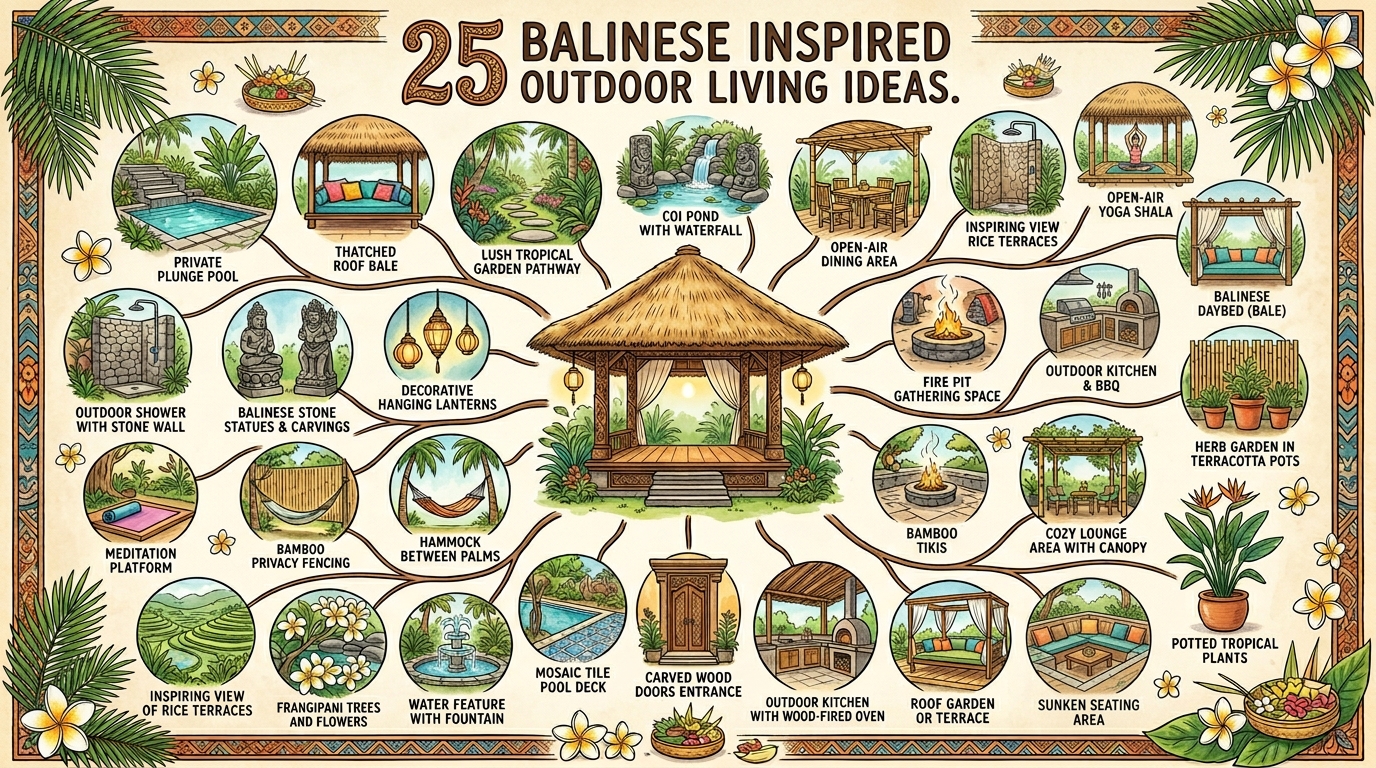
Balinese inspired outdoor living is the design philosophy of transforming exterior spaces into open-air sanctuaries that blend natural materials, spiritual intention, and lush tropical abundance — drawing directly from the compound architecture and garden traditions of Bali, Indonesia. This article delivers exactly 25 Balinese inspired outdoor living ideas spanning materials, lighting, water features, furniture, plants, and layout so you can build the outdoor sanctuary your home has been waiting for.
There is a particular stillness that settles over a well-designed Balinese outdoor space — the sound of water moving over stone, the weight of frangipani scent in warm air, the way hand-carved teak catches the last hour of afternoon light. Balinese inspired outdoor living is less a decorating style and more a philosophy of outdoor inhabitation: the belief that the space between walls and sky deserves the same care, intention, and beauty as any interior room. Here are 25 ideas worth saving — and stealing.
Why Balinese Inspired Outdoor Living Works So Well
Balinese outdoor design draws from a deeply integrated tradition of Hindu-Dharmic philosophy, Javanese craft heritage, and the specific ecological abundance of the Indonesian island of Bali. Unlike Western landscape design — which typically organizes outdoor space around lawn, perimeter planting, and a patio — Balinese compound design treats every outdoor zone as a series of intentional rooms, each with its own function, material character, and spiritual axis. The outdoor space is never residual; it is the primary architecture. This is what distinguishes Balinese inspired design from adjacent tropical styles like Hawaiian resort or Polynesian tiki — the Balinese tradition is rooted in ceremony, craft, and material honesty rather than leisure escapism.
The core materials of authentic Balinese outdoor design include hand-carved volcanic andesite stone, reclaimed teak and ironwood, alang-alang (thatched grass) roofing, black lava stone pavers, woven bamboo and rattan, glazed terracotta and hand-thrown clay pots, and natural rope and jute. The palette is drawn entirely from the Balinese landscape: deep forest green, warm terracotta, volcanic black, raw sand, weathered teak gray, and the burnt orange of tropical sunset. Every surface should read as though it arrived from the earth rather than from a factory.
Balinese outdoor living has surged in design interest since 2022, driven by the post-pandemic hunger for outdoor spaces that function as genuine living rooms. Pinterest searches for “Balinese garden,” “tropical outdoor sanctuary,” and “Bali style patio” have grown year-over-year, and the rise of the “outdoor room” concept has pushed homeowners toward more investment in furniture quality, planting density, and permanent outdoor structures. The cultural moment also connects to a broader sustainability conversation — natural materials, handmade objects, and dense planting are inherently lower in embodied carbon than manufactured outdoor furniture systems.
Small outdoor spaces — a courtyard, a townhouse terrace, a narrow side yard — can achieve Balinese atmosphere with specific focus. The most important first decision is vertical density: Balinese gardens read rich because they layer plants at multiple heights simultaneously. Even a 10-foot-square terrace achieves the enclosure of a Balinese garden when it has tall bamboo screening, mid-height tropical foliage, and ground-level creeping plants creating a continuous green surround.
Style at a Glance
| Element | Core Trait |
| Philosophy | Outdoor space as sacred sanctuary; nature as architecture |
| Key Materials | Hand-carved andesite, reclaimed teak, alang-alang thatch, black lava stone, rattan |
| Key Colors | Deep forest green, volcanic black, warm terracotta, raw sand, weathered teak gray |
25 Balinese Inspired Outdoor Living Ideas
1. Teak Daybed with Draped Canopy as the Outdoor Centerpiece
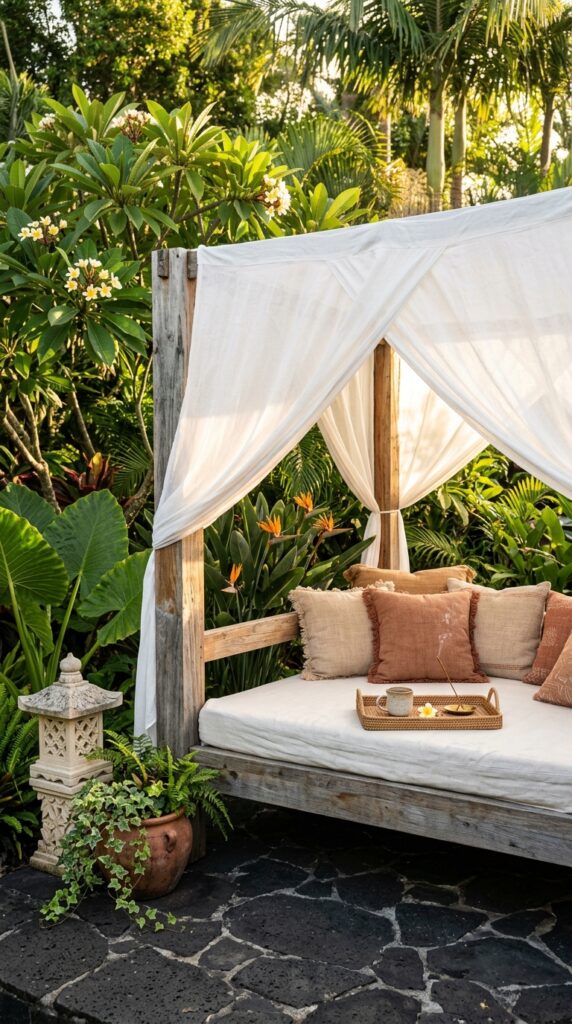
Vibe: The daybed reads suspended — a place between waking and sleep where the garden sounds replace the need for thought.
Why it works: A canopied teak daybed is the single most defining furniture element of Balinese outdoor design because it creates a room-within-a-room: the four corner posts and draped canopy define a spatial boundary in the open air without walls, establishing a zone of stillness within the larger garden. This is the design principle of implied enclosure — the canopy overhead and the posts at the corners give the body a psychological sense of shelter even while remaining fully exposed to breeze and sound. Reclaimed teak is the correct material specification because its weathering to silver-gray is a feature of the Balinese aesthetic, not a maintenance failure.
How to get it: Source solid reclaimed teak daybeds from Indonesian furniture importers or from direct-trade retailers like Teak Warehouse or Island Living. Hang a white or natural linen curtain panel from each of the four corner posts using a simple tension rod or bamboo dowel at canopy height — no hardware required. Use outdoor-rated linen (Sunbrella’s “Canvas” fabric in natural or white) for weather resistance without sacrificing the authentic drape quality.
💡 Quick Win: A $40 white outdoor curtain panel tied to a pergola beam above an existing outdoor sofa immediately creates the canopy feeling of a Balinese daybed without any furniture purchase.
🛍️ Shop the Look — Amazon Product Ideas
| # | Product Search Phrase | Why It Fits |
| 1 | Teak outdoor daybed canopy natural wood | Hero outdoor furniture |
| 2 | White outdoor linen curtain panel UV resistant | Canopy drape fabric |
| 3 | Woven rattan serving tray outdoor natural | Daybed surface tray |
| 4 | Terracotta outdoor throw pillow cover set | Warm textile accent |
| 5 | Brass incense holder outdoor decorative | Sensory ritual accent |
2. Black Lava Stone Paving for Authentic Balinese Ground Plane
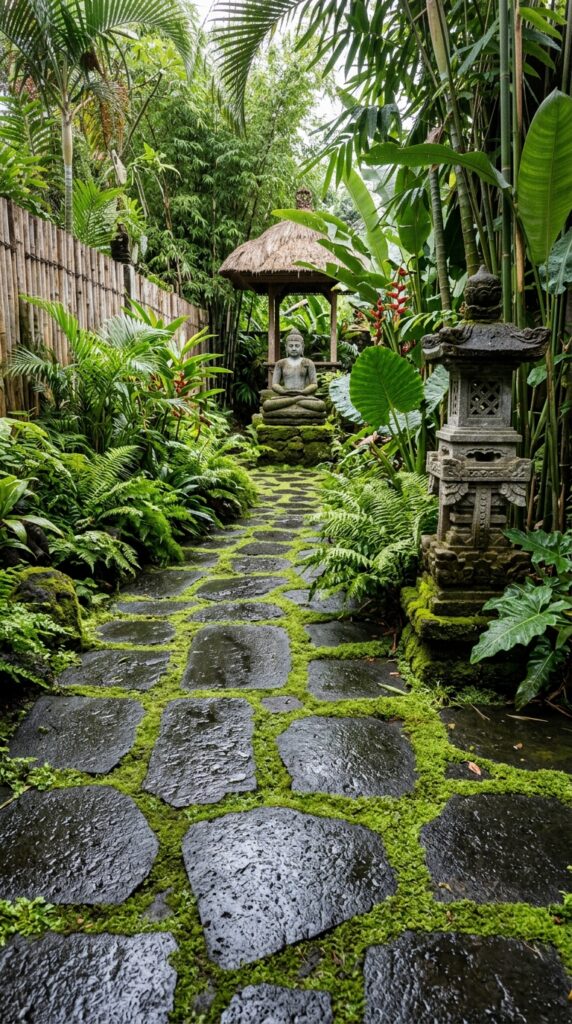
Vibe: The path reads ancient — worn black stone that seems to have been here before the garden, before the house, before the idea of a garden at all.
Why it works: Black lava stone paving is the single most authentic material choice for a Balinese outdoor ground plane because it references the volcanic geology of the island itself — Bali’s landscape is built from Gunung Agung’s millennia of eruptions, and lava stone is omnipresent in traditional Balinese temple and compound architecture. The dark surface serves a specific design function: it recedes visually, making the green planting and carved stone decorative elements read forward against the dark ground. Moss growing in the joints is not a maintenance issue but the intended end state — Balinese garden aesthetics prize the evidence of age and organic integration.
How to get it: Black basalt or lava stone pavers are available from landscape stone suppliers in irregular flagstone and cut formats at $4–9 per square foot. Install with wide joints (1.5–2 inches) filled with a sand and soil mix rather than grout — this allows moss to establish naturally in humid climates, or you can transplant plug moss from a nursery directly into the joints for immediate effect.
🛍️ Shop the Look — Amazon Product Ideas
| # | Product Search Phrase | Why It Fits |
| 1 | Black lava stone paver natural volcanic | Authentic ground material |
| 2 | Sheet moss plug garden joint filler | Joint moss establishment |
| 3 | Carved andesite stone lantern garden | Pathway lighting accent |
| 4 | Stone Buddha statue garden outdoor | Path destination focal point |
| 5 | Bamboo garden fence panel natural | Boundary screening material |
3. Alang-Alang Thatched Roof Bale Structure
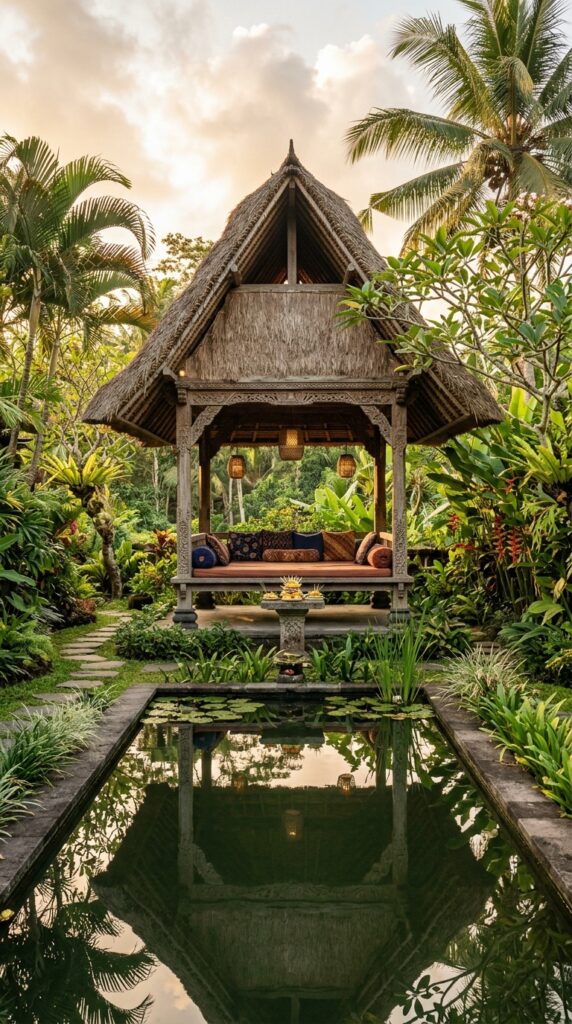
Vibe: The bale reads ceremonial — a structure that insists you slow down the moment you step beneath it.
Why it works: The bale (traditional Balinese open pavilion) achieves outdoor shelter through the principle of overhead plane definition — a structure that covers without enclosing creates shelter that still feels connected to the garden. The steep alang-alang thatch roof has evolved specifically for tropical climate performance: the natural grass creates exceptional thermal insulation, keeping the interior dramatically cooler than metal or tile roofing, while the steep pitch sheds tropical rainfall instantly. The carved teak columns function as outdoor sculpture that frames the garden view from beneath the structure.
How to get it: Prefabricated Balinese bale structures can be imported directly from Balinese craftsmen through suppliers like Tropical Bali or Bali Hai Outdoor — freight for a standard 3×4-meter bale runs $2,000–4,000 with the structure itself at $3,000–8,000 depending on carving detail. For a budget version, a pergola with a synthetic thatch roofing panel (available from Amazon at $40–60 per 13×4-foot panel) and teak or bamboo post wraps creates a convincing bale atmosphere at $800–2,000 total.
💡 Quick Win: Synthetic thatch roll ($45–70 on Amazon) stapled to an existing pergola frame immediately creates the Balinese roofscape in an afternoon — the texture and density of quality synthetic thatch is convincing from 10 feet away.
🛍️ Shop the Look — Amazon Product Ideas
| # | Product Search Phrase | Why It Fits |
| 1 | Synthetic thatch roof panel outdoor pergola | Bale roof material |
| 2 | Teak outdoor platform daybed low | Low bale seating platform |
| 3 | Batik outdoor cushion cover indigo terracotta | Authentic textile color |
| 4 | Rattan hanging lantern outdoor set | Bale interior lighting |
| 5 | Carved teak post wrap column decorative | Column architectural detail |
4. Frangipani Tree as the Spiritual Garden Anchor
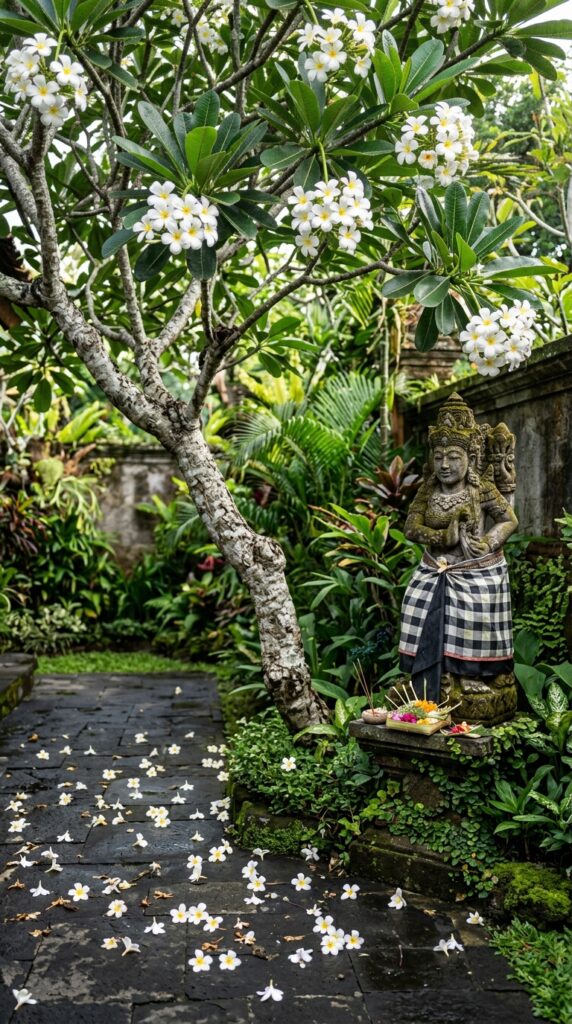
Vibe: The tree reads sacred — the blossoms falling with an unhurried inevitability that makes the whole garden feel watched over.
Why it works: The frangipani (Plumeria) is the single most culturally significant plant in Balinese outdoor design — it is the flower of the gods in Balinese Hindu tradition, used in daily temple offerings and worn by women in traditional dress. Its scent is one of the defining sensory characteristics of a Balinese garden, particularly in the morning and evening when the fragrance intensifies. As an outdoor design element, the frangipani’s spreading canopy and gnarled, sculptural trunk provide a year-round structural focal point even when not in bloom, and the fallen blossoms on a dark paving surface create one of the most evocative and authentic visual signatures of Balinese outdoor living.
How to get it: Frangipani grows in USDA zones 9–12 and is available as container specimens from tropical nurseries and online growers. In cooler climates, grow in a large terracotta pot (18-inch minimum) and overwinter indoors — the plant is deciduous in winter and requires no watering during dormancy. Plant in full sun in well-draining soil; frangipani is extremely drought-tolerant once established.
🛍️ Shop the Look — Amazon Product Ideas
| # | Product Search Phrase | Why It Fits |
| 1 | Plumeria frangipani plant white tropical | Sacred garden anchor |
| 2 | Large terracotta pot outdoor 18 inch | Frangipani container vessel |
| 3 | Carved stone garden deity figure andesite | Spiritual garden focal point |
| 4 | Bamboo incense holder outdoor small | Garden offering element |
| 5 | Creeping fig plant ground cover outdoor | Stone base planting |
5. Tiered Stone Water Feature with Lotus Bowl
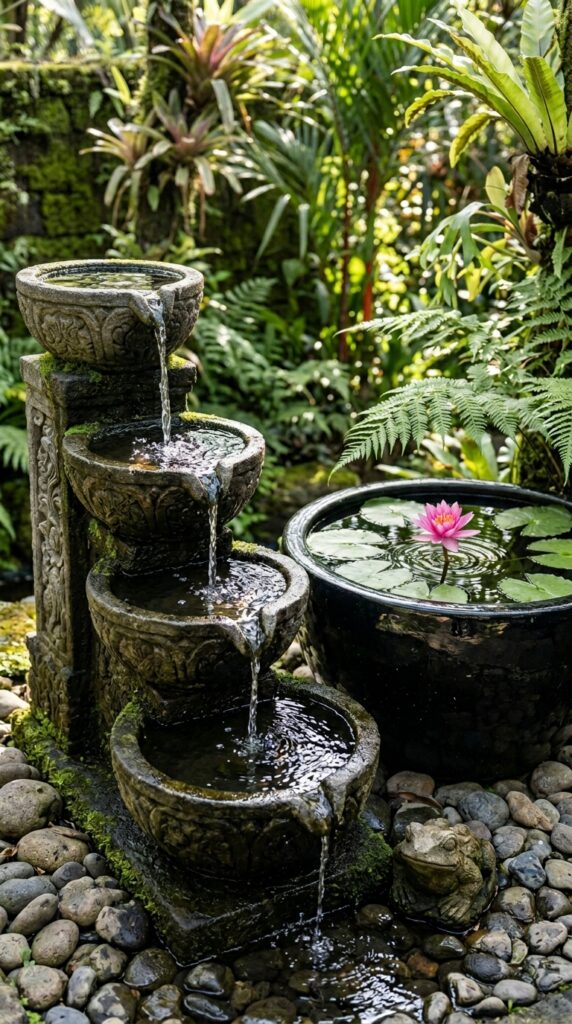
Vibe: The water feature reads cooling — the sound arriving before the visual, slowing the breath before the eye even registers the stone.
Why it works: Water is the single most important sensory element of Balinese outdoor design — it appears in every traditional compound in some form, from the grand reflecting pools of major temples to the simple stone basins of domestic gardens. The design principle at work is auditory atmosphere: the sound of moving water creates a continuous acoustic presence that masks traffic, neighbors, and urban noise, effectively acoustic-sealing a garden from its surroundings. A tiered stone water feature and a still lotus bowl create two complementary sound environments — the gentle cascade of the feature and the total silence of the still bowl — that together create the complete Balinese water soundscape.
How to get it: Carved andesite stone water features are available from Balinese import suppliers and through Amazon for $150–600 depending on scale. Pair with a large black glazed ceramic bowl (minimum 18-inch diameter) planted with a single Nymphaea (water lily) — choose a pygmy variety for containers. Place a small submersible pump in the stone feature reservoir and run the power cord under the paving to the nearest outlet.
🛍️ Shop the Look — Amazon Product Ideas
| # | Product Search Phrase | Why It Fits |
| 1 | Carved stone tiered water fountain outdoor | Water sound feature |
| 2 | Black glazed ceramic lotus bowl large | Water lily planting vessel |
| 3 | Water lily pygmy aquatic plant | Lotus bowl planting |
| 4 | Small submersible pump fountain quiet | Water feature pump |
| 5 | River stone smooth pebble bag natural | Feature base surround |
6. Bamboo Privacy Screen with Tropical Planting Behind
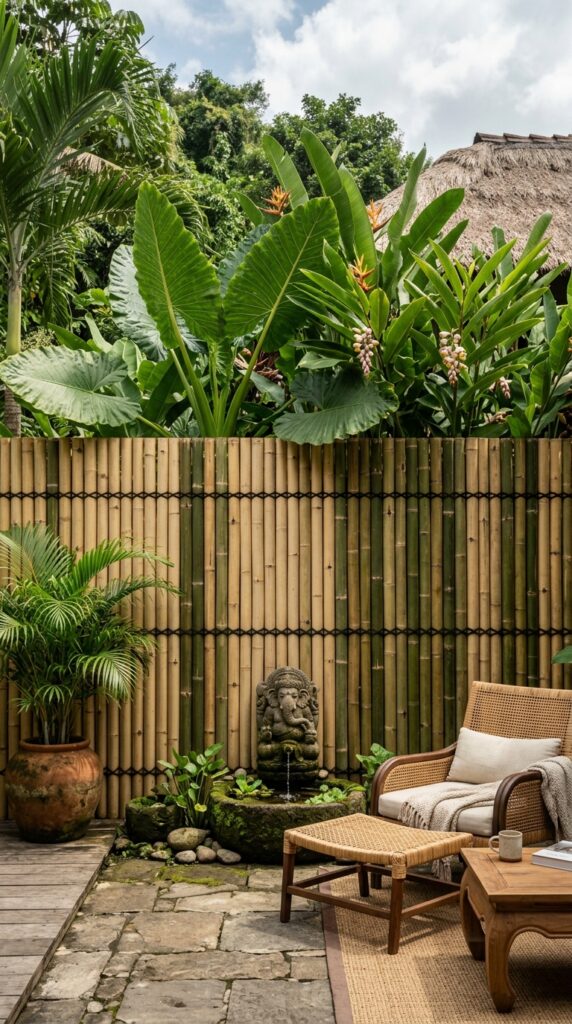
Vibe: The screen reads enclosing — a wall that breathes, the bamboo filtering both light and sound without sealing either out.
Why it works: A bamboo privacy screen solves the fundamental outdoor living problem of enclosure without heaviness — bamboo poles create a visual barrier that reads as natural and permeable rather than constructed and solid. The design principle is permeable boundary definition: the gaps between culms allow air movement and filtered light while still creating the psychological sense of an enclosed outdoor room. Tropical planting that overtops the screen from behind adds depth and the impression that the garden continues beyond the screen, preventing the boundary from reading as a dead end.
How to get it: Natural bamboo pole fencing in 6 or 8-foot heights is available in roll form ($30–80 per 8-foot roll) from garden centers and Amazon. Secure to pressure-treated 4×4 posts set 6 feet apart with UV-resistant black nylon ties rather than jute for longevity — wrap the ties in natural jute twine after securing for the authentic Balinese binding appearance. Plant elephant ear (Colocasia) or canna lily directly behind the screen at 12-inch intervals for density.
🛍️ Shop the Look — Amazon Product Ideas
| # | Product Search Phrase | Why It Fits |
| 1 | Natural bamboo roll fence 8 foot tall | Privacy screen material |
| 2 | Elephant ear colocasia bulb large tropical | Overtopping plant material |
| 3 | Black jute twine natural garden binding | Bamboo tie material |
| 4 | Large terracotta pot outdoor 20 inch | Corner planting vessel |
| 5 | Rattan lounge chair outdoor natural | Foreground seating |
7. Carved Stone Deity or Guardian Figure as Garden Focal Point
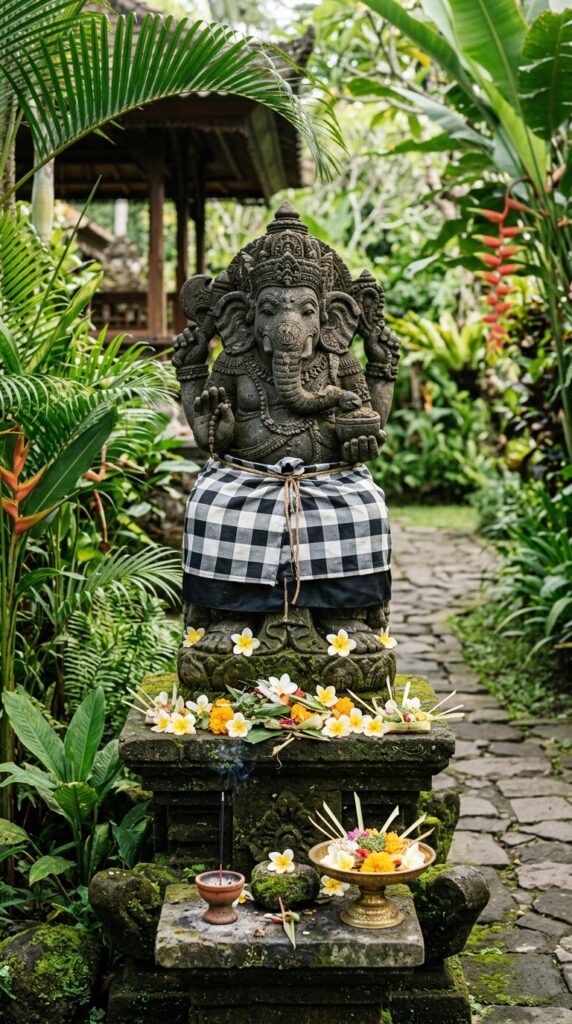
Vibe: The figure reads present — a stillness that makes the rest of the garden feel observed and, somehow, protected.
Why it works: Carved stone deity figures in Balinese outdoor design apply the principle of spiritual focal point — a single sculptural figure at the garden threshold or path junction creates a node of concentrated intention that organizes the surrounding space into a composition rather than a collection of plants and furniture. In traditional Balinese compounds, carved stone figures at entrances and junctions are understood as guardians that mark the transition from public to private, from secular to sacred space. Even in a non-religious context, this spatial marking function remains effective: the figure creates an arrival experience and gives the garden a center of gravity.
How to get it: Authentic hand-carved andesite stone figures are imported directly from Balinese craftsmen through suppliers including Bali Direct, Bali Artisan, and Amazon’s Indonesian import vendors in the $80–400 range depending on carving complexity and size. Wrap with a small piece of black and white checked cloth (poleng fabric is available on Etsy from Balinese sellers) at the figure’s midsection for authentic cultural completeness.
💡 Quick Win: A $25 strip of poleng black and white checkered fabric (the traditional Balinese sacred cloth) wrapped around any existing garden stone figure immediately signals the Balinese design vocabulary with a single material detail.
🛍️ Shop the Look — Amazon Product Ideas
| # | Product Search Phrase | Why It Fits |
| 1 | Carved stone Ganesha garden statue andesite | Spiritual focal point |
| 2 | Poleng black white checkered fabric yard | Traditional sacred cloth |
| 3 | Stone garden plinth pedestal carved | Figure display base |
| 4 | Clay incense holder outdoor small | Offering ritual element |
| 5 | Creeping moss plug groundcover base | Stone base planting |
8. Low Teak Platform Dining Set for Outdoor Floor-Level Feasting
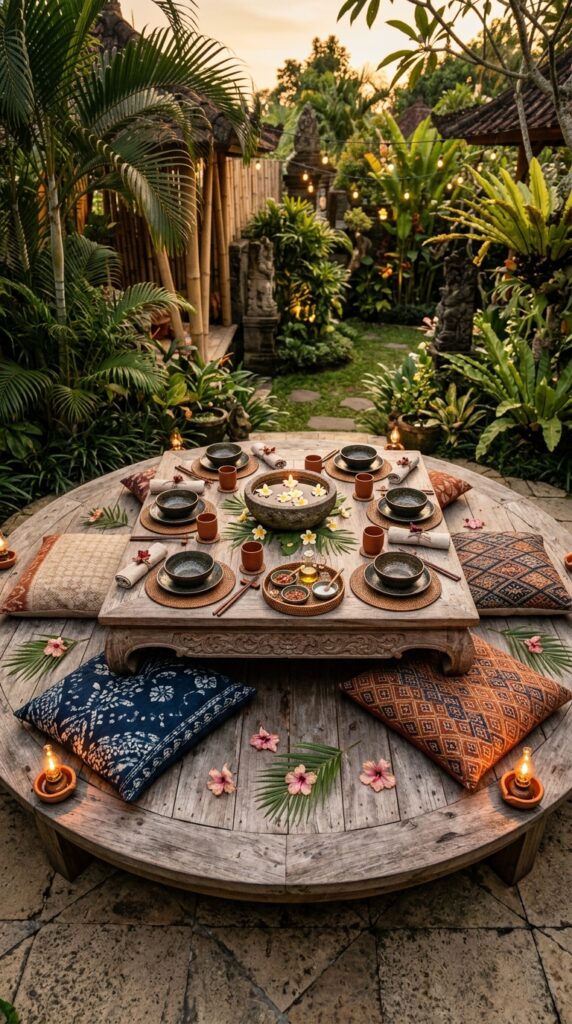
Vibe: The platform reads communal — the low height insisting on closeness, the floor cushions insisting on ease.
Why it works: Low-platform floor dining is the defining social format of Balinese feast culture — the absence of chairs creates physical equality among diners (no head of table, no elevated seat of honor) and encourages the relaxed body posture that makes long meals feel effortless rather than formal. The design principle is democratic seating: when everyone is at the same low height on the same continuous platform, the social dynamics of the meal shift toward shared experience. Floor cushions in deep indigo and terracotta batik prints introduce the authentic textile language of Balinese ceremonial culture without requiring any construction.
How to get it: Build a low platform from 2×6 pressure-treated lumber topped with 1-inch teak deck boards — or purchase a prefabricated teak deck platform in 6×6-foot or 8×8-foot modules. Source large outdoor floor cushions (minimum 24×24 inches) with removable covers in outdoor-rated batik-print fabrics. The cushion covers should be machine-washable and UV-stabilized — look for Sunbrella fabric in jewel-toned prints for maximum longevity.
🛍️ Shop the Look — Amazon Product Ideas
| # | Product Search Phrase | Why It Fits |
| 1 | Large floor cushion outdoor 24 inch square | Platform floor seating |
| 2 | Teak outdoor deck tile platform 12×12 | Platform flooring module |
| 3 | Batik print outdoor cushion cover indigo | Authentic textile color |
| 4 | Low stone outdoor coffee table carved | Platform center table |
| 5 | Floating candle bowl stone outdoor | Water candlelight feature |
9. Tropical Planting in Oversized Terracotta Pots
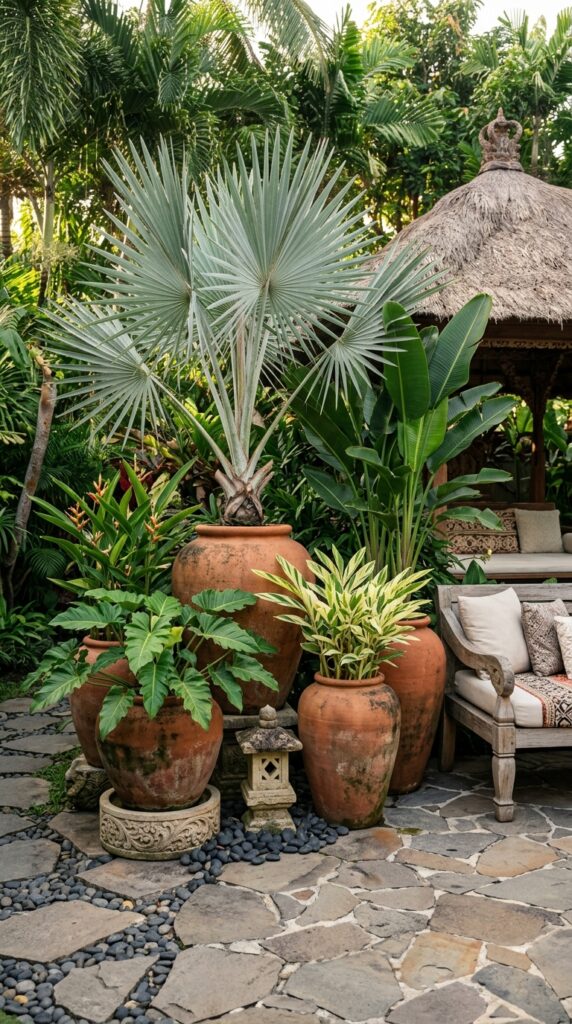
Vibe: The cluster reads abundant — the terracotta and tropical foliage creating the impression that the garden has been growing here for decades, not weeks.
Why it works: Oversized terracotta pots planted with tropical specimens are the most versatile element in a Balinese outdoor scheme because they can move with the seasons, can be repositioned to refine the composition, and can be overwintered in a garage or greenhouse in climates where tropical plants don’t survive frost. The design principle is height stratification in a container format — by varying pot height and plant height within a single cluster, the composition creates the multi-layered canopy structure of a Balinese garden in a small footprint. Terracotta specifically connects the planting to the warm orange-rust earth tones of the Balinese landscape.
How to get it: Start with one specimen per container — resist the temptation to plant multiple species in a single large pot, which creates visual competition. The tallest plant in the cluster should be 2–3× the pot height for correct proportion. Terracotta pots larger than 20 inches require a moisture-retaining potting mix with added perlite — standard potting soil dries out too quickly in large terracotta containers in hot weather.
🛍️ Shop the Look — Amazon Product Ideas
| # | Product Search Phrase | Why It Fits |
| 1 | Large terracotta pot outdoor 24 inch planter | Tropical container vessel |
| 2 | Bird of paradise strelitzia plant large | Balinese statement plant |
| 3 | Heliconia tropical plant red outdoor | Bold tropical color plant |
| 4 | Black lava rock pebble mulch decorative | Pot base ground cover |
| 5 | Moisture retentive potting mix tropical | Container growing medium |
10. Outdoor Shower with Volcanic Stone and Bamboo Privacy
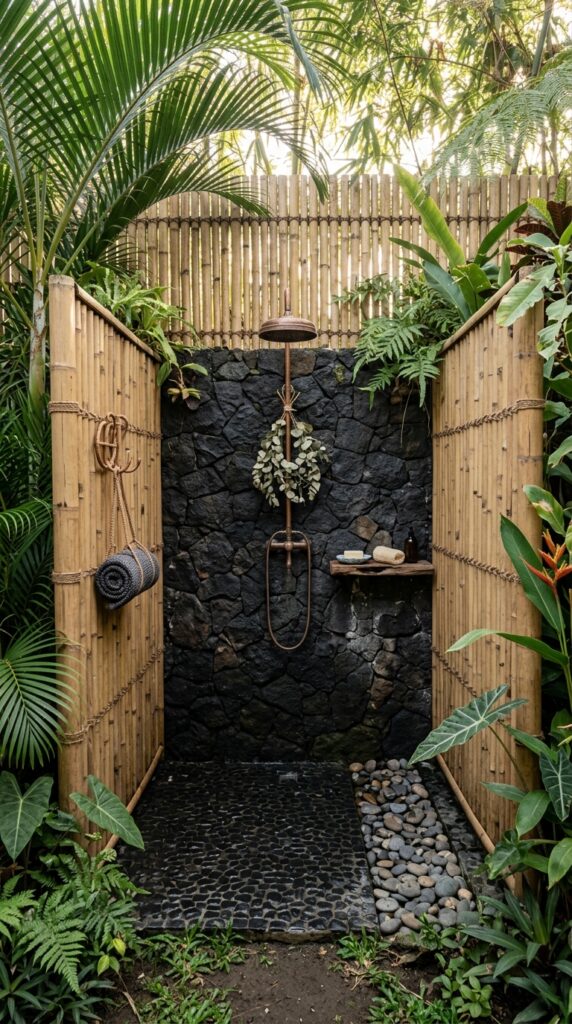
Vibe: The shower reads elemental — bathing with sky overhead and stone underfoot, the experience of the body returned to something older than plumbing.
Why it works: An outdoor shower is one of the most experientially transformative additions to a Balinese inspired outdoor space because it extends the body’s relationship with the outdoor environment into the most private daily ritual. The design principle is sensory expansion — showering outdoors engages touch (water, breeze, stone texture underfoot), sound (birdsong, water on stone), smell (eucalyptus, tropical planting), and sight (sky, foliage) simultaneously, creating an experience that no interior bathroom can replicate. Volcanic black stone walls and copper fittings are the authentic material pairing of Balinese luxury resort shower design.
How to get it: An outdoor shower requires a plumbing rough-in from an interior wall (typically a $300–600 plumber cost for the connection) and a drainage solution — either a connection to the household drain or a dry creek bed of river stones leading to a planted area. The shower wall can be built from stacked concrete blocks veneered in black basalt tile, or from actual lava stone available through landscape suppliers.
🛍️ Shop the Look — Amazon Product Ideas
| # | Product Search Phrase | Why It Fits |
| 1 | Outdoor shower head rainfall copper bronze | Signature shower fixture |
| 2 | Black basalt tile mosaic floor sheet | Shower floor material |
| 3 | Teak shower shelf outdoor wall mount | Natural wood shower storage |
| 4 | Dried eucalyptus bundle shower hanging | Aromatherapy shower detail |
| 5 | Rattan hook outdoor wall towel holder | Natural towel accessory |
11. Rattan and Teak Outdoor Lounge Setting
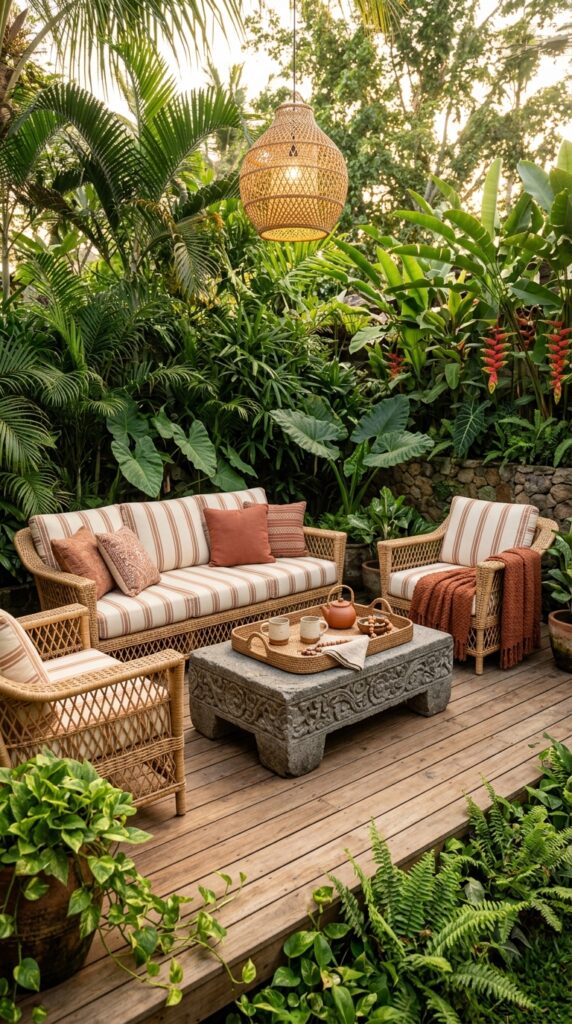
Vibe: The setting reads unhurried — furniture that invites the body to stay longer than planned, and makes no apology for it.
Why it works: Rattan outdoor furniture is the material foundation of Balinese lounging culture because it is simultaneously lightweight (easily repositioned), visually warm (the woven pattern reads as craft rather than manufacture), and climatically appropriate (the open weave allows air circulation in tropical heat). The design principle of material warmth hierarchy applies: rattan above the stone platform and below the teak structure creates three distinct material layers that each contribute a different texture register to the composition. Thick, generous cushion volume is the non-negotiable detail — undersized or thin cushions make rattan furniture read as utilitarian rather than luxurious.
How to get it: Specify rattan or synthetic rattan (all-weather wicker) outdoor furniture in a natural or honey tone — avoid very dark or black wicker frames, which read as contemporary rather than Balinese. Cushion thickness should be minimum 4 inches for a lounge sofa and 3 inches for armchairs. Outdoor fabric in cream or natural with a terracotta stripe in Sunbrella or Outdura material will outlast five seasons in most climates.
💡 Quick Win: Replacing existing outdoor cushions with new covers in a terracotta or warm ochre stripe ($25–45 per cover) transforms any existing outdoor furniture frame into a Balinese-adjacent setting in under ten minutes per cushion.
🛍️ Shop the Look — Amazon Product Ideas
| # | Product Search Phrase | Why It Fits |
| 1 | Rattan outdoor sofa set natural 3 piece | Lounge furniture foundation |
| 2 | Terracotta stripe outdoor cushion cover | Warm textile color |
| 3 | Woven rattan serving tray handles large | Coffee table surface styling |
| 4 | Hand woven throw blanket rust outdoor | Armrest textile layer |
| 5 | Carved stone coffee table outdoor low | Natural stone surface |
12. Hanging Rattan Lanterns for Evening Atmosphere
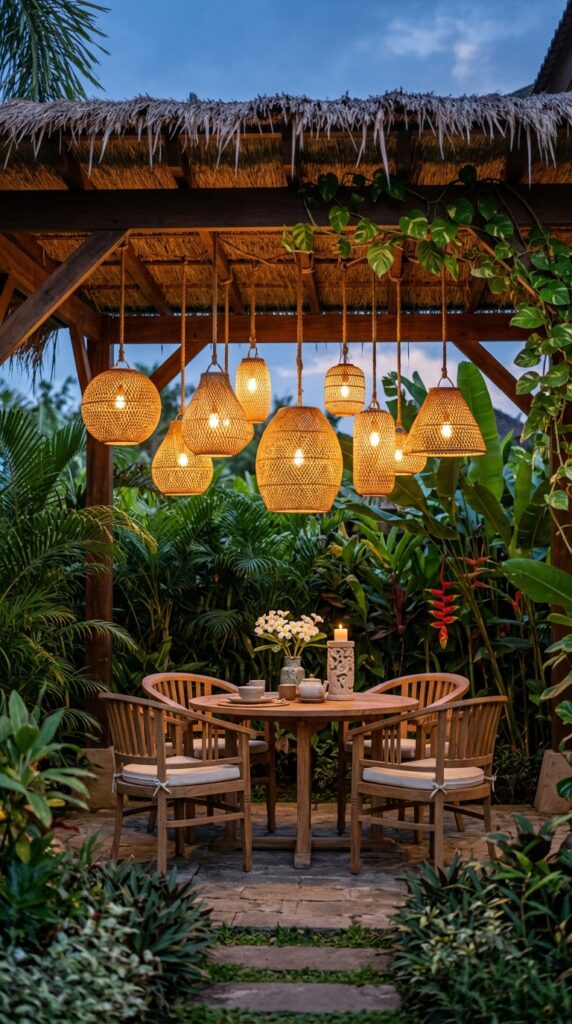
Vibe: The overhead lanterns read celebratory in a quiet way — the light saying this evening was planned for, and welcomed.
Why it works: Hanging rattan lanterns at varying heights create the outdoor equivalent of a chandelier through the principle of suspended light mass — multiple warm light sources clustered at the ceiling plane draw the eye upward and create an overhead visual boundary that makes an open outdoor space feel like a room. The warm amber light transmitted through the rattan weave creates a secondary pattern of dappled light on surfaces below that shifts as the lanterns move in breeze — a continuous, subtle animation that makes the space feel alive. Varying lantern shapes and sizes within a single installation prevents the composition from reading as a matched set (which looks retail) and instead suggests accumulation and curation.
How to get it: Rattan or bamboo outdoor lanterns designed for battery LED tea lights are available in the $15–45 range each — source at least five to seven for an effective hanging cluster. Use outdoor extension cords or a canopy rated outdoor string light system as the suspension structure, varying drop heights between 12 inches and 36 inches from the anchor point for compositional variety. Battery-operated flickering LED tea lights are the safest and most maintenance-free candle alternative for outdoor rattan.
🛍️ Shop the Look — Amazon Product Ideas
| # | Product Search Phrase | Why It Fits |
| 1 | Rattan hanging lantern outdoor set teardrop | Ceiling light cluster |
| 2 | Battery flickering LED tea light set 12 | Safe lantern light source |
| 3 | Outdoor ceiling hook swag kit hardware | Lantern hanging hardware |
| 4 | Trailing pothos plant hanging outdoor | Beam-climbing green detail |
| 5 | Carved stone candle holder outdoor table | Surface light accent |
13. Infinity-Edge Plunge Pool with Stone Surround
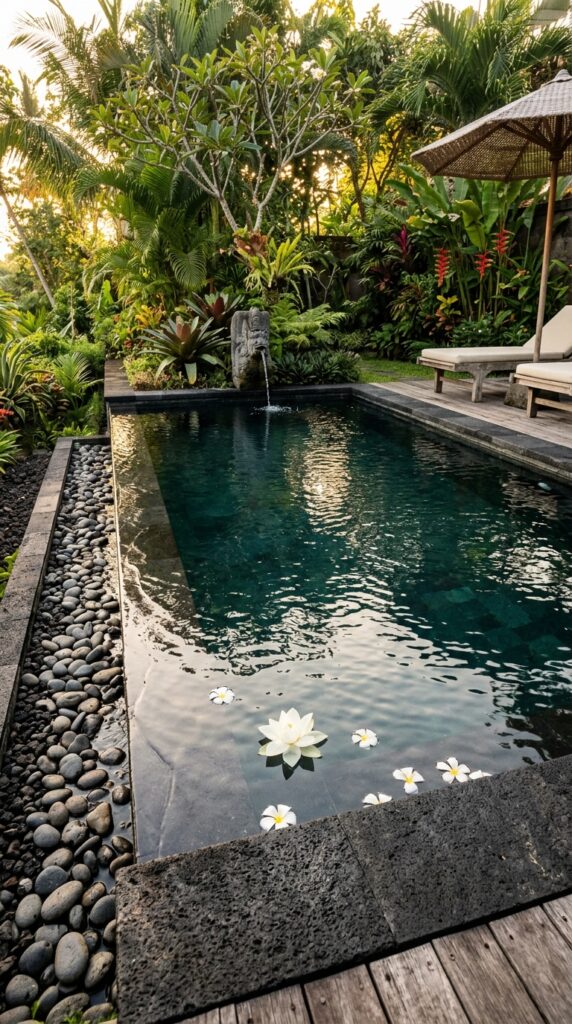
Vibe: The pool reads still and deep — the dark interior making the water look borrowed from somewhere ancient and very far below.
Why it works: A dark-tiled plunge pool with an infinity edge is the signature luxury element of Balinese resort design because it applies two simultaneous visual principles: depth amplification through dark surface (a black or dark tile interior makes water read as infinitely deep rather than shallow) and boundary dissolution through infinity edge (the overflow edge removes the visual termination of the pool, merging the water surface with the surrounding garden or sky). Even a small plunge pool of 8×10 feet achieves both effects when correctly tiled and edged — it is the tile color and the edge detail that create the magic, not the size.
How to get it: Dark volcanic basalt or black pool tile is available from specialty pool tile suppliers at $8–20 per square foot — specify a matte rather than glossy finish for the Balinese aesthetic. The pool coping (the horizontal stone at the pool edge) should be in matching black lava stone for material continuity. A plunge pool of 8×12 feet with professional installation runs $15,000–35,000 depending on market and site conditions.
🛍️ Shop the Look — Amazon Product Ideas
| # | Product Search Phrase | Why It Fits |
| 1 | Black volcanic basalt pool tile mosaic | Dark pool interior tile |
| 2 | Teak outdoor chaise lounge sunbed | Poolside lounging furniture |
| 3 | Carved stone wall water spout fountain | Pool water inlet feature |
| 4 | Rattan market umbrella outdoor 9 foot | Poolside shade element |
| 5 | Floating lotus flower candle pool decoration | Pool surface accent |
14. Outdoor Meditation Corner with Stone and Sand
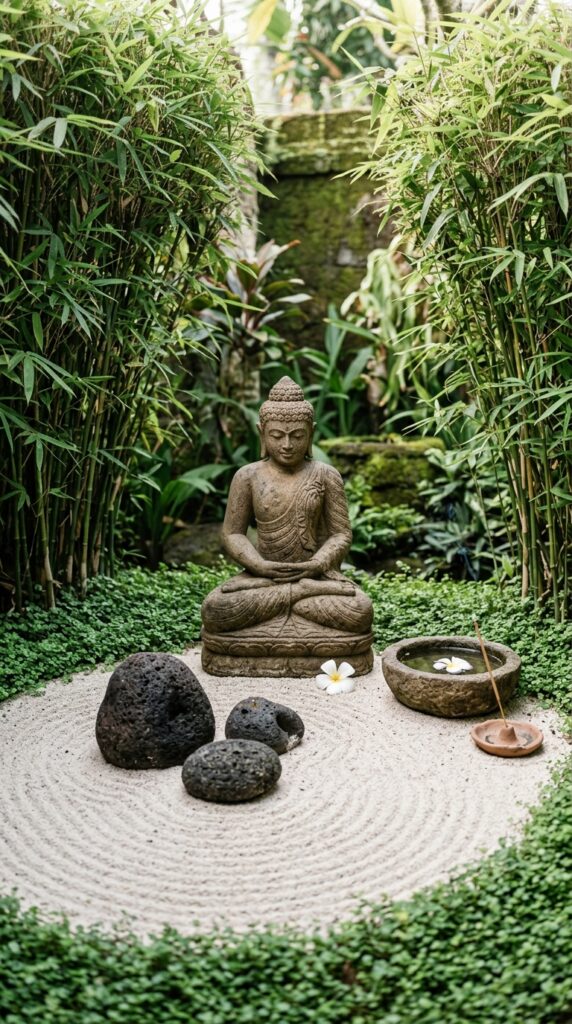
Vibe: The corner reads still — the raked sand holding the morning light and the quiet with equal ease.
Why it works: A meditative sand-and-stone garden corner applies the Japanese karesansui (dry landscape) aesthetic through a Balinese material lens — volcanic black stones replace river boulders, carved Hindu figures replace simple stone markers, and the surrounding planting shifts from Japanese maple and moss to bamboo and tropical ground cover. The design principle is intentional emptiness — the raked sand or gravel creates a visual clearing within a densely planted garden that gives the eye and the mind a resting point, an unoccupied zone that makes the surrounding planting read as more lush by contrast.
How to get it: Define the meditation corner with a low border of black basalt cobblestones or a simple bamboo edging strip. Fill with white or pale gray pea gravel (not sand, which compacts and discolors over time) raked with a simple wooden garden rake. Place three volcanic or black river stones in the odd-number Balinese tradition — one large, one medium, one small — at asymmetric positions within the gravel field.
💡 Quick Win: A 50-pound bag of white pea gravel ($18), three large river stones ($12 from a landscape supplier), and a simple $8 garden rake creates a functional meditative gravel garden in 30 minutes — the most affordable Balinese garden element available.
🛍️ Shop the Look — Amazon Product Ideas
| # | Product Search Phrase | Why It Fits |
| 1 | White pea gravel bag 50lb garden zen | Meditative ground surface |
| 2 | Large volcanic black stone decorative garden | Stone garden feature |
| 3 | Stone Buddha meditation statue outdoor | Spiritual corner focal point |
| 4 | Zen garden rake wooden small | Gravel raking tool |
| 5 | Baby tears ground cover creeping plant | Sand border edging plant |
15. Tropical Plant Wall or Living Green Screen
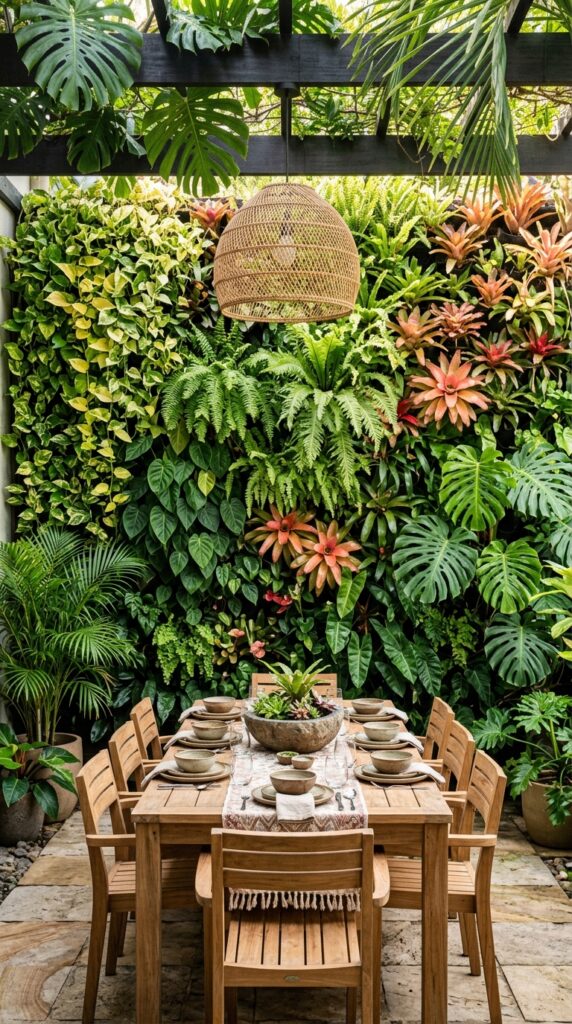
Vibe: The green wall reads breathing — a surface that moves and grows and changes with the season in a way no painted wall can approach.
Why it works: A living tropical plant wall applies the design principle of surface animation — by replacing an inert architectural surface (fence, wall, screen) with a living plane of foliage, the entire visual character of the outdoor space changes from built to grown. This is the design move that most completely achieves the Balinese ideal of architecture and nature as continuous rather than opposed. A mix of leaf textures within a green wall — large oval, small round, delicate feathered, waxy rosette — creates compositional richness within a single color family, making the wall read as endlessly detailed at close range.
How to get it: Modular felt pocket planters mounted on a waterproof backing panel (brands like Woolly Pocket and Florafelt) create a living wall that can be installed on any exterior wall surface. Use a drip irrigation system with a timer set to water twice daily in hot weather — hand-watering a large living wall is impractical. Choose shade-tolerant species (pothos, ferns, bromeliads, peace lily) for walls with less than 6 hours of direct sun.
🛍️ Shop the Look — Amazon Product Ideas
| # | Product Search Phrase | Why It Fits |
| 1 | Living wall pocket planter felt modular | Green wall growing system |
| 2 | Pothos golden plant tropical easy care | Green wall foundation plant |
| 3 | Bromeliad plant tropical colorful indoor outdoor | Texture color variation |
| 4 | Drip irrigation kit wall planter timer | Living wall watering system |
| 5 | Boston fern plant outdoor shade tolerant | Delicate frond texture |
16. Small Balcony Transformed into a Balinese Sanctuary
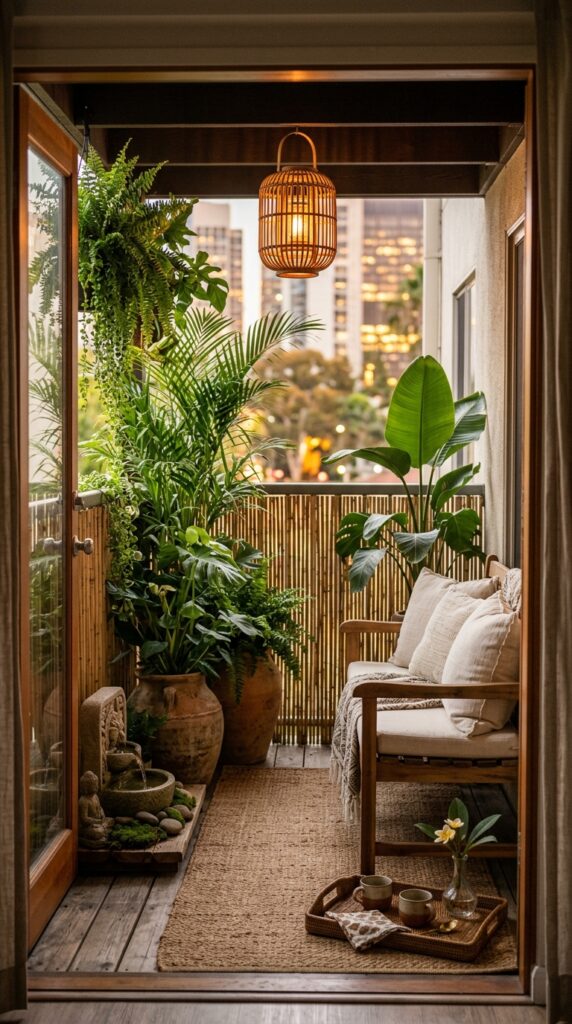
Vibe: The balcony reads transported — the six feet of outdoor space achieving the atmospheric distance of somewhere completely different.
Why it works: A small balcony Balinese transformation applies the principle of sensory layering at compressed scale — by stacking multiple sensory elements (the sound of a small water feature, the scent of frangipani, the texture of woven rattan, the visual enclosure of tropical planting) within a small space, the overall atmospheric effect exceeds what the square footage suggests. The key small-space technique is vertical planting: two large terracotta pots with tall tropical specimens at the railing edge create a green wall that visually replaces the railing itself with foliage, eliminating the awareness of the city beyond.
How to get it: Balcony weight limits are the primary constraint — most balconies are rated for 50–100 lbs per square foot. Choose lightweight plastic pots disguised with terracotta-finish spray paint ($8) rather than actual terracotta for large balcony planters. A tabletop or plug-in mini water feature ($35–80) provides the water sound element without any plumbing. Bamboo roll fencing zip-tied to the balcony railing creates the privacy screen.
🛍️ Shop the Look — Amazon Product Ideas
| # | Product Search Phrase | Why It Fits |
| 1 | Tabletop mini water fountain stone plug in | Compact water sound feature |
| 2 | Lightweight planter pot terracotta look plastic | Weight-safe balcony pot |
| 3 | Bamboo roll fence balcony railing screen | Privacy screening material |
| 4 | Teak bench two seater outdoor small | Compact balcony seating |
| 5 | Jute outdoor rug natural woven 4×6 | Balcony floor layer |
17. Outdoor Fire Element: Clay Pot Fire Bowl
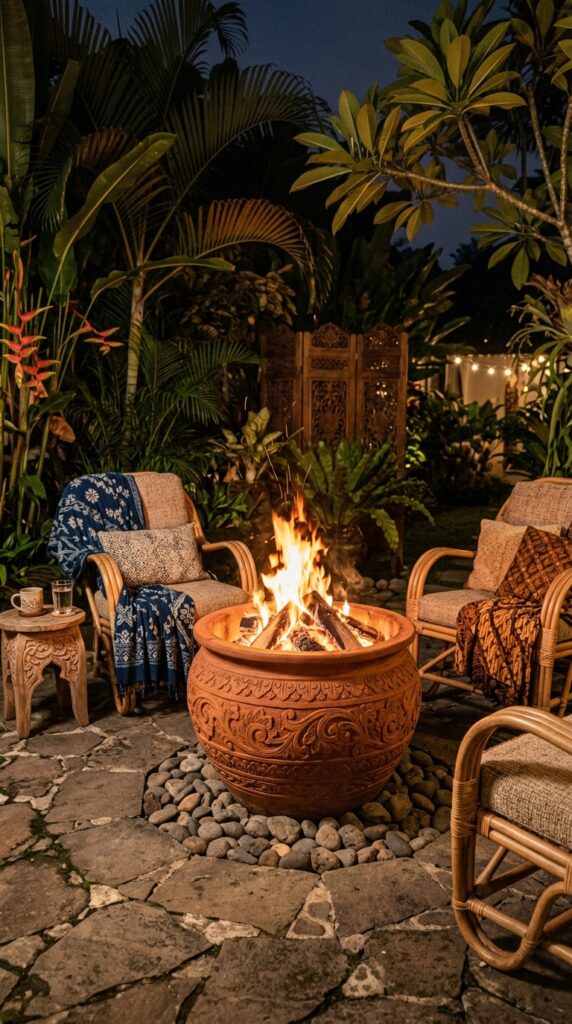
Vibe: The fire bowl reads primal — the oldest light source surrounded by the oldest outdoor materials, nothing between the flame and the sky.
Why it works: A clay pot fire bowl introduces the Balinese element of fire (agni) into the outdoor space, completing the four natural elements — earth (stone and soil), water (pool or fountain), air (the open space and breeze), fire (the flame) — that Balinese spatial philosophy considers necessary for a complete and spiritually balanced outdoor environment. As a design element, a fire bowl at the center of a seating arrangement applies the ancient principle of fire as social magnet — every culture gathers around fire, and placing it at the center of the outdoor seating zone creates an automatic focal point that organizes conversation and movement.
How to get it: Glazed terracotta fire bowls are available from garden centers and online at $60–200 in the 20–28-inch diameter range suitable for a wood or charcoal fire. Place on a non-combustible base (a ring of river stones, a concrete paving stone, or a low stone plinth) and maintain a minimum 4-foot clearance from any overhead structure. Never burn in a covered bale or pergola — fire bowls are for open-air use only.
🛍️ Shop the Look — Amazon Product Ideas
| # | Product Search Phrase | Why It Fits |
| 1 | Terracotta clay fire bowl outdoor large carved | Fire element feature |
| 2 | River stone ring fire pit surround | Non-combustible bowl base |
| 3 | Batik throw blanket outdoor rust indigo | Fireside textile layer |
| 4 | Ceramic outdoor cup set 2 handmade | Fireside drink vessel |
| 5 | Carved stone side table outdoor low | Fireside surface |
18. Tropical Color Palette: Hibiscus, Heliconia, and Bougainvillea

Vibe: The border reads abundant — the kind of planting that makes you stop walking and simply stand in the middle of it.
Why it works: Balinese garden planting deliberately combines color in ways that Western landscape design often considers too bold — magenta bougainvillea, red Heliconia, orange hibiscus — because in Bali, vivid tropical color is understood as an offering of beauty to the divine. The design principle is chromatic abundance as homage: bold, saturated flowering plants against a dark stone ground plane create maximum visual contrast and maximum sensory reward. The dark lava stone paving is the essential counterpoint that makes the floral color read as luminous rather than chaotic — without the dark background, the same plants would read as merely busy.
How to get it: Bougainvillea grows in zones 9–11 and requires a masonry wall or strong trellis to climb — plant at the base of a stone or concrete wall and train by tying new growth to the wall surface annually. Heliconia bihai (red and yellow bract varieties) is a zone 10–12 rhizomatous plant that spreads to form a substantial clump over three years. In cooler climates, use Canna lily in orange and red tones as a Heliconia equivalent — fully hardy to zone 7.
🛍️ Shop the Look — Amazon Product Ideas
| # | Product Search Phrase | Why It Fits |
| 1 | Bougainvillea plant magenta tropical vine | Cascading color climber |
| 2 | Canna lily rhizome orange red tropical look | Heliconia substitute plant |
| 3 | Hibiscus tropical plant orange red large | Bold flower border plant |
| 4 | Carved stone wall planter outdoor | Color plant display vessel |
| 5 | Stone garden frog figurine pathway | Playful garden detail |
19. Woven Bamboo Ceiling for an Outdoor Room
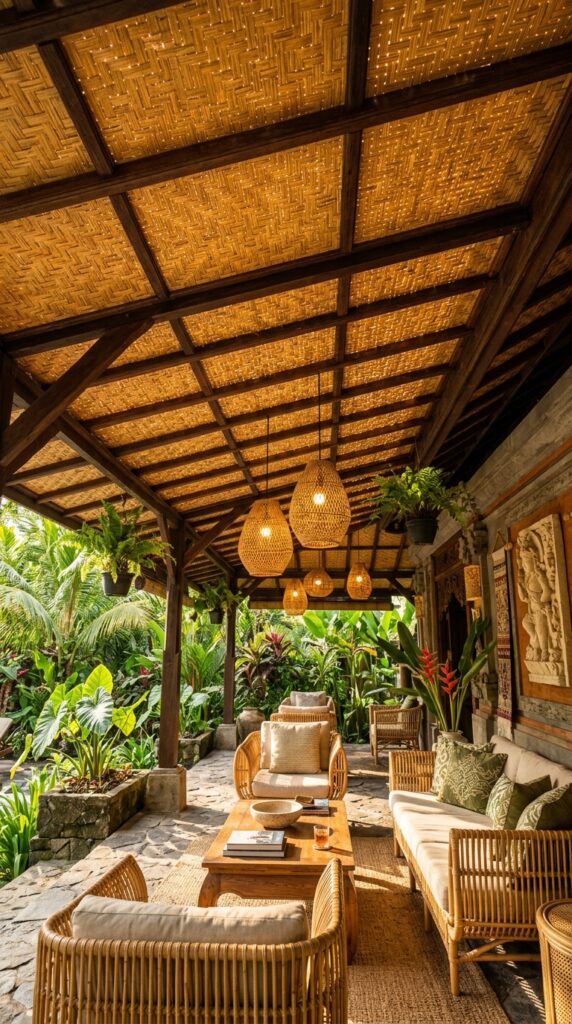
Vibe: The ceiling reads warm from above — the filtered light changing the quality of every surface beneath it, making midday feel like late afternoon.
Why it works: A woven bamboo ceiling installed between pergola rafters applies the design principle of overhead plane definition — adding a textured surface overhead transforms an open pergola from a shade structure into an outdoor room with a defined ceiling plane. The woven bamboo splits light into small, diffuse dapples rather than blocking it entirely, creating the quality of light found under a forest canopy: warm, variable, and continuously interesting. The honey-gold tone of split bamboo radiates a warm reflected light downward that shifts the ambient color of the space toward the amber of late afternoon regardless of the actual time of day.
How to get it: Split bamboo matting panels (also sold as “bamboo fencing” in roll format) can be stapled directly to the underside of pergola rafters using a staple gun and exterior-grade staples. Use 6-foot wide rolls and cut to the rafter bay width. Apply a UV-stabilizing bamboo sealant annually to prevent the natural honey tone from fading to gray in full sun exposure.
💡 Quick Win: A single 6×8-foot section of bamboo split panel ($20) stapled to the ceiling of a covered porch immediately shifts the atmosphere of the space — the warm reflected light effect is instant and dramatic.
🛍️ Shop the Look — Amazon Product Ideas
| # | Product Search Phrase | Why It Fits |
| 1 | Split bamboo mat panel roll 6 foot wide | Ceiling infill material |
| 2 | Bamboo UV sealant exterior protector spray | Bamboo longevity treatment |
| 3 | Rattan hanging lantern set outdoor | Ceiling light cluster |
| 4 | Outdoor staple gun heavy duty pergola | Ceiling panel installation tool |
| 5 | Carved stone wall bracket decorative outdoor | Room accent detail |
20. Balinese Outdoor Dining Table in Carved Teak
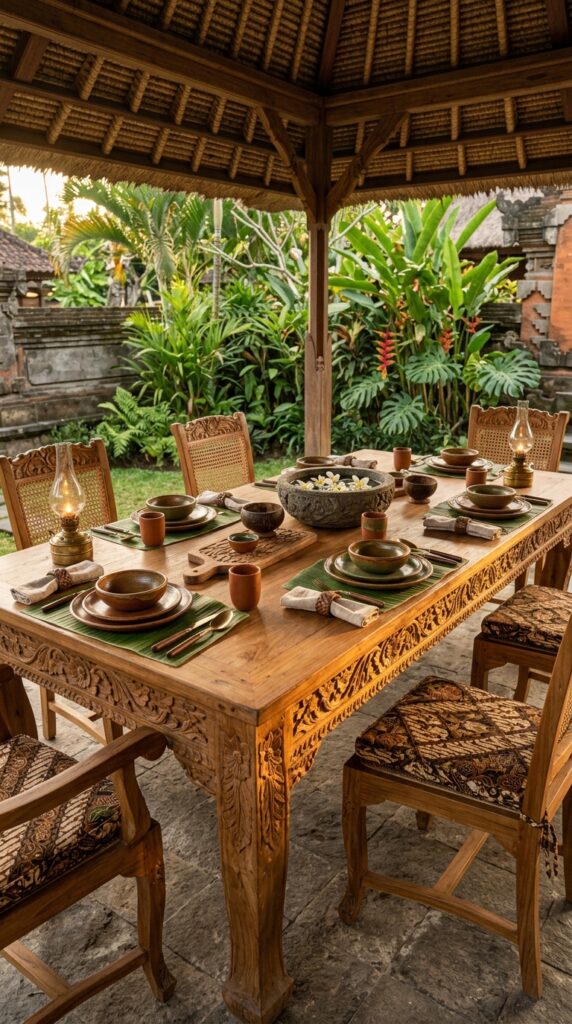
Vibe: The table reads ceremonial — set with the care of something that happens on special occasions, even when it happens every evening.
Why it works: A hand-carved teak outdoor dining table is the outdoor equivalent of a statement dining table — the surface around which the entire outdoor dining experience is organized and which communicates the quality of the outdoor room’s investment. Hand-carved relief decoration on the apron and legs applies the Balinese principle of ornamented function: the table does not choose between being useful and being beautiful, but insists on both simultaneously. At an outdoor scale, the carved detail also performs as a textural element that the eye reads from the seating position, giving the table a visual richness that a plain plank-top table cannot achieve.
How to get it: Solid carved teak outdoor dining tables are available from Indonesian furniture importers in the $600–2,500 range for 8-foot lengths. Treat annually with teak oil to maintain the warm brown tone or allow to weather naturally to silver-gray — both finishes are authentic and legitimate. Banana leaf placemats are available at Asian grocery stores and online for $1–3 each, making them the most cost-effective authentic Balinese table element.
🛍️ Shop the Look — Amazon Product Ideas
| # | Product Search Phrase | Why It Fits |
| 1 | Carved teak outdoor dining table 8 foot | Dining room hero piece |
| 2 | Banana leaf placemat natural set 6 | Authentic table element |
| 3 | Handmade ceramic plate set outdoor | Artisanal dinnerware |
| 4 | Brass oil lamp outdoor dining table | Warm flame table light |
| 5 | Coconut shell bowl decorative natural | Organic table accent |
21. Stone Pathway Flanked by Torch Lights at Night
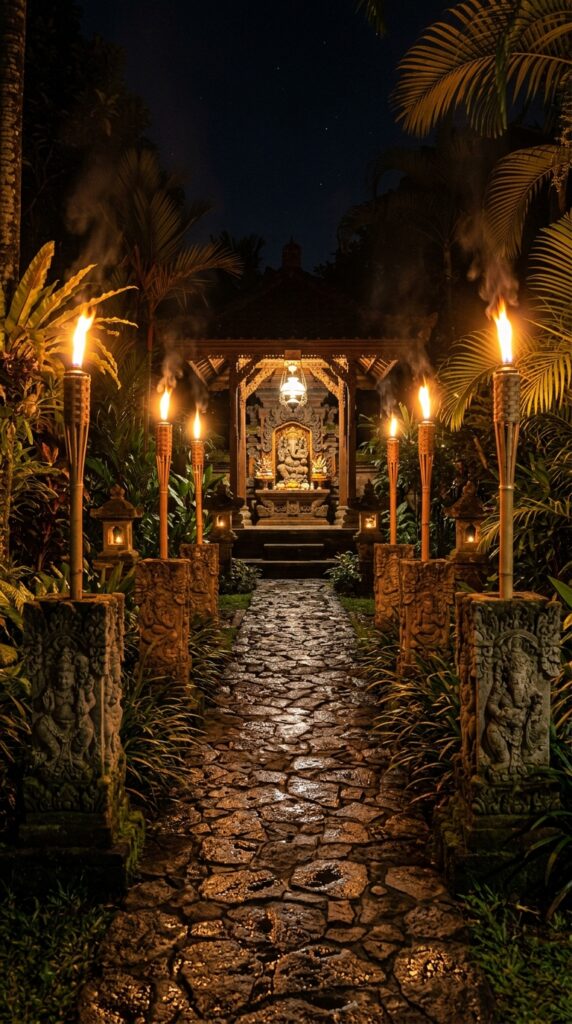
Vibe: The path reads processional — the torches insisting that arriving somewhere through a garden at night is itself an event.
Why it works: Torch-lit garden pathways apply the ancient ceremonial design principle of illuminated procession — fire at either side of a path has been used since antiquity to mark the importance of the passage and the destination. In Balinese temple and compound design, torch pathways signal the approach to a sacred or significant space, and the principle translates directly to residential outdoor design: a torch-lit path from the garden gate to the outdoor dining bale turns arrival into ceremony. The warm amber torchlight also flatters the volcanic black stone surface more dramatically than any electric alternative.
How to get it: Tiki torch fuel ($12–18 per liter) and bamboo tiki torches ($3–8 each) are widely available and last 4–6 hours per fill. For a permanent installation, use carved stone torch holders (available from Balinese import suppliers for $40–120 each) with a stainless steel fuel cup insert that accepts standard tiki fuel. Install at 4–6 foot intervals along a 12–18-inch setback from the path edge.
🛍️ Shop the Look — Amazon Product Ideas
| # | Product Search Phrase | Why It Fits |
| 1 | Stone tiki torch holder garden carved | Permanent torch holder |
| 2 | Bamboo tiki torch garden stake set 6 | Torch pathway element |
| 3 | Tiki torch fuel clean burn outdoor | Torch fuel supply |
| 4 | Carved stone garden lantern pathway | Path intersection light |
| 5 | Stainless steel tiki fuel cup insert | Permanent torch insert |
22. Outdoor Bathtub in a Garden Setting
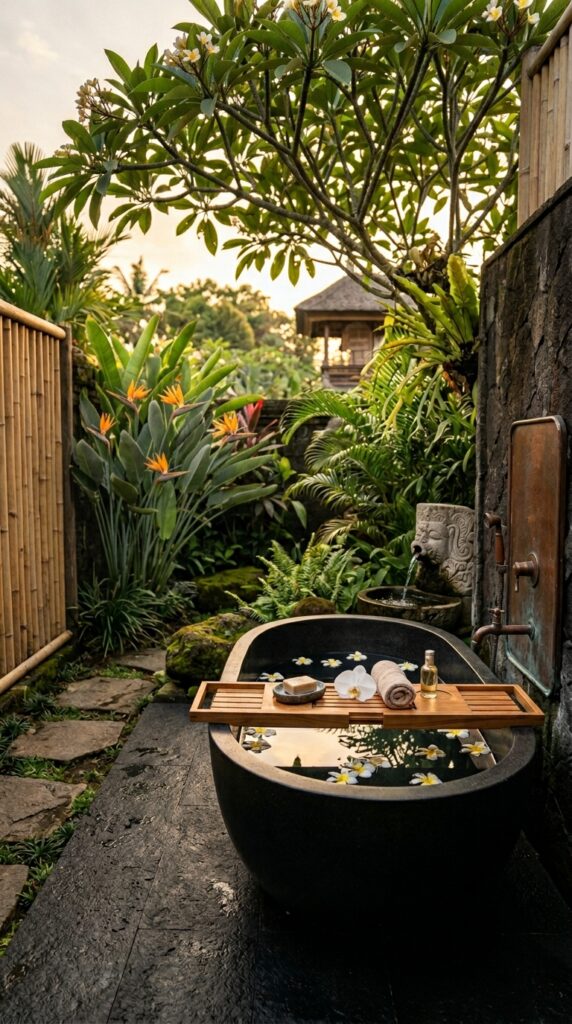
Vibe: The garden tub reads transformative — the most private act made the most connected to the outdoors, sky and scent and stone all present at once.
Why it works: An outdoor bathtub in a garden setting is the most direct expression of the Balinese design philosophy of dissolving the boundary between interior comfort and exterior nature. The principle is sensory immersion in landscape: the body surrounded by warm water while also surrounded by living plants, open sky, and the sounds of the garden creates a multi-sensory experience that no interior bathroom can approach. A matte black stone composite tub reads as a natural feature of the landscape rather than a manufactured object — it appears as a pool that was always here, waiting to be filled.
How to get it: Outdoor bathtubs require a frost-free exterior plumbing connection and must be properly drained after each use in climates with freezing winters. A copper or bronze wall-mount bath filler is the correct fixture choice — stainless steel reads too contemporary against the volcanic aesthetic. Bamboo screening on at least one side provides minimum privacy for a comfortable outdoor bathing experience.
🛍️ Shop the Look — Amazon Product Ideas
| # | Product Search Phrase | Why It Fits |
| 1 | Freestanding soaking tub matte black stone resin | Garden bathing vessel |
| 2 | Copper wall mount bath filler floor freestanding | Warm metal fixture |
| 3 | Teak bath tray across tub adjustable | Natural wood tub surface |
| 4 | Orchid stem artificial realistic single | Tub tray botanical accent |
| 5 | Outdoor privacy screen bamboo panel portable | Bathing enclosure screen |
23. Carved Teak Entrance Gate as the Garden Threshold
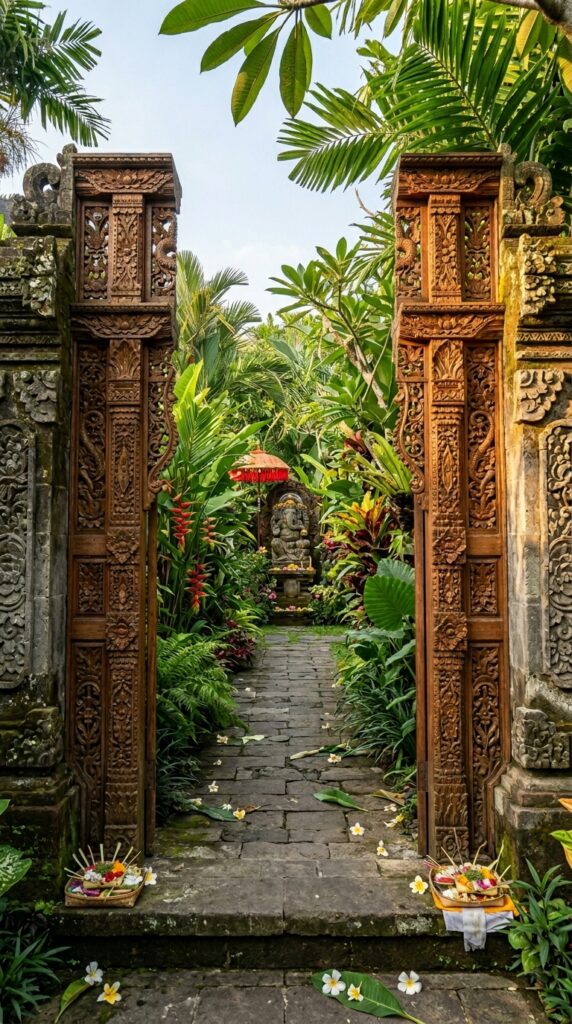
Vibe: The gate reads threshold — passing through it, something shifts, and the garden on the other side belongs to a different set of rules.
Why it works: A Candi Bentar (split gate) entrance is the defining architectural marker of Balinese compound design — the two mirrored halves of a gate that never join at the top represent the spiritual split between the secular world outside and the sacred space within. Even in a non-religious residential context, this spatial marking function is powerful: passing through a defined threshold creates a psychological transition that makes the garden feel like a destination rather than an extension of the house. The carved teak and stone materials of the gate establish the design vocabulary for the entire outdoor space before a single plant or piece of furniture is encountered.
How to get it: Authentic Candi Bentar gate replicas in carved teak are available from Balinese furniture importers in the $800–4,000 range depending on carving complexity and size. A simplified version using two carved wooden posts with a cross-beam can be built from dimensional lumber and decorated with applied teak carved panels ($150–400 from Balinese import sellers on Amazon and Etsy).
💡 Quick Win: Two matching oversized terracotta pots ($35 each) planted with tall bamboo or palms, placed symmetrically at the garden entrance 3–4 feet apart, create a simplified threshold marker that achieves the split-gate spatial effect for under $100.
🛍️ Shop the Look — Amazon Product Ideas
| # | Product Search Phrase | Why It Fits |
| 1 | Carved teak gate panel decorative Balinese | Gate carved detail panel |
| 2 | Carved andesite stone gate post outdoor | Gate structural post |
| 3 | Offering basket flower stand bamboo | Gate base offering element |
| 4 | Oversized terracotta pot 22 inch garden | Budget threshold marker |
| 5 | Bamboo garden screen post 8 foot natural | Gateway screening plant |
24. Balinese Outdoor Bed with Mosquito Net Canopy
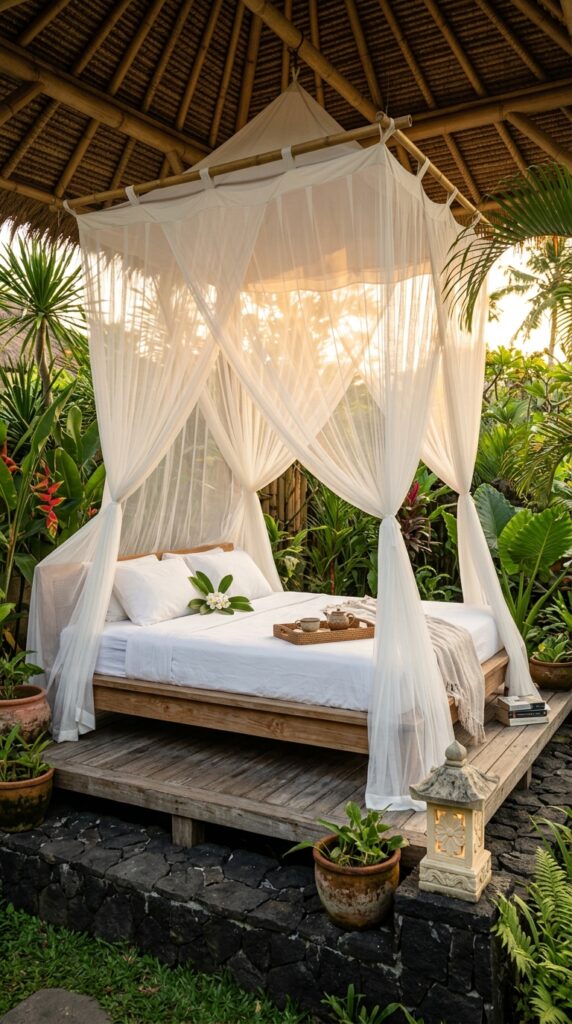
Vibe: The outdoor bed reads dreamed — the mosquito net creating a room inside the garden, silk-thin walls between sleeping and sky.
Why it works: An outdoor bed with a mosquito net canopy is the ultimate expression of the Balinese luxury resort aesthetic — the design principle of permeable enclosure at its most romantic. The sheer white net creates visual privacy (the interior becomes slightly obscured, creating intimacy) while remaining fully transparent to breeze and sound. The canopy’s billowing movement in any breeze creates continuous visual animation that makes the sleeping space feel alive. White sheer fabric against a tropical green and black stone backdrop creates the maximum contrast — the bed reading as a luminous object within a dark, lush surround.
How to get it: Use an outdoor-rated sheer fabric (treated polyester voile or mosquito net fabric with UV resistance) rather than interior sheer curtains, which degrade quickly in sun. Hang from a single ceiling hook using a crown canopy ring (available for $15–25) that fans the net into four quadrants around the bed. Choose a teak outdoor bed frame with a weather-rated outdoor mattress in a quick-dry foam with a removable, machine-washable cover.
🛍️ Shop the Look — Amazon Product Ideas
| # | Product Search Phrase | Why It Fits |
| 1 | Outdoor bed canopy mosquito net white sheer | Net canopy material |
| 2 | Crown canopy ring hook ceiling net hanging | Canopy suspension hardware |
| 3 | Teak outdoor bed frame platform king | Outdoor bed foundation |
| 4 | Quick dry outdoor mattress cover removable | Weatherproof sleeping surface |
| 5 | Frangipani stem artificial tropical decor | Pillow botanical accent |
25. Balinese Offering-Style Outdoor Dining Tablescape
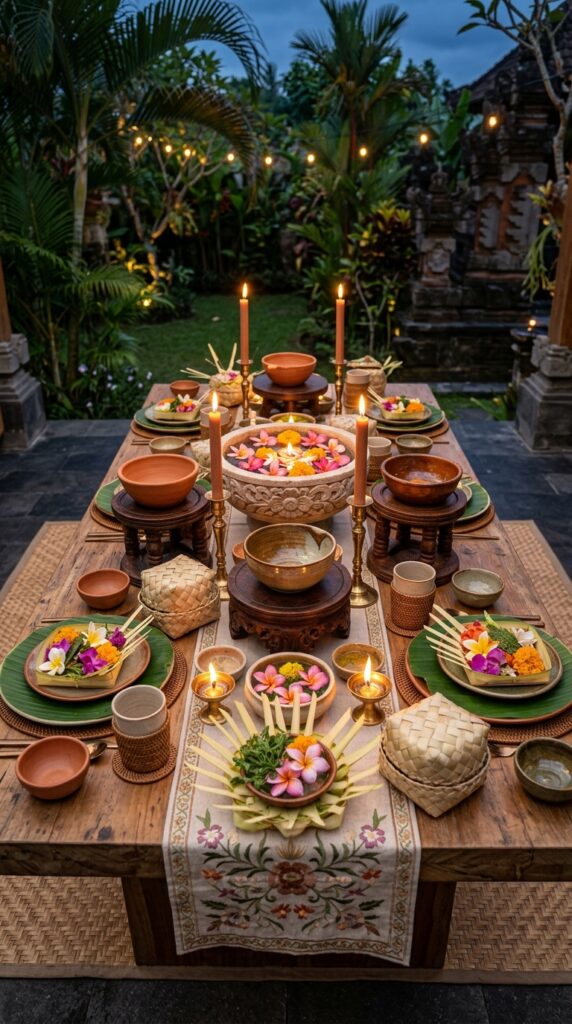
Vibe: The table reads abundant — the kind of setting that makes guests understand immediately that this meal was prepared with genuine intention.
Why it works: A Balinese offering-style tablescape applies the principle of elevation variation as ceremonial abundance — in traditional Balinese temple offerings, food and flowers are presented at multiple heights simultaneously, with the most important offerings elevated on bamboo or carved stands. Translating this principle into outdoor dining table design creates a composition of extraordinary richness from simple, natural materials: banana leaves, ceramic bowls, woven baskets, and floating flowers. The visual complexity of the layered heights means the eye travels continuously across the table surface, discovering new details at every stop — the highest expression of a table set for welcome.
How to get it: Banana leaf placemats are available at Asian grocery stores ($1–2 each) or as preserved banana leaf sheets online. Carved wooden risers or small bamboo pedestals ($8–20 each) placed under select ceramic bowls create the height variation. Floating tea candles in shallow ceramic dishes ($5–15 for a set) distribute along the table length to provide candlelight at table level in addition to the tapers. Woven palm leaf or rattan charger plates ($2–5 each) complete the Balinese base layer.
🛍️ Shop the Look — Amazon Product Ideas
| # | Product Search Phrase | Why It Fits |
| 1 | Banana leaf placemat natural set 6 | Balinese charger layer |
| 2 | Carved wooden riser stand small set | Offering height variation |
| 3 | Rattan charger plate set 6 natural | Woven base plate layer |
| 4 | Floating tea candle ceramic bowl set | Water candle table accent |
| 5 | Woven palm leaf decorative basket small | Offering basket element |
How to Start Your Balinese Inspired Outdoor Transformation
The single most powerful first move is defining your ground plane material — specifically, replacing or overlaying existing concrete or timber decking with black basalt pavers or black lava stone tiles in the primary outdoor zone. The dark volcanic ground plane is the visual foundation that makes every subsequent Balinese element — terracotta pots, carved stone, tropical planting, rattan furniture — read as authentically placed rather than decoratively added. Benjamin Moore’s exterior paint color “Black Beauty” (2128-10) applied to an existing concrete slab as an epoxy floor paint achieves the dark ground plane effect at a fraction of the paving cost as a first-season solution.
The most common beginner mistake is under-planting — purchasing one or two tropical specimens and spacing them too far apart. Balinese gardens achieve their lush, enveloping quality through density: plants at three distinct height layers (tall canopy, mid-story foliage, ground-level creeping plants) installed at close spacing so they overlap and intermingle within one growing season. A common fix is to plant at one-third to one-half the spacing recommended on the plant tag and accept that thinning will be needed in years two and three as the desired density develops.
For under $50: a bundle of dried bamboo stalks tied with black jute twine leaned against an exterior wall ($15), a carved andesite stone garden candle lantern ($28 on Amazon), and a small frangipani cutting in a terracotta pot from a local nursery ($12) immediately signal the complete Balinese material palette in three objects.
A weekend can establish a meditation corner, install bamboo privacy screening, create a torch-lit pathway, and complete a full tablescaping refresh. A complete Balinese outdoor room — bale structure, plunge pool, mature planting, and outdoor bathing — is a 6-month to 2-year project with a realistic total investment of $8,000–$60,000 depending on scope, or $800–3,000 for a high-impact atmospheric version focused on plants, textiles, and portable elements.
Frequently Asked Questions About Balinese Inspired Outdoor Living
What is the difference between Balinese inspired outdoor design and general tropical outdoor style?
Balinese design is philosophically distinct from generic tropical style in that it is rooted in spiritual spatial organization, artisanal material culture, and the specific material palette of Bali’s volcanic landscape. Generic tropical style prioritizes lush planting and resort-leisure furniture; Balinese design adds carved stone deity figures, offering elements, hand-carved teak furniture with relief decoration, black volcanic stone ground planes, and the specific plant species — frangipani, Heliconia, bamboo — that carry cultural meaning in Balinese tradition. The difference is legible: a Balinese outdoor space has a sense of sacred intentionality that tropical-resort style does not.
What plants work best for a Balinese inspired outdoor garden in a non-tropical climate?
The most cold-hardy Balinese-look plants are bamboo (many varieties hardy to zone 5–6), Canna lily (zone 7, overwinters from rhizomes), elephant ear (Colocasia, zone 8, or in containers), banana (Musa basjoo, the hardiest variety, zone 5 in protected sites), and frangipani in containers (overwintered indoors). In zones below 9, grow frangipani, Heliconia, and tropical palms in large terracotta containers and move indoors before the first frost. Bamboo remains the single most accessible Balinese garden plant across the broadest range of climates.
How much does a Balinese inspired outdoor living space cost to create?
A high-impact atmospheric Balinese outdoor space — rattan furniture, bamboo screening, terracotta pot planting, carved stone elements, torch pathway, and rattan lantern lighting — can be achieved for $1,500–4,000 in total investment using imported Balinese decor and standard nursery tropical plants. A mid-range transformation including a prefabricated thatched bale structure, a plunge pool, mature tropical planting, and carved teak dining furniture runs $25,000–55,000. The good news is that the atmospheric effect scales well downward — even $500 in targeted spending on a carved stone figure, bamboo screening, three terracotta pots with tropicals, and rattan lanterns transforms a standard patio meaningfully.
Can Balinese outdoor design work in a cold climate or short-season garden?
Yes, with a container-first strategy and seasonal commitment. Use oversized terracotta or faux-terracotta containers for all tropical specimens so they can be moved indoors in autumn. Build the permanent elements — stone pathways, bamboo structures, a water feature — from frost-hardy materials so they remain in place year-round. Hardy bamboo screening, black basalt pavers, and carved stone elements look equally atmospheric in a winter snowscape as in summer green. Reserve frangipani, Heliconia, and palm trees for container growing, and bring them out as the centerpieces of the space from late spring through early autumn.
What is the most important single element to include for an authentic Balinese outdoor atmosphere?
Water. In Balinese spatial philosophy, water is the element that purifies, cools, and animates a space — without it, even a beautifully planted and furnished outdoor space lacks the sensory completeness of genuine Balinese atmosphere. A tiered stone water feature, a lotus bowl with a small pump, an outdoor shower, or a plunge pool are all valid ways to introduce the water element — even a small tabletop fountain ($35–80) provides the essential auditory signature of moving water that masks urban noise and creates the meditative quality that Balinese outdoor living is built upon.
Ready to Create Your Dream Balinese Inspired Outdoor Living Space?
These 25 Balinese inspired outdoor living ideas span the full range of what makes an outdoor sanctuary sing — from material decisions in carved andesite stone, reclaimed teak, and black volcanic paving, to planting choices in frangipani, bamboo, and tropical abundance, to atmospheric elements like torch-lit pathways, mosquito net outdoor beds, and tiered water features. Beginning with a single carved stone figure, a bamboo screen, and three terracotta pots of tropical planting is not the incomplete version of this design vision — it is the correct starting point, because Balinese gardens are built by accumulation, each element deepening the atmosphere created by the one before. The one thing you can do today: visit a garden center and buy one frangipani in a terracotta pot, place it where you can smell it from your primary outdoor seat, and let that single sensory detail begin the transformation. When the space is fully realized, you will feel what Balinese design has always promised — that the outdoors is not where you go to leave the house, but where the best part of being home actually happens. Save the ideas that made you stop scrolling — especially the ones that felt like somewhere you’ve already been in a dream.