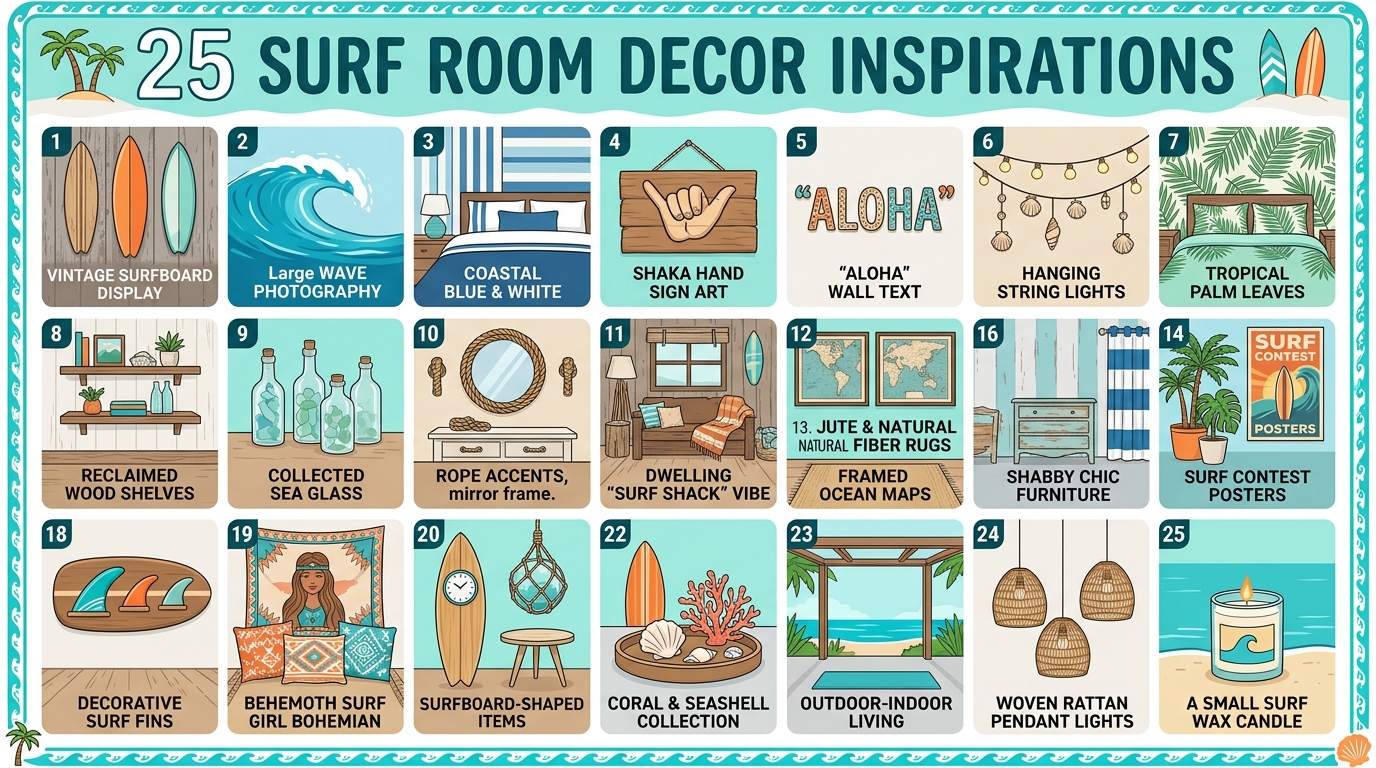
Surf room decor is a design language rooted in the authentic culture of coastal living — sun-bleached wood, salt-worn textures, the particular blue-green of a wave just before it breaks, and the relaxed confidence of a space that has spent time near the ocean. Here are 25 specific inspirations, from material choices to spatial arrangements, to help you build a room that feels genuinely connected to surf culture rather than decorated with its imagery.
There is a looseness to a well-executed surf room — the way a worn linen curtain moves in cross-ventilation, the weight of a shaped board leaning against a whitewashed wall, the smell of coconut wax and cedar that meets you at the door. It is a style that earns its ease rather than performing it. Here are 25 ideas worth saving — and stealing.
Why Surf Room Decor Works So Well
Surf room decor is not beach house styling with a surfboard added — it draws from a specific cultural lineage rooted in 1950s and 60s California and Hawaiian surf culture, filtered through the minimalism of Australian coastal design and the craft-forward sensibility of contemporary surf artisans. Its design ancestors include the board shapers’ workshops of the North Shore, the open-air architecture of Balinese surf camps, and the bleached-wood beach shacks of Malibu. What distinguishes authentic surf aesthetic from generic coastal décor is the presence of actual use and actual craft — shaped objects, worn surfaces, functional tools displayed as art.
The material vocabulary is specific: sun-bleached white oak and driftwood, raw cedar and pine, hemp rope and weathered canvas, rattan and woven seagrass, handblown sea-glass, and the occasional flash of resin — the same material that builds boards. Colour runs from warm white and bone through the full blue-green spectrum of ocean water: pale aqua, deep teal, sea-glass green, and the particular navy of deep water. Earthy accents in warm sand, terracotta, and sun-faded coral reference the beach itself rather than the ocean alone.
The style is resonant right now because it connects to a broader cultural appetite for slow living and outdoor culture — the surf lifestyle’s inherent anti-hustle philosophy aligns with post-pandemic reassessments of how and where people want to spend their time. Pinterest searches for “surf room aesthetic” and “coastal surf decor” have grown significantly since 2021, driven by a generation that grew up watching surf documentaries and now wants to build domestic spaces that hold that same quality of unhurried presence.
Small spaces achieve this style readily because its natural register is already minimal — surf culture prizes the essential over the accumulative. A single wall with a shaped board, a hook for a wetsuit, a woven rug on a timber floor, and a good light is a complete surf room. The editing principle here is simple: if it would not survive a beach shack, it probably does not belong.
| Element | Core Trait 1 | Core Trait 2 |
| Philosophy | Functional honesty | Earned ease |
| Materials | Sun-bleached oak, hemp rope, raw cedar | Rattan, woven seagrass, handblown sea-glass |
| Color palette | Warm white, bone, pale aqua, deep teal | Sea-glass green, warm sand, sun-faded coral |
25 Surf Room Decor Inspirations
1. Surfboard as Wall Art
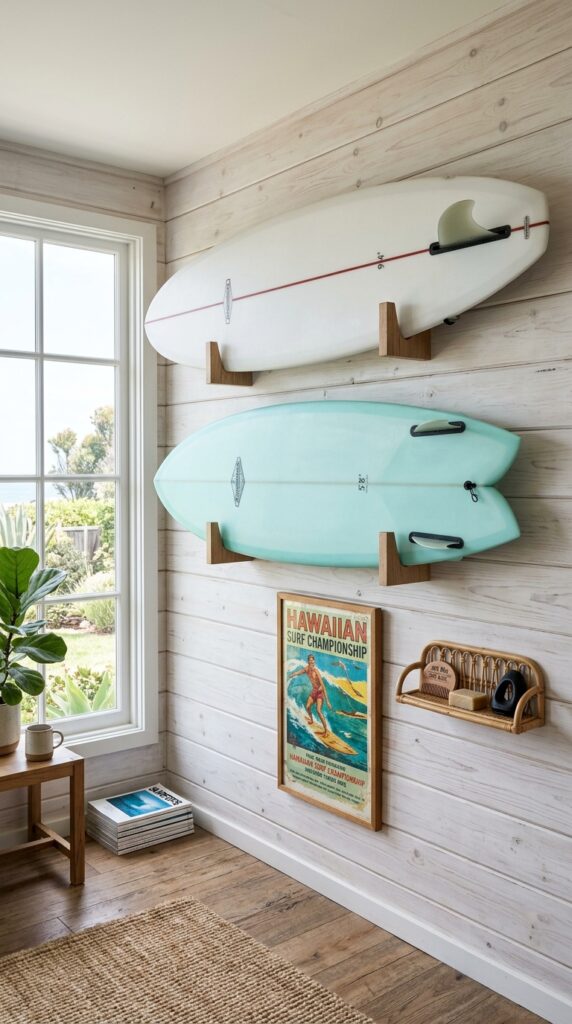
Vibe: Grounded — boards on a wall say someone here actually surfs.
Why it works: Mounted surfboards are the defining art object of surf room decor precisely because they are not art objects — they are functional tools displayed at rest, and that distinction communicates everything about the style’s philosophy. The shaped profile of a well-made surfboard — the rocker, the concave, the rail taper from nose to tail — is genuinely sculptural, and placing two boards of different shapes and tint colours side by side creates a composition with contrast and rhythm that no purchased wall art replicates. The boards should be boards that have been surfed: ding repairs, wax residue, and sun-faded tints are features, not flaws.
How to get it: Mount boards horizontally using purpose-made foam-padded wall brackets — Curve Surfboard Wall Racks are the standard — spaced at one-third and two-thirds of the board’s length. For a 9-foot longboard, mount at 3 feet and 6 feet from the nose. Keep brackets level using a laser level rather than eye measurement — a slightly unlevel board is the most noticeable imperfection in this display type.
💡 Quick Win: A single shortboard mounted on two $18 foam-padded wall brackets at eye-plus-one-foot height (approximately 70 to 75 inches to the centre of the board) on a plain white wall is a complete surf room statement that costs under $50 to install.
Shop the Look
| Product |
| Foam padded surfboard wall rack mount horizontal |
| Vintage surf poster print retro coastal |
| Rattan wall shelf small natural |
| Surf wax comb bar set natural |
| Whitewash wood plank wall paneling |
2. Sun-Bleached Driftwood Feature Wall
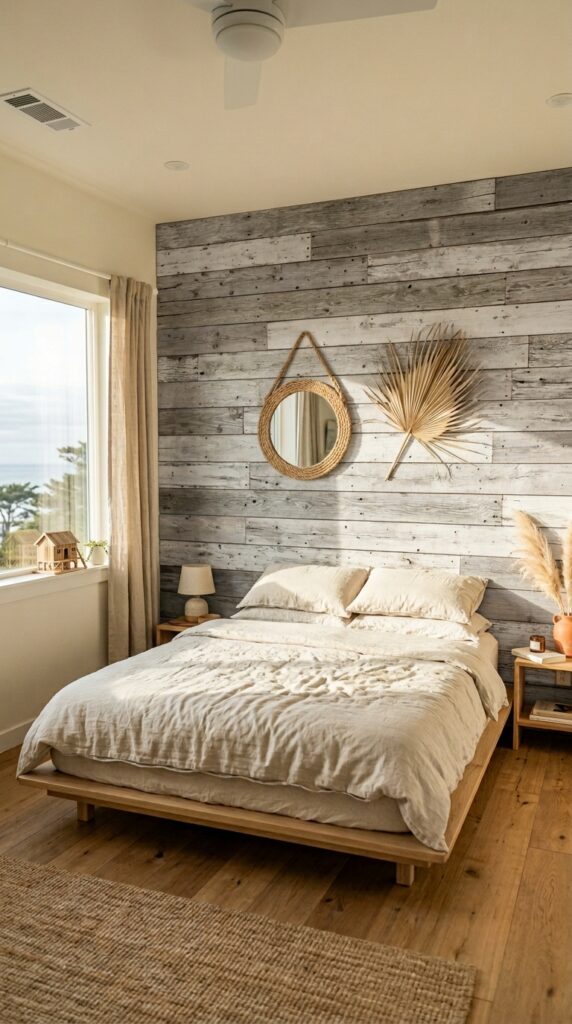
Vibe: Warm — a wall that has absorbed years of coastal weather and carries it lightly.
Why it works: Sun-bleached driftwood planks applied horizontally to a feature wall deliver the authentic weathered-coastal character that no painted wall achieves — the variation in grey-silver tones across individual planks, the visible grain raised by years of salt and UV exposure, and the subtle colour differences between pieces create a surface with genuine depth. Horizontal installation echoes the horizon line and the layered planes of beach and ocean, reinforcing the room’s spatial orientation toward the coast. Behind a low bed, the driftwood wall provides a headboard-scale visual anchor that is materially specific to this style.
How to get it: Source reclaimed grey weathered barn wood or pine planks and leave unsealed — the dry, slightly chalky surface is the quality that reads as driftwood. If sourcing actual beach driftwood, kiln-dry it thoroughly before installation to prevent salt crystallization and moisture issues. Install horizontally with a 1/4-inch gap between boards using consistent spacers.
Shop the Look
| Product |
| Weathered grey wood plank wall panel set |
| Low profile platform bed natural wood minimal |
| Natural bone linen duvet cover set |
| Rope hung round mirror natural braided |
| Dried palm frond tropical decor natural |
3. Ocean Blue and Teal Colour Palette
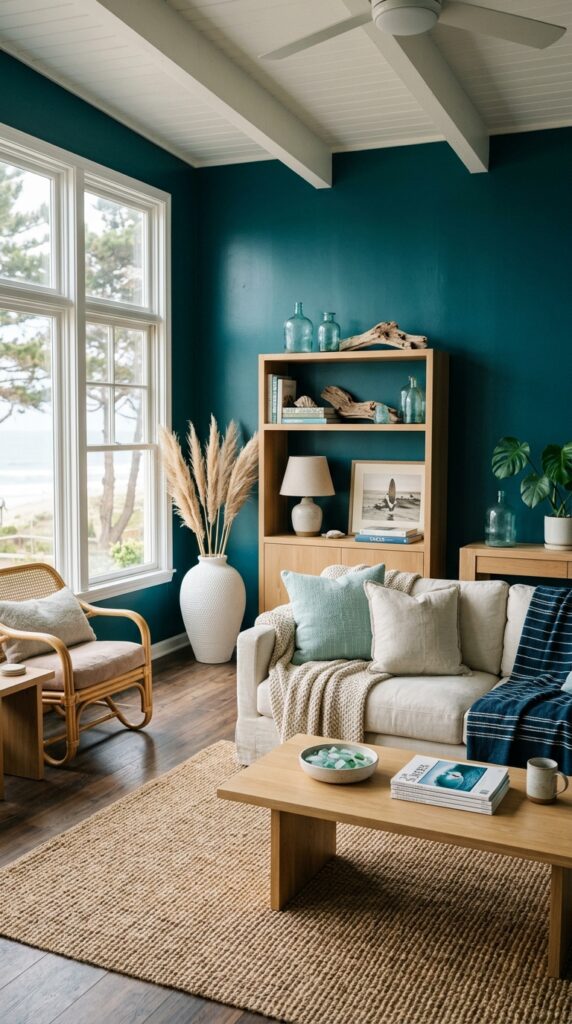
Vibe: Immersive — a room that puts you inside the colour of the ocean.
Why it works: Deep teal walls in a surf room achieve the specific colour experience of being underwater in clear coastal water — a hue that sits between blue and green with enough depth to feel genuinely oceanic rather than decoratively coastal. Farrow & Ball Vardo, or Benjamin Moore’s Teal Ocean, is the benchmark register: saturated but not primary, complex enough to shift from blue-green in morning light to almost grey-green by evening. Against this wall colour, warm white oak furniture and bone linen upholstery create the contrast of beach against sea — the warmth of sand and wood against the depth of water. This is the room’s fundamental colour story made spatial.
How to get it: Apply teal in an eggshell or satin finish rather than flat — the slight sheen reflects the quality of light on water and prevents the deep colour from absorbing too much light in rooms with limited windows. Keep all other surfaces (ceiling, trim, floor) in warm white to prevent the room from feeling overwhelmed by the saturated wall colour.
💡 Quick Win: A single sample pot of Farrow & Ball Vardo or Benjamin Moore Teal Ocean ($10–$18) applied to a full 4×4-foot section of wall and evaluated at multiple times of day is the only reliable way to commit to a teal room. The colour shifts more dramatically than most in changing light.
Shop the Look
| Product |
| Deep teal interior wall paint eggshell finish |
| Handblown sea glass vessel set blue green |
| Pale aqua linen cushion cover set |
| Woven seagrass rug 8×10 natural |
| Large white ceramic floor vase minimal |
4. Vintage Surf Poster Gallery Wall
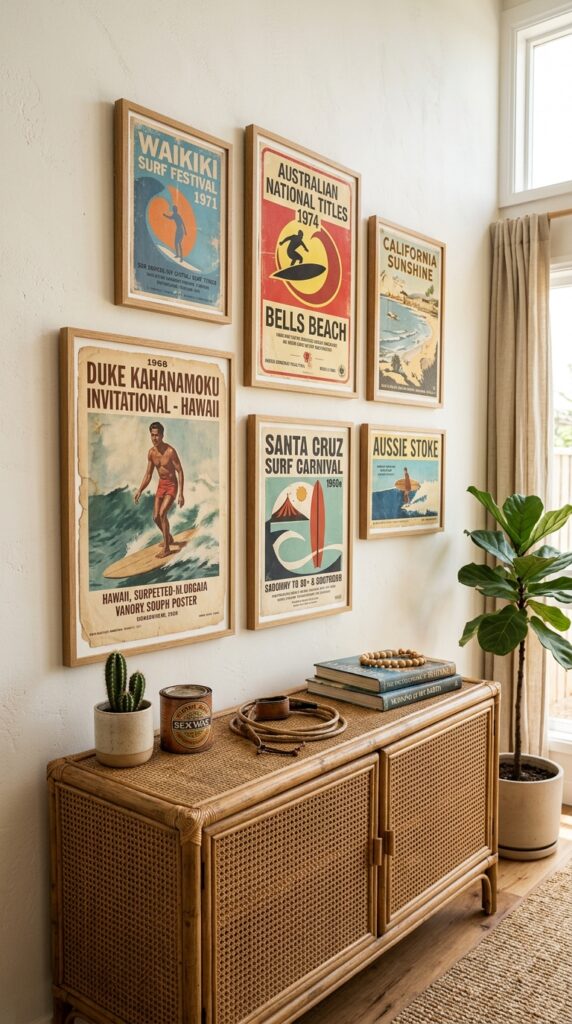
Vibe: Storied — a wall that reads like the stamps in a well-used passport.
Why it works: A vintage surf poster gallery wall works through cultural reference rather than decoration — each poster is a document of a specific moment in surf history, a specific break, a specific competitive era, and the accumulation of several on one wall communicates breadth of knowledge and genuine engagement with the culture rather than surface-level aesthetic. Faded vintage print colours — warm reds, sun-yellowed whites, ocean blues that have lost their saturation to decades of light exposure — hold together as a tonal group even when the individual posters reference very different places and eras. Consistent natural oak frames provide the visual unity that allows the varied poster content to read as a collection.
How to get it: Source vintage surf posters from specialist print dealers, estate sales, or directly from surf brands’ archive collections. Hawaiian IPS (International Professional Surfers) competition posters from the 1970s and 80s, Windansea Surf Club event posters, and Duke Kahanamoku competition prints are among the most visually resolved. Arrange on the floor before mounting, photograph the arrangement, and mount using the photograph as reference.
Shop the Look
| Product |
| Vintage surf poster print set retro Hawaii |
| Thin natural oak picture frame set |
| Rattan console sideboard natural modern |
| Surf wax tin vintage label decor |
| Small cactus succulent indoor plant pot |
5. Wetsuits and Board Shorts as Functional Art
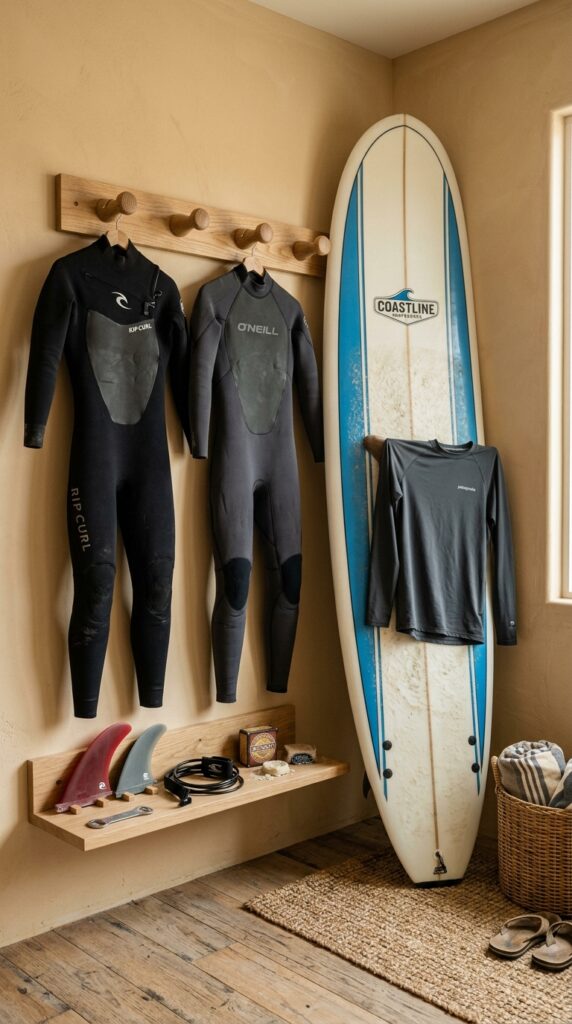
Vibe: Functional — a corner that has earned its organisation through actual use.
Why it works: Displaying surf equipment — wetsuits, fins, leashes, wax — as an intentional entry composition rather than hiding it in a cupboard is the most direct expression of surf room philosophy: functional objects are beautiful, and concealing them is a denial of the lifestyle the room is meant to embody. A peg rail in bleached oak with three to four large turned wood pegs provides the structural armature; the wetsuits’ black neoprene against the pale wood creates a strong graphic contrast. The arrangement should look organised but not sterile — as though it was last used this morning and will be used again tomorrow.
How to get it: Install a 48-inch peg rail at 72 inches height — high enough to clear wetsuit legs from the floor. Use 2-inch diameter turned wood pegs at 10-inch spacing to accommodate neoprene without pinching. Leave a shelf below at 36 inches for fins, wax, and accessories — a single 10-inch-deep pine plank on two raw steel brackets achieves this.
Shop the Look
| Product |
| Wooden peg rail coat hook bleached oak |
| Turned wood wall peg hook large single |
| Raw steel shelf bracket industrial minimal |
| Hemp natural doormat rectangle large |
| Surfboard fin set FCS thruster natural |
6. Rattan and Woven Seagrass Furniture
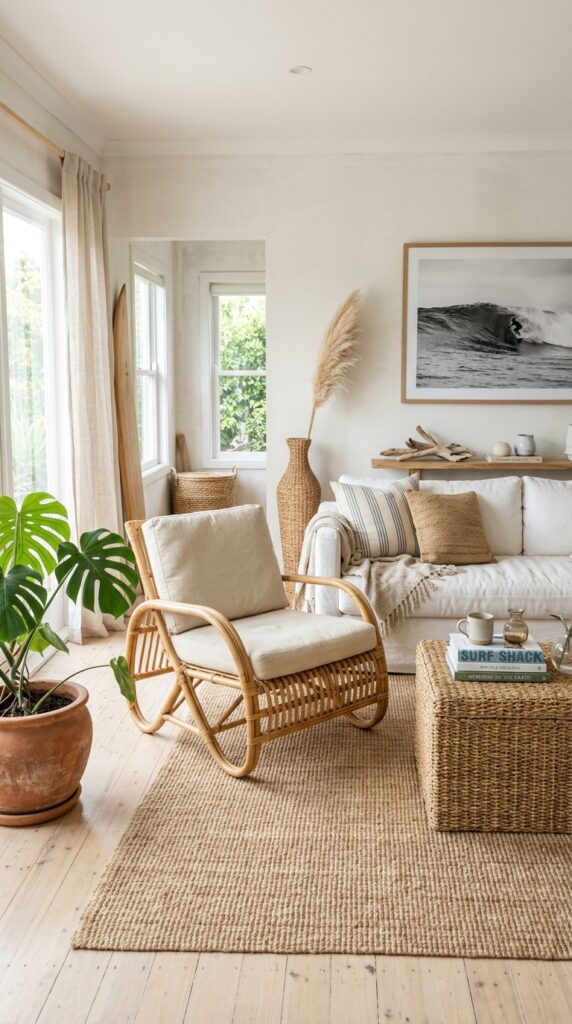
Vibe: Airy — a room that breathes.
Why it works: Rattan and woven seagrass furniture carry the surf aesthetic naturally because their open weave structures reference the fishing baskets, boat nets, and woven grass mats of coastal cultures worldwide — the tactile and visual language of making things from what the coast provides. Rattan’s open construction also allows air to pass through it, which creates a quality of lightness and airiness that upholstered furniture cannot match, and this lightness is fundamental to the surf room’s anti-heaviness philosophy. The combination of rattan chair, seagrass table, and sisal rug layers three different natural-fibre weave textures that read as cohesive because they share the same warm neutral colour family.
How to get it: When sourcing rattan furniture, check the construction quality at the joints — machine-bent rattan with visible seams at corners is less durable and less beautiful than hand-bent rattan with wrapped joint bindings. The binding should be tight and consistent; loose bindings indicate poor craftsmanship that will worsen with use.
Shop the Look
| Product |
| Rattan lounge chair natural cushion indoor |
| Woven seagrass coffee table rectangular |
| Sisal natural area rug 8×10 |
| Monstera plant large indoor terracotta pot |
| Dried pampas grass stem arrangement natural |
7. Sea Glass and Shell Collection Display
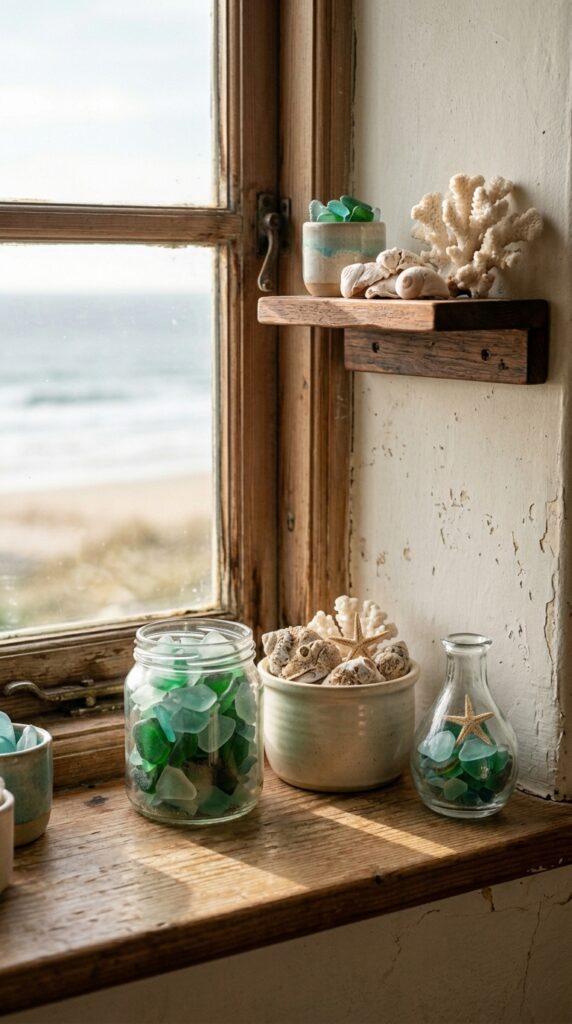
Vibe: Collected — a display built one piece at a time over many beach walks.
Why it works: A sea glass and shell collection display is the most personal possible surf room decoration — it is a direct material record of time spent at the coast, and that biographical quality is what separates it from any purchased decoration. The frosted translucency of sea glass, created by years of sand abrasion on discarded glass, produces a quality of light diffusion that no manufactured glass object replicates: the pieces glow from within when backlit by window light, turning a windowsill into a small light installation. Grouping pieces by colour within small ceramic vessels rather than laying them flat creates height variation and allows the collection to read as curated rather than accumulated.
How to get it: Arrange sea glass and shells in groups of three to five, colour-sorted across separate vessels — all aqua pieces together, all frosted white together, a mixed neutral vessel for sand-toned pieces. Position the collection on a windowsill where it will receive direct low-angle morning or afternoon light for the backlighting effect. Replace or add pieces seasonally as the collection grows.
Shop the Look
| Product |
| Sea glass collection mixed aqua green natural |
| Small ceramic vessel set matte white minimal |
| Natural white shell collection set beach |
| Handblown glass bud vase coastal blue |
| Small floating shelf natural oak simple |
8. Hemp Rope and Macramé Wall Hanging
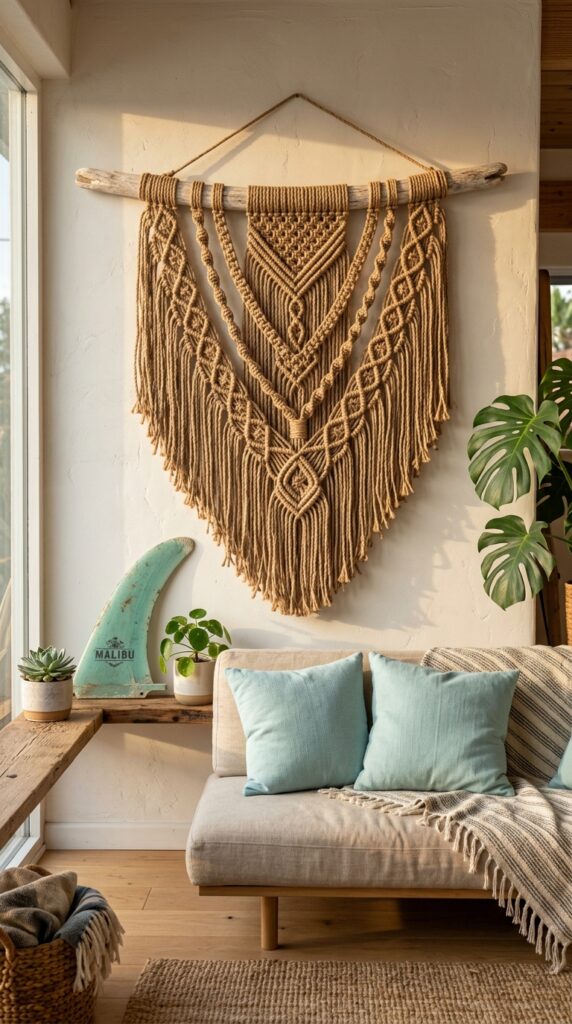
Vibe: Tactile — knotwork that carries the logic of rigging and rope work into the room.
Why it works: Hemp rope macramé belongs in the surf room because it references the actual rope culture of the coast — the mooring lines, sail rigging, fishing nets, and hammocks that are part of coastal and maritime life. Large-scale macramé in 6mm or larger natural hemp reads as structural and confident rather than decorative and delicate, which is the register this style requires. Hung from a bleached driftwood dowel rather than a metal rod, the connection between the hanging and its material heritage is made legible: rope on wood, the same combination used to rig boats for centuries. The knotwork’s shadow pattern at golden hour becomes a secondary visual element.
How to get it: When commissioning or sourcing macramé for a surf room, specify natural undyed hemp or jute rather than cotton — cotton macramé reads as more refined and interior, while hemp’s rougher fibre texture and warm tan colour reads as more genuinely coastal. Scale matters: for a living room wall, the hanging should be at minimum 36 inches wide and 40 inches long to read as architectural.
💡 Quick Win: A 6mm natural hemp rope macramé wall hanging kit — rope, dowel, and instructions — runs $35–$55 online and produces a 30×40 inch hanging in a 4 to 6 hour session. No prior craft experience required for basic square-knot patterns.
Shop the Look
| Product |
| Natural hemp rope macramé wall hanging large |
| 6mm natural hemp rope roll craft knotting |
| Bleached driftwood dowel branch natural |
| Pale aqua linen cushion cover set throw |
| Surfboard fin display stand shelf natural |
9. Warm Sandy Neutral Base Palette
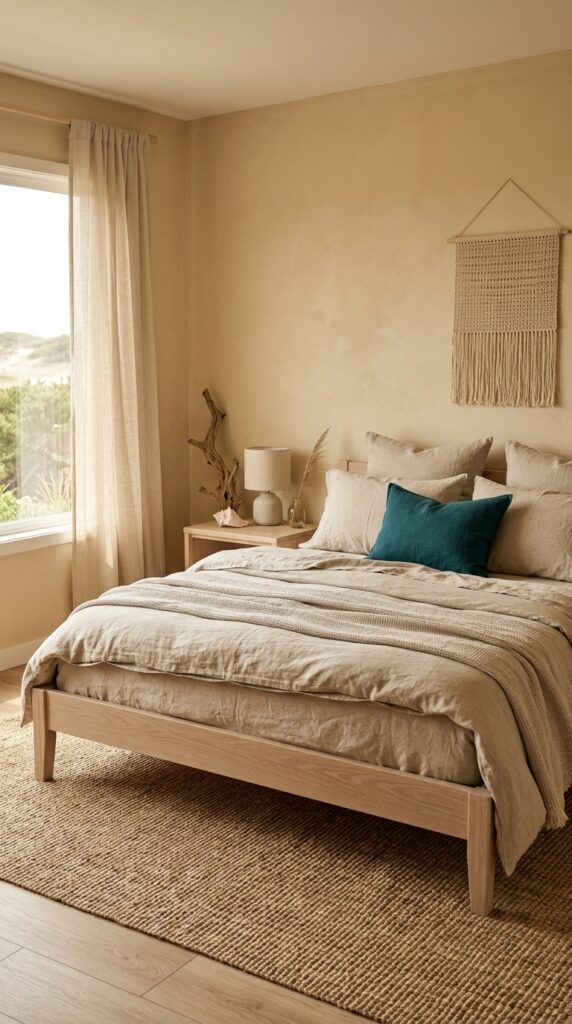
Vibe: Still — the colour of sand between the ocean and the dunes.
Why it works: A warm sandy neutral base palette works in a surf room because it references the literal colour of the coastal environment — the beach itself, the dunes, the bleached timber of boardwalks left in the sun. Warm sand tones (Benjamin Moore Pale Straw, Farrow & Ball Savage Ground, or similar) have a yellow-red undertone that reads as sun-warmed rather than cold or clinical, which gives the room an inherent warmth that needs minimal supplementing. Against this sandy field, a single deep teal or ocean blue accent — one cushion, one vessel, one throw — provides the contrast of ocean seen from the beach, and the pairing is the room’s complete colour story.
How to get it: Commit to the tonal range fully — sand walls, natural linen, bleached oak, seagrass — and resist the urge to add multiple accent colours. The sandy neutral palette only works if it occupies 85 to 90% of the room’s visual field; diluting it with multiple accent colours loses the specific quality of tonal warmth that makes the approach work.
Shop the Look
| Product |
| Warm sand interior wall paint Benjamin Moore |
| Bleached oak bed frame low profile natural |
| Natural flax linen bedding set queen |
| Seagrass bedroom rug natural warm |
| Deep teal linen throw cushion cover |
10. Surfboard Fin Collection on Pegboard
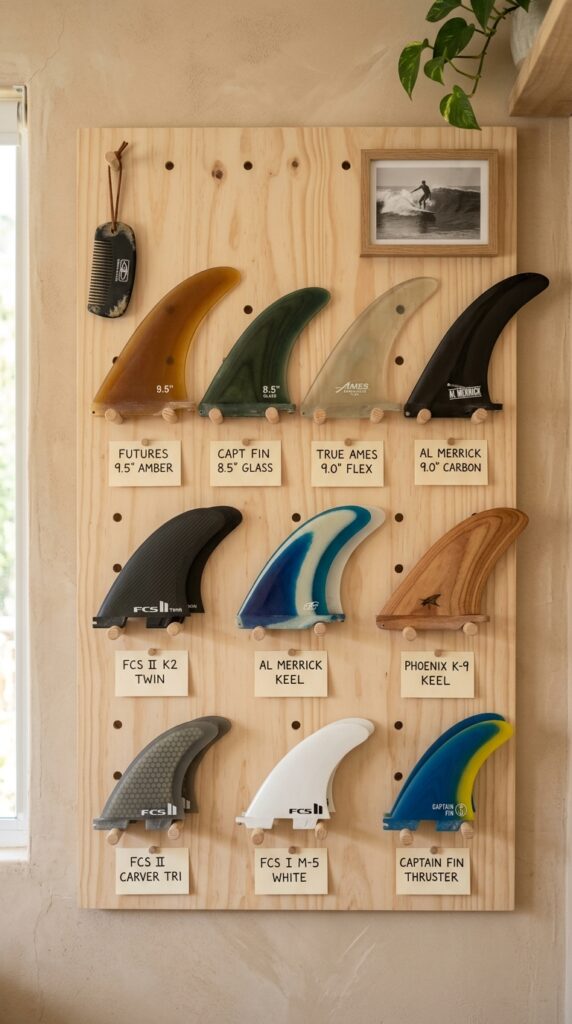
Vibe: Curated — a collection that communicates knowledge before a word is said.
Why it works: A surfboard fin collection displayed as a wall installation occupies the perfect intersection of functional object and sculptural form — fins in fibreglass, glass-on, and carbon fibre have genuinely beautiful profiles, from the upright single fin of classic longboarding to the swept-back cant of a modern thruster set, and displaying them as a collection reveals the design evolution of the form over decades. The pegboard armature provides functional flexibility — fins can be rotated, rearranged, or added to without wall damage — while its bleached pine material sits naturally within the surf room palette. Small handwritten identification labels beneath each set add the museum-display quality that makes the collection read as serious.
How to get it: Mount fins upright using custom-cut foam strips adhered to the pegboard surface — this is the gentlest mounting method for valuable fins and allows easy removal. Cut foam strips to match the fin’s base profile and adhere with a removable adhesive so fins can be swapped in and out of rotation.
Shop the Look
| Product |
| Bleached pine pegboard wall display panel |
| Surfboard fin set display variety fibreglass |
| Pegboard hook set metal small |
| Black and white surf photography print small |
| Foam grip tape strip roll craft mounting |
11. Whitewashed Timber Ceiling
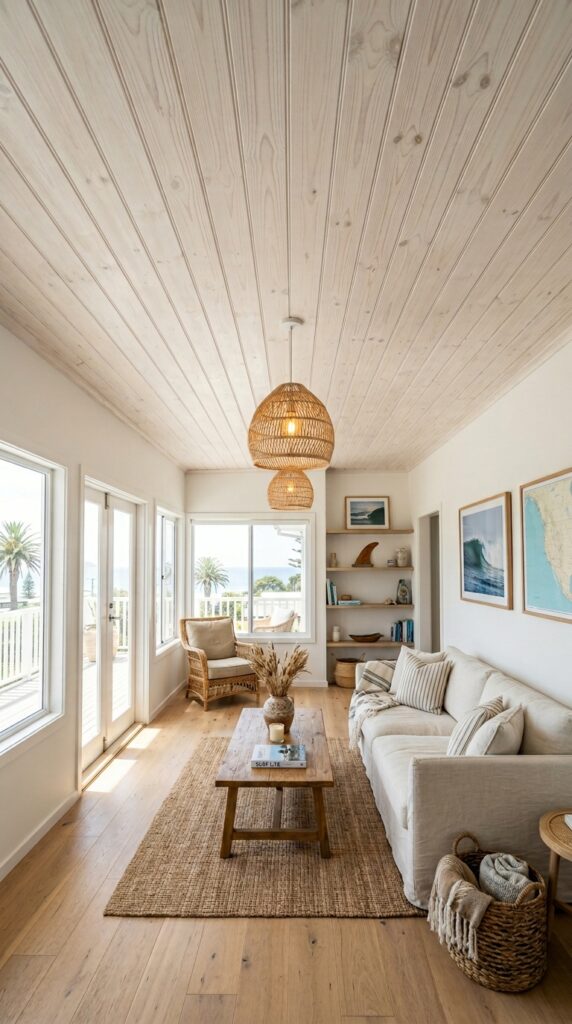
Vibe: Airy — a ceiling that opens the room upward rather than closing it.
Why it works: A whitewashed timber ceiling in a surf room references the underside of a beach house deck, the ceiling of a wooden boat cabin, and the interior of a corrugated iron coastal shed all at once — it carries architectural coastal character through material rather than decoration. The whitewash finish — white paint thinned 50% with water and applied in a single coat, leaving the grain visible beneath — reflects significantly more light than stained or sealed natural timber, making the ceiling function as a reflective surface that bounces natural light back into the room. Running the boards longitudinally (parallel to the longest wall) extends the perceived length of the room.
How to get it: Apply DIY whitewash to existing ceiling boards by mixing Benjamin Moore White Dove or similar flat white with an equal volume of water, applying with a wide brush in the grain direction, and wiping back with a dry cloth before full drying. One coat is correct — two coats loses the grain visibility that makes whitewash distinct from paint.
Shop the Look
| Product |
| Tongue and groove ceiling board pine natural |
| Whitewash wood stain wash interior finish |
| Rattan pendant light shade natural round |
| Blonde oak engineered flooring wide plank |
| White interior wall paint flat finish |
12. Outdoor Shower Aesthetic Brought Indoors
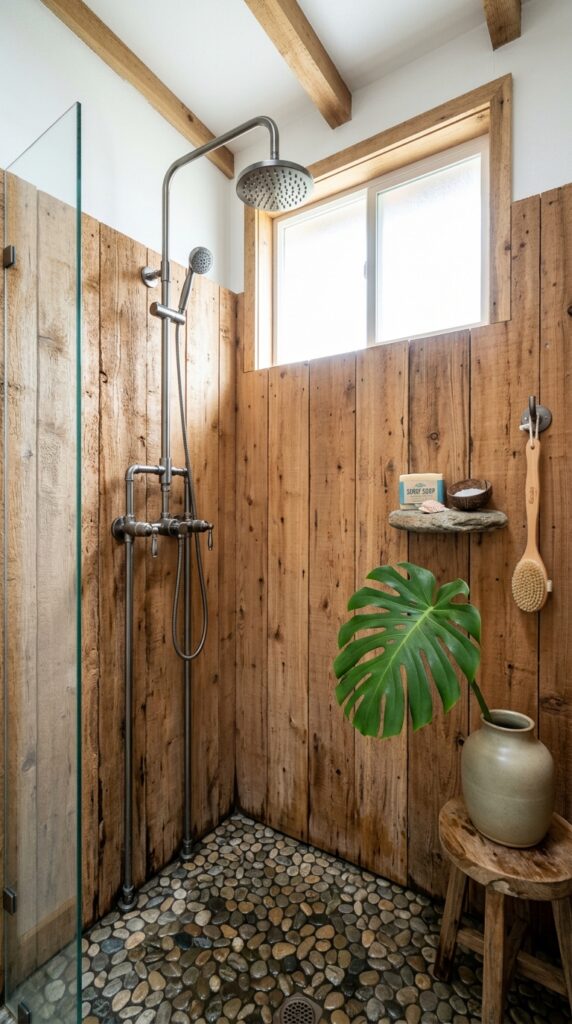
Vibe: Refreshing — the shower feels like rinsing off after a dawn session.
Why it works: An outdoor shower aesthetic brought indoors references the specific rituals of surf life — the post-session rinse, the cold water, the sun on timber — and translates them into a domestic bathroom with raw material choices rather than decorative additions. Rough-sawn vertical cedar boards read as genuinely architectural (cedar is the traditional wood for outdoor showers because of its natural rot resistance) and provide a warm aromatic quality that generic tile walls cannot. The exposed pipe shower fitting in gunmetal is the functional honesty principle applied to plumbing: no concealed pipes, no decorative housing, just the working hardware at its most resolved.
How to get it: Seal rough-sawn cedar bathroom walls with a penetrating oil (Penofin or similar exterior cedar oil) rather than a topcoat varnish — the oil soaks in and preserves the rough surface texture, while a topcoat would fill the grain and produce a plasticky quality. Reapply the oil annually to maintain water resistance.
Shop the Look
| Product |
| Exposed steel pipe shower arm fitting gunmetal |
| River pebble mosaic tile floor bathroom |
| Rough sawn cedar board interior natural |
| Monstera plant small indoor ceramic pot |
| Wooden bath brush natural bristle |
13. Vintage Surfboard Shaping Tools as Wall Display
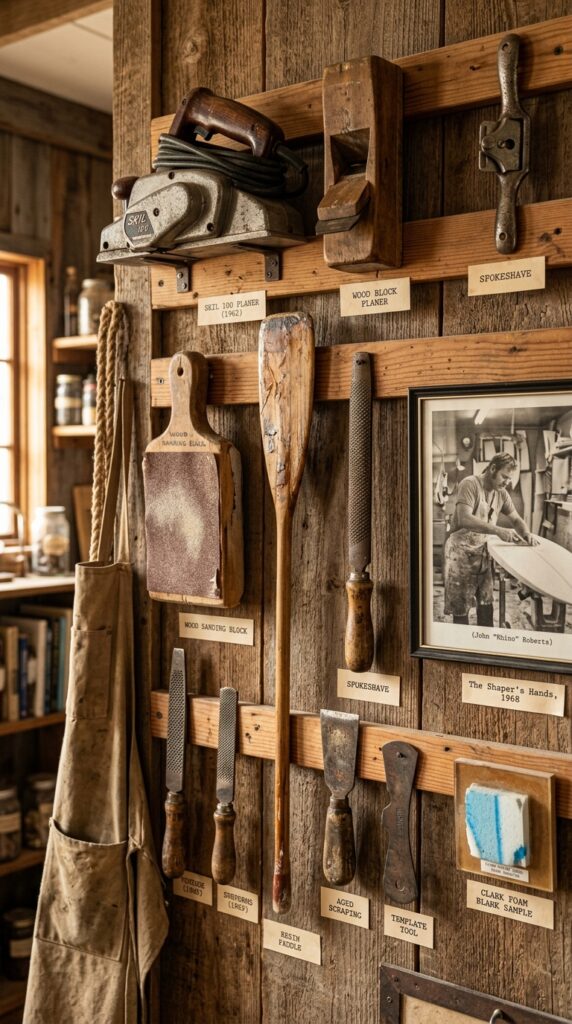
Vibe: Historical — a wall that holds the craft knowledge of surfboard making.
Why it works: Vintage shaping tools as a display communicates the deepest level of engagement with surf culture — beyond riding, into making — and that craft knowledge expressed materially gives a surf room a specificity and seriousness that purely decorative elements cannot. The worn wooden handles, the steel surform blades pitted with resin residue, the sanding block with its compressed cork face — these are objects that carry the history of actual shaping rooms in their surface condition. Mounted on horizontal timber rails on a workshop wall, they read as a craftsman’s tool board rather than a decoration, which is the distinction the style requires.
How to get it: Source vintage shaping tools from surfboard shapers clearing their workshops, from surf memorabilia dealers, or from estate sales in coastal communities. Mount on 2-inch-wide horizontal timber rails using leather straps and copper rivets — the leather and copper provide a third material that bridges tool and display without tipping toward precious.
Shop the Look
| Product |
| Vintage surfboard shaping surform tool set |
| Natural timber mounting rail board display |
| Leather mounting strap small craft |
| Copper rivet fastener set craft |
| Black and white surfboard shaping print |
14. Coastal Plant Styling — Monstera and Bird of Paradise
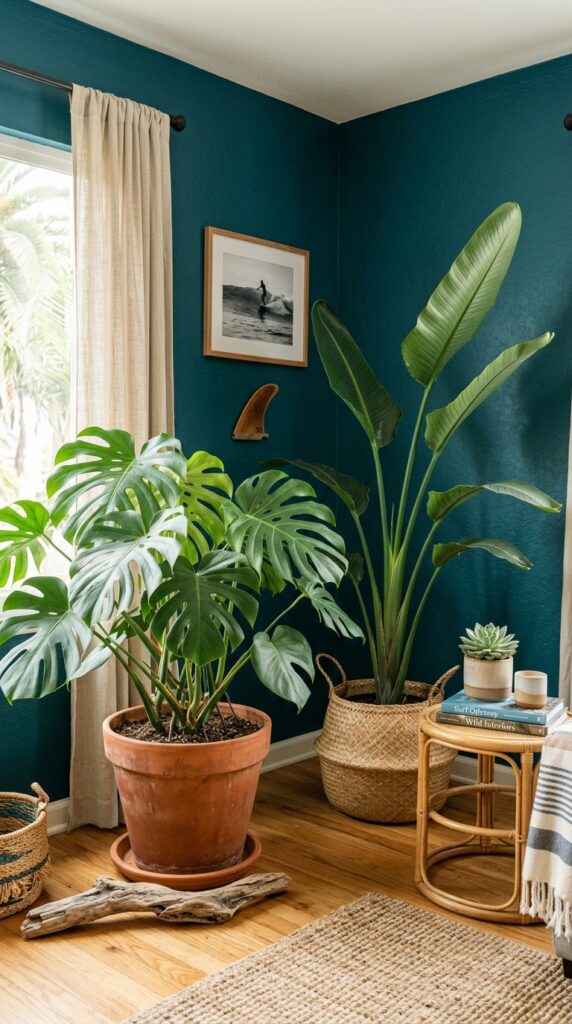
Vibe: Lush — a corner that brings the tropical coast inside.
Why it works: Large-leaf tropical plants — monstera, bird of paradise, split-leaf philodendron — belong in the surf room because they reference the coastal vegetation of the breaks where surfing evolved: the banana trees of Hawaii, the ficus of Bali, the palms of California point breaks. Their large, architectural leaves create silhouettes with genuine sculptural presence, and at 5 to 7 feet the plants occupy vertical space that furniture cannot reach, drawing the eye upward and extending the room’s sense of height. In a terracotta pot and seagrass basket, the planting choices reinforce the natural material vocabulary of the room.
How to get it: Position monstera and bird of paradise within 6 feet of a bright indirect light source — direct sun burns the large leaves. Terracotta pots are the best container choice for these plants in a surf room aesthetic: they allow the roots to breathe, develop a natural salt-bloom patina over time, and their warm orange-red tone is one of the most resonant accent colours in the coastal palette.
Shop the Look
| Product |
| Monstera deliciosa plant large indoor |
| Bird of paradise plant tall indoor |
| Large terracotta plant pot with drainage hole |
| Woven seagrass plant basket pot cover |
| Natural rattan plant stand small |
15. Hammock Chair in the Corner
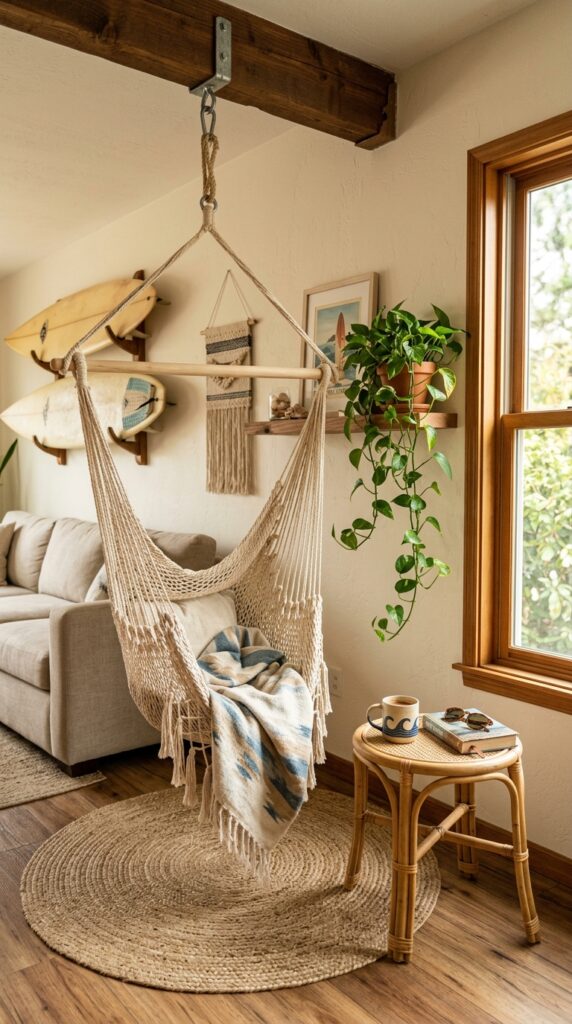
Vibe: Relaxed — a corner that makes no demands on the person in it.
Why it works: A hammock chair is the single piece of furniture that most directly imports the surf lifestyle’s relationship to leisure into a domestic space — it references the between-session hammock, the afternoon nap in the shade, the boat-deck lounge that is fundamental to coastal living culture. Its hanging construction introduces gentle movement into an otherwise static room, and the natural rope material connects it directly to the nautical and coastal material vocabulary. In a corner with a rattan side table and a trailing plant, the hammock chair creates a self-contained relaxation zone that requires nothing except a person and an afternoon.
How to get it: Mount the hammock chair from a single structural ceiling point — find and mark a joist with a stud finder, then install a forged steel ceiling hook rated to at least 300 lbs into the joist centre. Use a hammock hanging kit with a swivel hook to allow the chair to rotate freely without twisting the suspension rope.
💡 Quick Win: A natural cotton rope hammock chair ($45–$85) with a $12 ceiling hook and a $8 s-hook carabiner is the fastest, highest-impact surf lifestyle purchase available — install time is under 20 minutes with a drill and stud finder.
Shop the Look
| Product |
| Natural cotton rope hammock chair hanging |
| Ceiling hook mount forged steel hammock |
| Swivel hook hardware hanging chair |
| Rattan round side table small natural |
| Trailing pothos plant indoor hanging |
16. Wave-Inspired Wall Mural
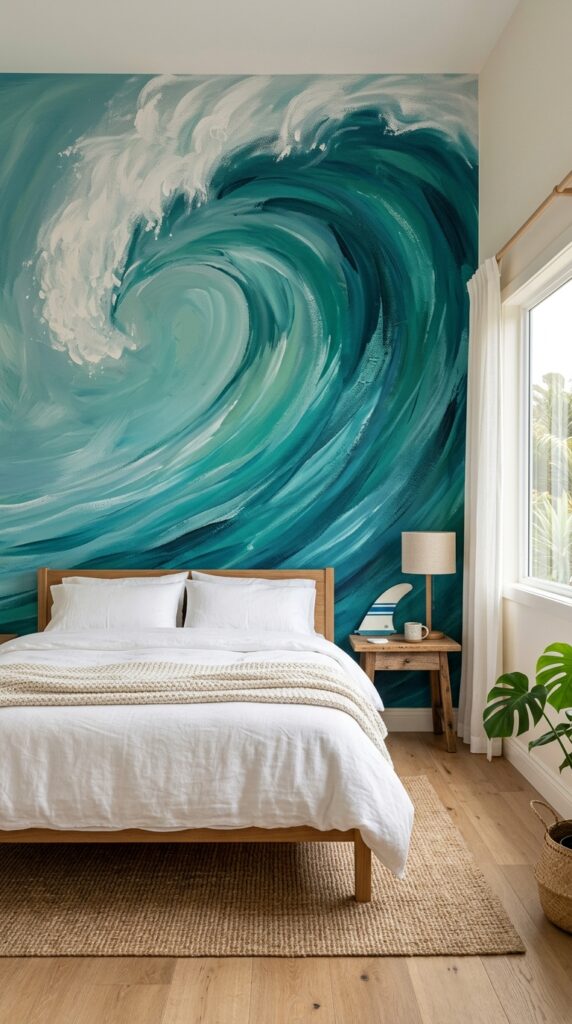
Vibe: Immersive — waking up inside a wave.
Why it works: A wave mural as a bedroom feature wall achieves the surf room ideal of environment rather than decoration — the room does not show a picture of the ocean, it becomes a spatial experience of it. The key is scale and execution: the wave should fill the entire wall from skirting to ceiling without border or frame, so the experience is immersive rather than displayed. Visible brushwork is essential — the gestural quality of a hand-painted mural distinguishes it from a printed wallpaper and communicates that the image was made rather than manufactured. The wave form’s natural movement brings kinetic energy to a sleeping space without the disturbance of pattern.
How to get it: Commission a local mural artist rather than attempting a DIY version for a primary bedroom — search Instagram for mural artists in your city using the hashtag #wavemural or #surfmural. Budget $400–$1,200 for a full wall depending on scale and location. For a DIY approach, use a projector to trace a reference wave image onto the wall in pencil before applying colour.
Shop the Look
| Product |
| Wave wall mural peel and stick removable teal |
| Teal and aqua interior wall paint set |
| White linen bedding set minimal |
| Surfboard fin single display bedside |
| Wide paint brush set mural art large |
17. Natural Fibre Layered Rugs
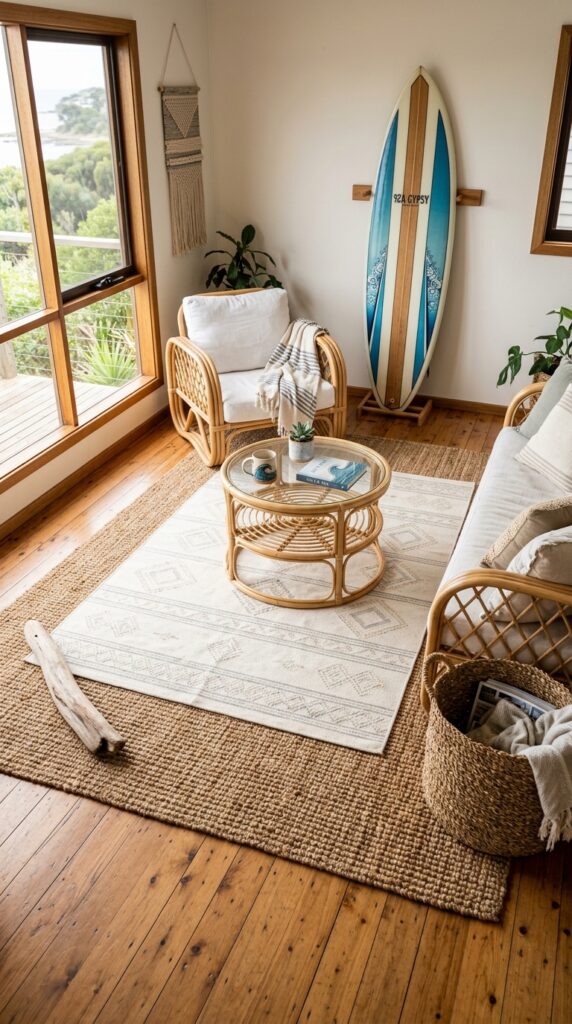
Vibe: Casual — a floor that looks like it has been lived on, not staged.
Why it works: Layering natural fibre rugs in a surf room produces the same casual, accumulated quality that characterises authentic surf spaces — nothing was placed with too much precision, and the slight offset of the top rug over the base reveals both layers as distinct objects with their own character. Jute and seagrass as base layers provide the coarse, honest-material quality of the style, while a bleached cotton or faded kilim rug layered on top introduces pattern and a slightly softer surface zone in the primary seating area. The two-layer system also provides acoustic benefit in timber-floored rooms — essential in loft-style surf spaces.
How to get it: The base rug should extend 12 to 18 inches beyond the furniture group on all sides; the top rug should sit within the furniture’s footprint, offset by approximately 12 inches toward the primary seating. Never centre the top rug perfectly over the base — the slight offset is what reads as casual and natural rather than arranged.
Shop the Look
| Product |
| Large natural jute area rug 9×12 |
| Bleached cotton kilim rug small layering |
| Non-slip rug pad layering floors |
| Driftwood piece decorative natural |
| Seagrass basket storage round natural |
18. Surf Photography Gallery
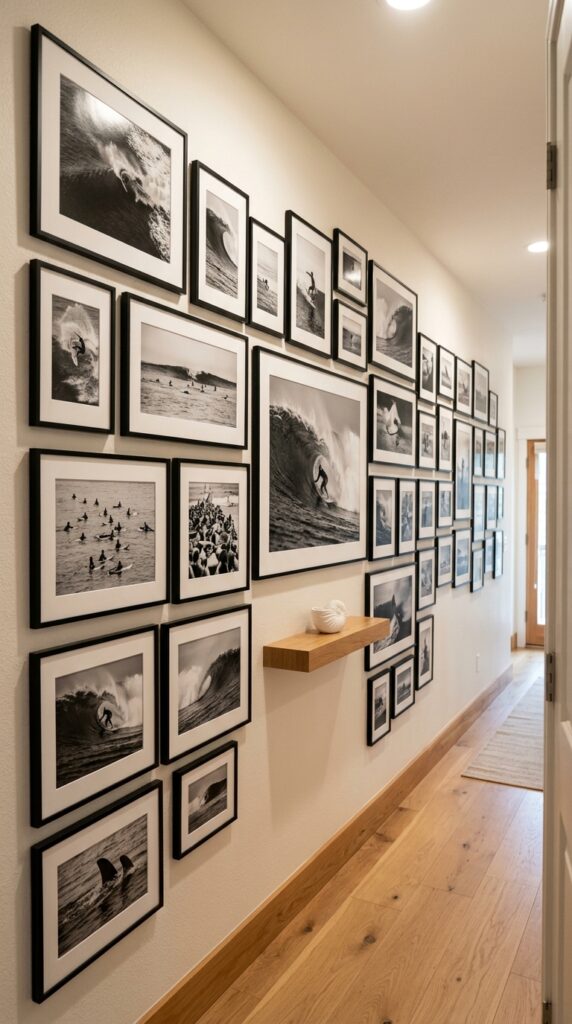
Vibe: Storied — a corridor that takes you through water before you arrive anywhere.
Why it works: Black-and-white surf photography in a gallery hang achieves a specific visual quality that colour photography cannot in this context: monochrome reduces the ocean to pure tonal values — the almost-white foam, the deep black of a tube’s interior, the grey of churned whitewater — and presents it as visual fact rather than colour experience. The salon-style hang (mixed sizes, asymmetrically arranged) references the accumulated quality of a life spent collecting images that matter, building the wall over time rather than purchasing a matching set. In a hallway, the gallery creates an immersive passthrough experience — entering the house is entering the ocean’s visual world.
How to get it: Source surf photography prints from photographers like Chris Burkard, Clark Little, or Ted Grambeau through their online print stores. Mix purchased prints with personal black-and-white prints of your own surf photography — the combination of professional and personal images is more authentic than either alone.
Shop the Look
| Product |
| Thin black picture frame set mixed sizes |
| Black and white surf photography print |
| Natural oak display shelf small wall mount |
| Ceramic shell sculpture decorative white |
| Gallery wall layout planning template |
19. Nautical Rope Accents and Hardware
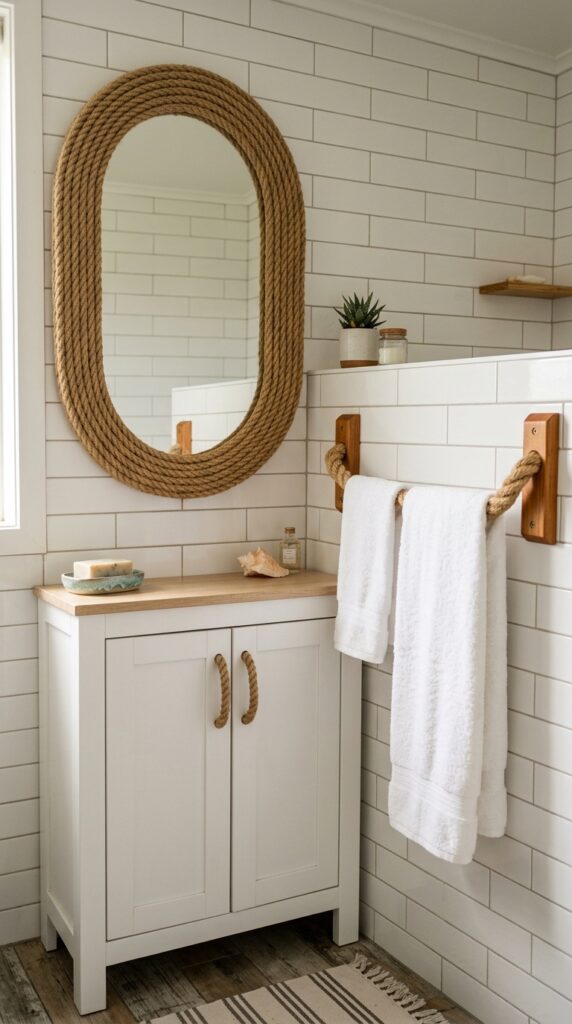
Vibe: Nautical — a bathroom that belongs to someone who knows their knots.
Why it works: Applying natural Manila or hemp rope as a functional accent material in a bathroom — wrapping mirror frames, replacing cabinet hardware, creating towel rails — works in the surf room because it references the actual rope hardware of boats, docks, and fishing vessels rather than decorative maritime theming. The rope is doing actual work in each application: holding the mirror frame, pulling open the cabinet, suspending the towels — and that functional honesty is what distinguishes nautical reference from nautical kitsch. Manila rope’s warm tan colour provides a natural material contrast to white subway tile that is warmer and more organic than any metal hardware.
How to get it: Wrap mirror frames with 12mm Manila rope using marine-grade adhesive applied to the frame backing — start and end the wrap at the bottom of the frame where the join is least visible. Secure the final wrap with a two-part epoxy at the join. For towel rails, use a figure-eight wrap around two wooden cleats mounted at the correct spacing — the standard nautical method that requires no additional hardware.
Shop the Look
| Product |
| Natural Manila rope roll 12mm craft |
| Rope wrapped bathroom mirror round natural |
| Wood nautical cleat hook wall mount |
| Sea foam ceramic soap dish bathroom |
| White cotton bath towel set thick |
20. Open-Air Flow — Curtains Instead of Doors
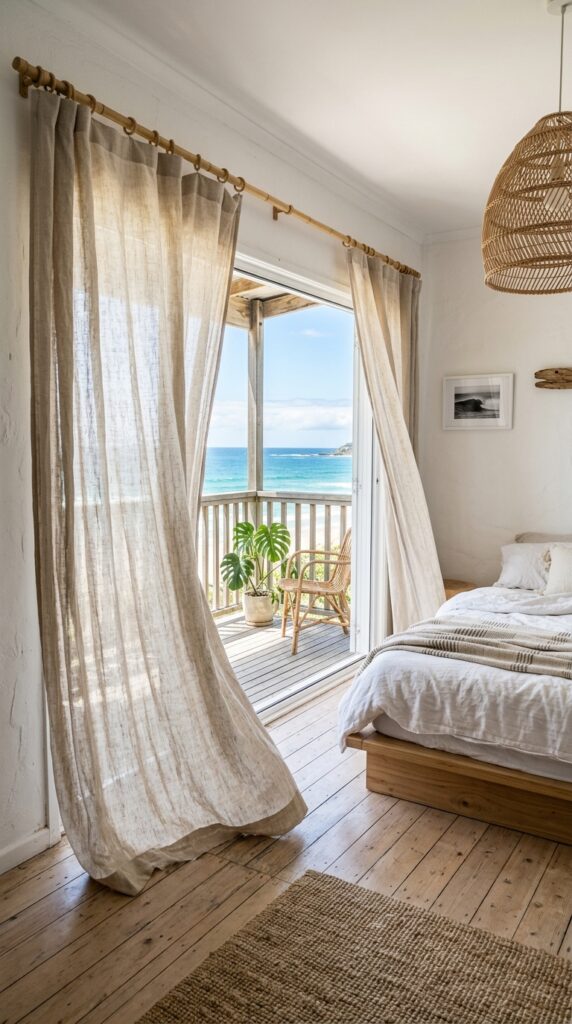
Vibe: Airy — the boundary between inside and outside dissolves.
Why it works: Heavy linen curtain panels used in place of or in front of glass doors dissolve the boundary between interior and exterior in a way that glass never does — they allow air, sound, and the suggestion of movement to pass between spaces, which is the fundamental spatial quality of coastal living architecture. The billowing of undyed linen in cross-ventilation is one of the most evocative domestic sensations possible, and it is entirely consistent with the surf room’s commitment to the felt experience of the coast rather than its visual representation. Floor-to-ceiling linen panels also dramatically increase the perceived height of any room.
How to get it: Use a linen fabric weight of at least 300g per square metre for curtain panels — lighter linen does not billow well and does not hang with the gravity that makes this look work. Mount the rod as close to the ceiling as possible (within 2 inches) and cut panels to pool on the floor by approximately 3 inches — the pooling reinforces the soft, unhurried quality of the effect.
Shop the Look
| Product |
| Natural undyed linen curtain panel set floor length |
| Bamboo curtain rod natural minimal |
| Linen curtain rod ring set natural |
| Rattan pendant light shade dome |
| Bare timber floor wax seal matte |
21. Compact Surf Room — Apartment Adaptation
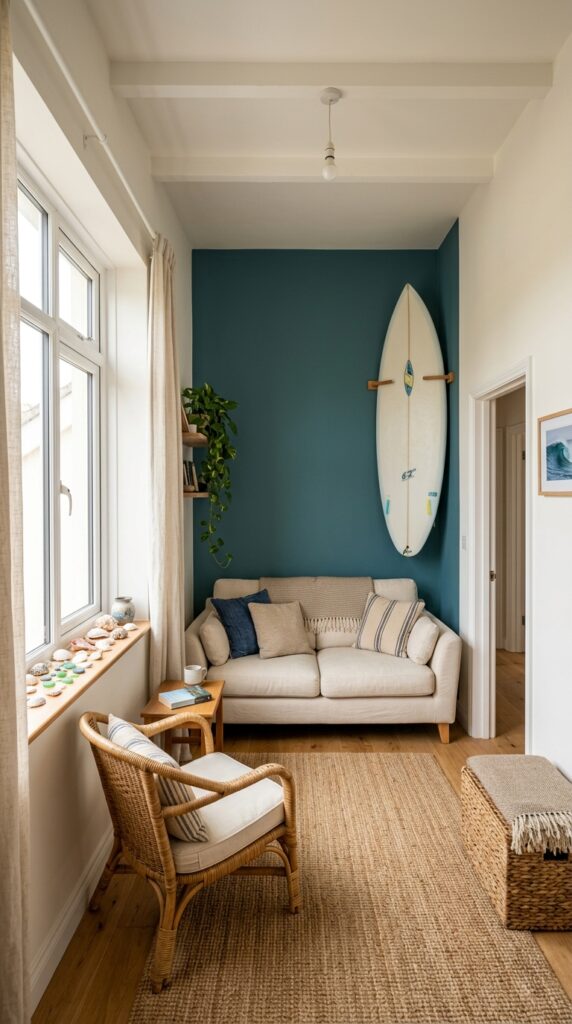
Vibe: Warm — a small room that commits to one idea and executes it with confidence.
Why it works: In a compact apartment, the surf room approach requires selecting one anchor element and allowing it to carry the full identity of the space — everything else in the room recedes into neutral support. A single mounted board in a corner (vertical mounting requires only 3 inches of width but creates a strong vertical accent), one teal accent wall, and a shell collection on the windowsill is the complete surf room expression for a small apartment. The discipline of choosing one of each — one board, one accent colour, one natural collection — is what makes the small-space version read as intentional rather than compromised.
How to get it: Mount a shortboard vertically in a corner using a single padded wall bracket at the board’s balance point (approximately 24 inches from the tail) — the tail rests on a small foam floor pad and the wall bracket holds the upper half. This uses the corner as the second structural support and requires only one wall anchor.
💡 Quick Win: A single shortboard mounted vertically in a corner, a teal throw pillow on an existing sofa, and a handful of shells on a windowsill is a complete small-apartment surf room transformation achievable for under $40 in new purchases (assuming you own a board).
Shop the Look
| Product |
| Vertical surfboard wall mount single bracket |
| Teal accent throw pillow cover set |
| Shell collection assorted natural white |
| Small compact rattan armchair indoor |
| Woven storage basket round natural |
22. Driftwood Lamp and Organic Lighting
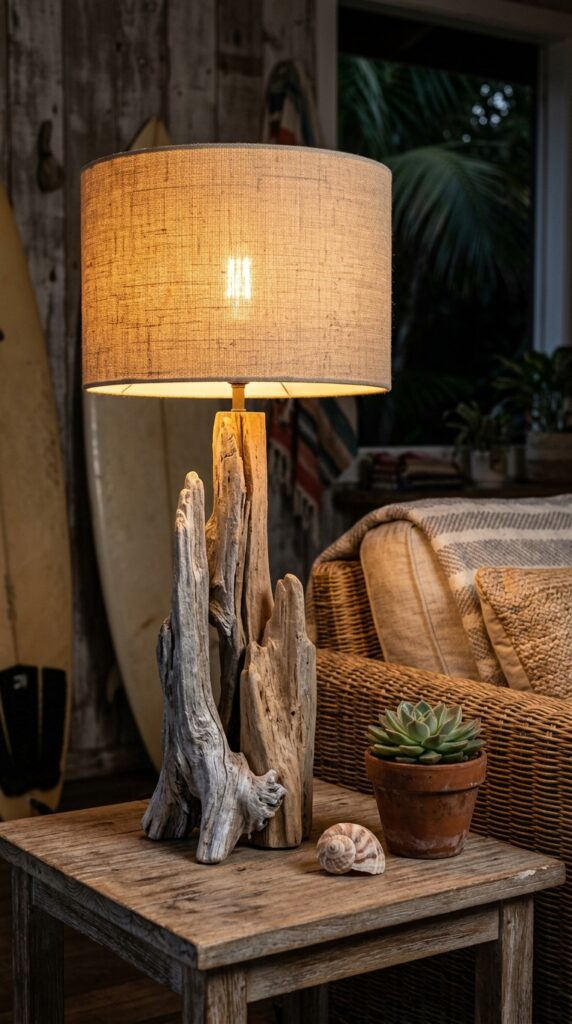
Vibe: Organic — a light source that grew rather than being manufactured.
Why it works: A driftwood lamp base is the most materially specific lighting choice for a surf room — the sculptural irregularity of the driftwood form, its grey-silver weathered surface, and its literal origin in coastal waterways make it an object with both aesthetic and biographical resonance. No two driftwood lamps are identical, and that uniqueness is the point: a driftwood lamp communicates a relationship to the coast that is personal and accumulated rather than purchased. The natural linen drum shade complements the organic base form without competing with it, and the warm amber light it produces is the room’s evening atmosphere in a single object.
How to get it: DIY driftwood lamps are fully achievable: purchase a lamp cord kit with inline switch ($15–$22), drill a vertical hole through the length of a suitable driftwood piece using a long spade bit, thread the cord through, and add a harp and shade attachment at the top. The drilling takes 10 minutes; the entire lamp can be made in an afternoon.
Shop the Look
| Product |
| Driftwood table lamp base natural coastal |
| Natural linen drum lamp shade modern |
| Lamp cord kit inline switch DIY |
| Small succulent plant terracotta pot |
| Bleached oak side table minimal round |
23. Retro Surf Culture — 70s Colour and Pattern
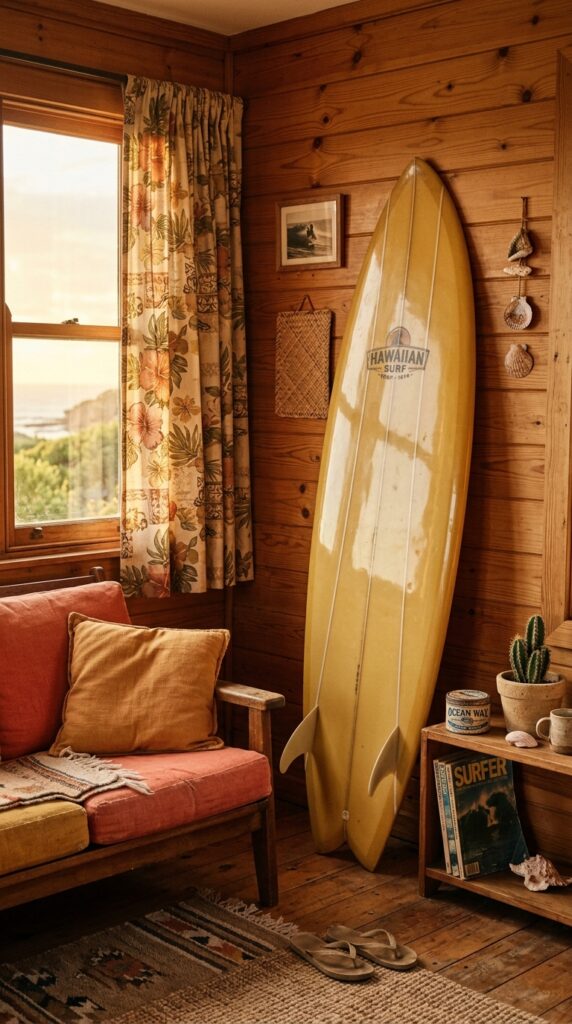
Vibe: Nostalgic — a room that belongs to the golden age of surfing culture.
Why it works: 1970s surf culture colour — sun-faded coral, warm mustard, avocado, and the warm yellows of resin-tinted boards from that era — provides a specific nostalgic register that references the cultural peak of surf’s mainstream emergence. The key to avoiding kitsch is the “sun-faded” quality: all colours should read as slightly desaturated, as though they have spent years in coastal UV exposure. A single vintage Hawaiian print panel — hibiscus or tapa-inspired, in muted warm tones — introduces pattern in the context of the era rather than as a decorative gesture, and the warm pine wall panelling references the Californian beach house interiors of the period directly.
How to get it: Source vintage Hawaiian fabric panels from estate sales or vintage fabric dealers online. Dry-clean any purchased vintage fabric before use — salt and humidity create conditions in coastal storage that standard washing addresses poorly. Hang as a single panel rather than making full curtains; the graphic quality of one panel is more considered than the repetition of a pair.
Shop the Look
| Product |
| Vintage Hawaiian fabric print panel warm |
| Sun-faded coral throw cushion set vintage |
| Pine wood wall panelling warm tone |
| Retro surf wax tin vintage design |
| Old surf magazine collection 1970s print |
24. Surf Book Library — Coffee Table Stack
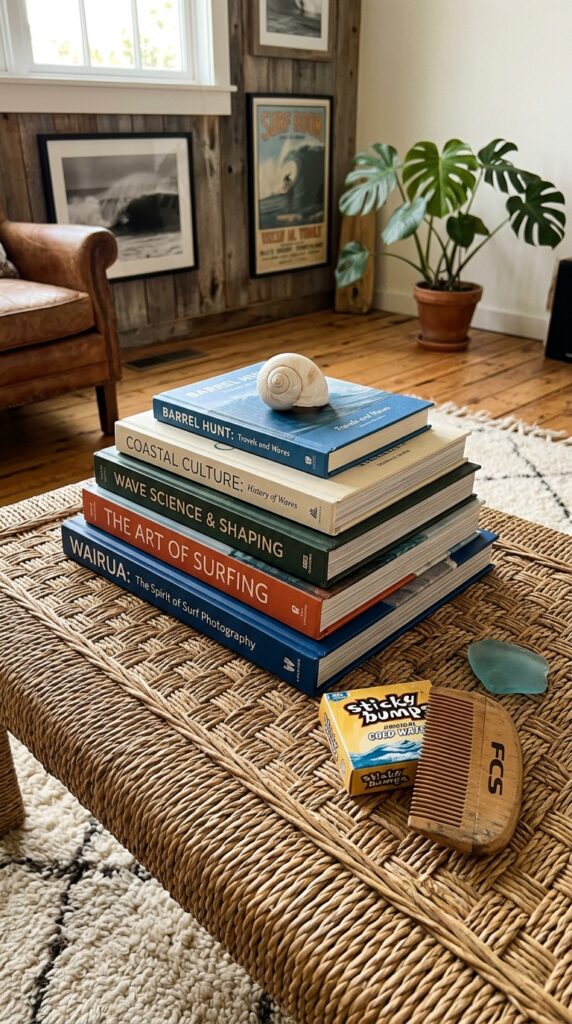
Vibe: Considered — books chosen and read, not purchased for their spines.
Why it works: A curated surf book stack on a coffee table communicates intellectual engagement with surf culture in a way that decorative objects alone cannot — books have titles and authors that are visible, and visible titles on a coffee table are a statement of values and interests. A stack of five large-format books in the coffee table composition follows the same rule as all surf room styling: the objects should be things that are actually used and actually valued. The small shell placed on top of the stack is the compositional full stop — a natural object closing the arrangement with an organic irregularity that a purely book-based stack would lack.
How to get it: The five most visually and intellectually considered surf titles for this display: The History of Surfing by Matt Warshaw (Chronicle Books), Surf Is Where You Find It by Gerry Lopez, Surfboard by Harry Knight, Beautiful Wetlands by Chris Burkard, and any volume of The Surfer’s Journal magazine in hardcover edition. Stack largest format at the base.
Shop the Look
| Product |
| Large format surf culture photography book |
| Surf history coffee table book hardcover |
| White decorative shell single large |
| Surf wax bar coconut natural |
| Surf wax comb scraper tool |
25. Dawn Patrol Bedroom — Early Start Energy
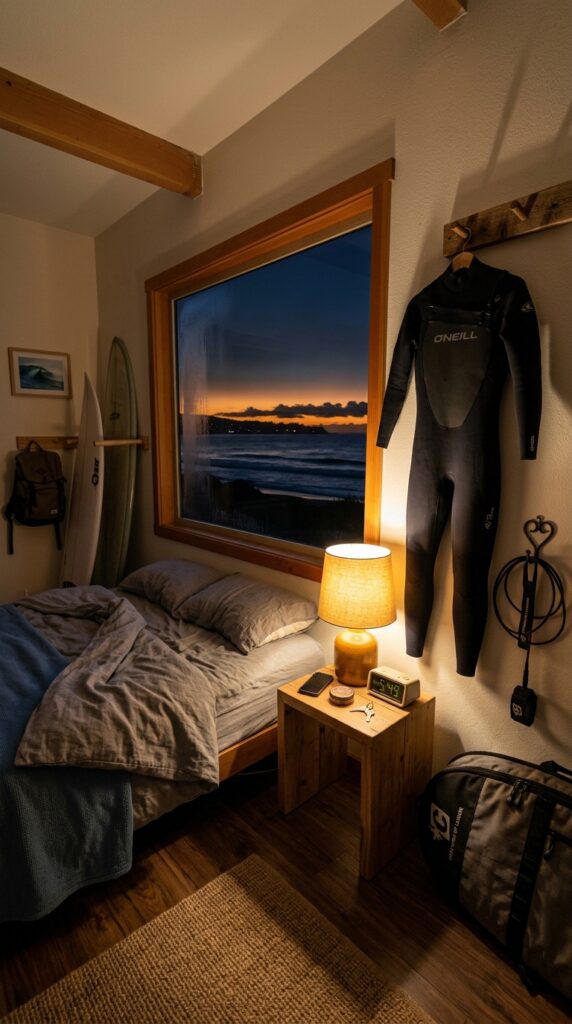
Vibe: Anticipatory — a room organised around the discipline of the early start.
Why it works: The dawn patrol bedroom concept designs the room around a specific surf lifestyle ritual — the pre-dawn wakeup, the wordless efficiency of gear check, the drive to the break in darkness — and makes that ritual the room’s organising principle. Everything in the room is positioned for the morning departure: wetsuit accessible, leash on a hook, board bag visible, nothing between the bed and the door. The window framing the pre-dawn horizon is the room’s focal point and its reason for being — the entire room exists in orientation toward the coming swell. This is the surf room’s most distilled philosophical expression: the space is in service of the act.
How to get it: Position the bed facing the primary window rather than the door — the surfer should see the sky before they see the room. Mount a simple peg rail beside the door at exit height (72 inches) for the wetsuit. Keep the bedside table to one object only: the alarm set for the swell window. Everything else in the room supports this one function.
Shop the Look
| Product |
| Wooden peg hook single wall mount natural |
| Surfboard leash coil holder hook wall |
| Minimal alarm clock analogue bedside |
| Board bag surfboard travel bag |
| Warm bedside table lamp small natural |
How to Start Your Surf Room Transformation
Start with one material decision: replace your standard ceiling light with a rattan pendant shade. This single fixture change shifts the entire room’s material register toward the natural, coastal, and handmade — rattan diffuses light warmly and casts a subtle woven shadow pattern on the ceiling that no manufactured shade replicates. Once the light source has changed, the room begins to communicate its new direction even before a single other element is adjusted, and every subsequent decision becomes easier to align with the style.
The most common mistake is adding surf imagery without surf materials — hanging a wave print on a wall painted in standard magnolia, on furniture bought from a generic home store, with synthetic carpeting underfoot. The print reads as decoration in the wrong room rather than as part of a coherent environment. The fix is material substitution before decoration: replace one synthetic textile with a natural one, add one piece of rattan or seagrass, change the light source to warm amber — then the wave print belongs.
Three specific items under $50 that create immediate surf room impact: a natural 6mm hemp rope macramé wall hanging kit ($35–$45), which can be completed in one evening and immediately installs an authentic material statement on any wall; a bag of assorted sea glass ($12–$18 for a mixed aqua and green collection), which grouped in a clear glass bowl on a windowsill creates the coast’s most characteristic light effect; and a warm 2200K Edison bulb replacement set ($14–$22 for four bulbs), which shifts the room’s entire evening light temperature toward the amber warmth of golden hour on the beach.
A starter surf room transformation — new lighting, one natural textile swap, one mounted board, and a botanical corner — runs $200–$500 and takes one committed weekend. A full room transformation including wall treatment (whitewash or driftwood cladding), furniture replacement to rattan and natural fibre, and a curated board display runs $2,500–$6,000 and takes two to three months of sourcing and installation. Patience in sourcing — waiting for the right vintage poster, the right driftwood lamp, the right shaped board to hang — always produces a space that reads as accumulated and authentic rather than purchased and installed.
Frequently Asked Questions About Surf Room Decor
What is the difference between surf room decor and general coastal or beach house styling?
Surf room decor is specifically rooted in surf culture — its tools (shaped boards, fins, wax), its craft heritage (shaping rooms, board design evolution), its geographic specificity (Hawaii, California, Australia, Bali), and its lifestyle philosophy of earned ease and functional honesty. General coastal or beach house styling uses nautical and marine motifs — anchors, lighthouses, rope, shells — decoratively without reference to a specific lived culture. The clearest distinction: a surf room displays actual surfboards, actual surf tools, and actual surf culture documents (posters, photography, books) as objects of genuine significance. A coastal room uses maritime imagery as decoration.
What colours work best for a surf room palette?
The most considered surf room palette works in three tonal layers. The base layer is warm sand and bone — Benjamin Moore Pale Straw, Farrow & Ball Savage Ground, or natural linen — covering 60 to 70% of the room’s surfaces. The mid layer is ocean-referenced colour — deep teal (Farrow & Ball Vardo), sea-glass aqua, or warm ocean blue — covering 20 to 30% as wall colour or large textile. The accent layer is either terracotta and warm coral (referencing the beach and sunset) or the natural colours of the materials themselves — driftwood silver-grey, rattan tan, hemp cream — covering the remaining 10%. Avoid bright turquoise or primary blue — they read as generic coastal rather than surf-specific.
How do I display a surfboard in a small apartment without it overwhelming the room?
Vertical mounting is the small-apartment solution: a shortboard mounted vertically in a corner using a single padded wall bracket occupies only 3 inches of wall width while providing a strong vertical accent that reads as intentional rather than storage. The key is corner placement — the corner provides a natural structural cradle that makes the board appear placed rather than leaning. A 5-foot-6 to 6-foot shortboard is the ideal apartment-scale board for vertical display; a longboard at 9 feet reads as overwhelming in rooms under 2.7 metres ceiling height. Alternatively, a single board mounted horizontally as the room’s primary wall art piece — positioned at the height of a large canvas painting — works in living rooms with a clear 10-foot-wide wall.
Can surf room decor work in a landlocked location, far from the coast?
The surf room’s material language — rattan, seagrass, driftwood, natural linen, hemp rope, bleached oak — is not geographically restricted; it is a material and cultural reference rather than a location. A well-executed surf room in a landlocked city reads as an expression of cultural affiliation and a relationship to a lifestyle, in the same way that a Japanese-influenced wabi-sabi interior works outside Japan, or a Scandinavian-inspired space works outside Scandinavia. The authenticity of the room depends on genuine engagement with surf culture — real boards, real photography, real craft objects — rather than geographic proximity to the ocean.
What are the most important surf room elements to prioritise with a limited budget?
In order of impact-per-dollar: lighting first (replacing a standard ceiling fixture with a rattan pendant shade runs $35–$80 and changes the room’s entire material register); then natural textiles (replacing one synthetic rug with a jute or seagrass rug runs $80–$180 and fundamentally changes the room’s material base); then a single mounted board (if you surf, this costs only the bracket at $25–$50); then one plant in terracotta (a large monstera or bird of paradise runs $30–$60 and adds tropical scale); and finally the surf book stack (five chosen books run $60–$150 and add cultural specificity that no other object provides at a similar cost). These five investments at their lower price ranges total under $400 and produce a genuinely coherent surf room environment.
Ready to Create Your Dream Surf Room?
These 25 inspirations have moved through every dimension of the style — from the foundational material choices of driftwood walls and rattan furniture, through the cultural specificity of vintage poster collections and fin displays, to the atmospheric details of amber candlelight, natural rope accents, and the dawn patrol bedroom designed around the ritual of the early start. Real surf room transformation begins not with a purchase but with a decision about which element of surf culture the room is in service of — the craft of shaping, the ritual of the session, the cultural history of the breaks, or simply the particular quality of light and air that exists only near the ocean. Replace one synthetic material with a natural one today, hang one piece of surf photography on a wall, or change one light bulb to 2200K and sit in the room at dusk — the direction the space wants to go will become apparent immediately. When this style lands fully, it produces a room that functions as a re-entry point to the coast regardless of where you are: the weight of rattan in warm amber light, the salt-worn surface of driftwood against your hand, the leash coiled on the hook by the door — all of it holding the particular quality of a life lived in relationship to the ocean. Save the inspirations that made you pause — in this style, the one that stopped your scroll is the one that knows what your room wants to become.