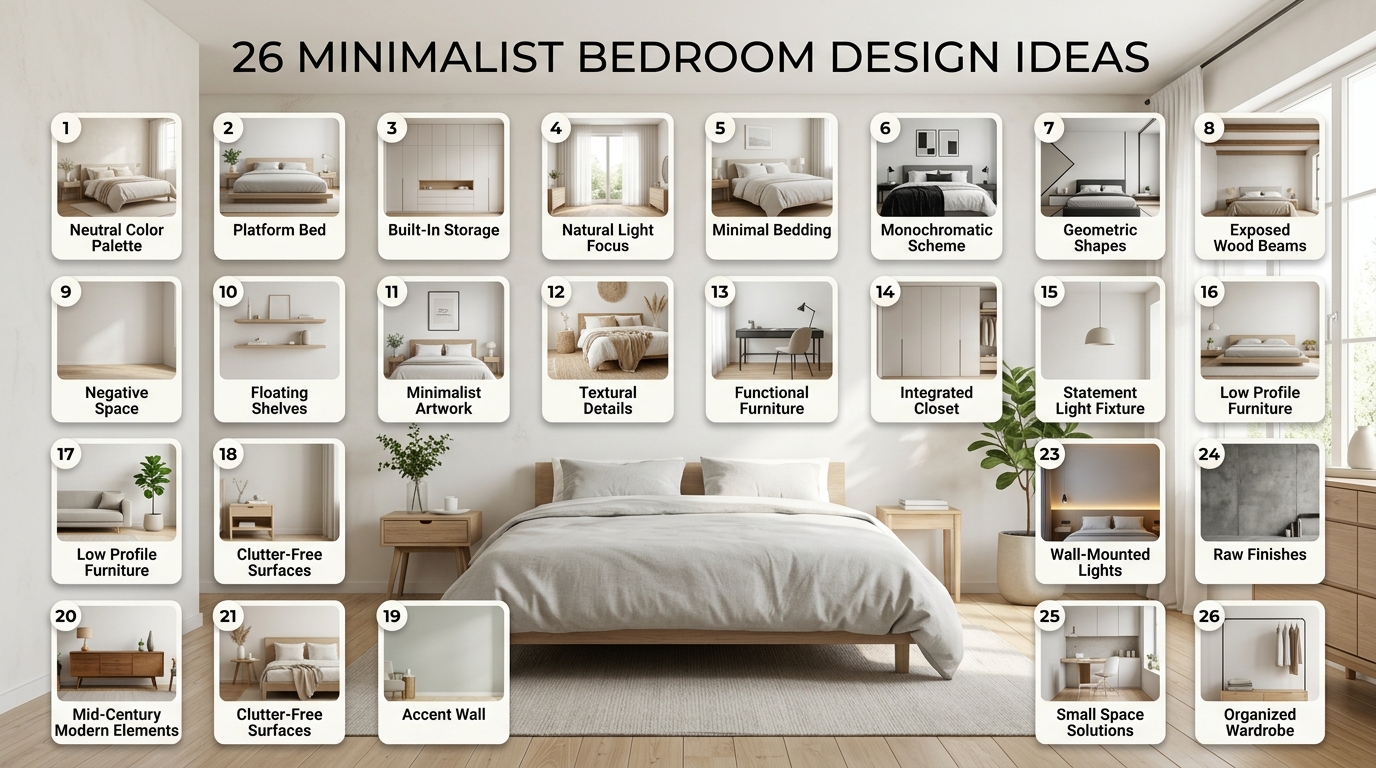
Minimalist bedroom design is the practice of reducing a sleeping space to only what is functionally necessary and visually intentional — creating rooms where every object earns its place and the space itself becomes the primary design element. This article gives you 26 specific, actionable minimalist bedroom ideas covering layout, color, materials, lighting, furniture, storage, accessories, and small-space techniques.
Walk into a well-executed minimalist bedroom and feel the shift immediately — the quiet that isn’t silence, the lightness that isn’t emptiness. The bed is made once and stays that way. Light moves across a single uninterrupted wall. There is nothing to straighten, nothing to wonder about, nothing competing for your attention at the end of the day. Minimalist bedroom design is not about owning less. It is about choosing better. Here are 26 ideas worth saving — and stealing.
Why Minimalist Bedroom Design Works So Well
Minimalist bedroom design is rooted in three distinct cultural and design traditions that converged in the twentieth century: the Japanese concept of ma — intentional negative space as an active design presence — the Bauhaus principle that form follows function and ornamentation is unnecessary, and the Scandinavian design tradition of crafting beautiful objects that serve daily life without excess. What emerged from this convergence was not a style of removal but a philosophy of precision: keeping exactly what serves the room and its occupant, expressed through the highest quality materials available.
The material vocabulary of a minimalist bedroom is deliberately narrow. Unfinished or lightly oiled white oak and walnut for furniture — visible grain, no stain that obscures the wood’s natural character. Linen and undyed cotton for bedding — natural, textured, slightly imperfect. Matte plaster or flat-finish paint for walls — no sheen, no reflective surface that creates distraction. Concrete, honed stone, and raw ceramic for accessories — materials that look better with time and use rather than worse. The color palette is anchored in warm white, warm greige, warm charcoal, and the natural tones of the materials themselves — wood, stone, linen — with no introduced color that doesn’t originate from nature.
Minimalist bedroom design is experiencing its deepest cultural resonance in decades, for reasons that are entirely specific to the current moment. Research consistently links bedroom visual complexity to sleep quality and cortisol levels — a cluttered or visually busy bedroom measurably increases physiological stress markers. At the same time, the over-stimulation of digital life has created a broad cultural hunger for spaces of genuine rest. Pinterest searches for “minimalist bedroom,” “clean bedroom aesthetic,” and “simple bedroom design” have grown every year since 2019 and continue to accelerate. People are not seeking emptiness; they are seeking relief.
Small bedrooms are where minimalist design produces its most dramatic results. The principles that govern a large minimalist bedroom — negative space, surface continuity, low visual noise — are precisely the principles that make small rooms feel larger. A small bedroom with one low platform bed, one floating nightstand, and bare walls reads as serene and considered; the same room with multiple furniture pieces, layered rugs, and wall art reads as cramped. Minimalism and small-space design are not merely compatible — they are allies.
Style at a Glance
| Element | Minimalist Principle | Design Payoff |
| Philosophy | Only what is necessary, expressed precisely | Rest, clarity, perceived space |
| Materials | White oak, linen, matte plaster, honed stone | Warmth without decoration |
| Color Palette | Warm white, warm greige, warm charcoal, natural tones | Cohesion, visual calm |
26 Minimalist Bedroom Design Ideas
1. The Platform Bed: Low, Clean, Grounded
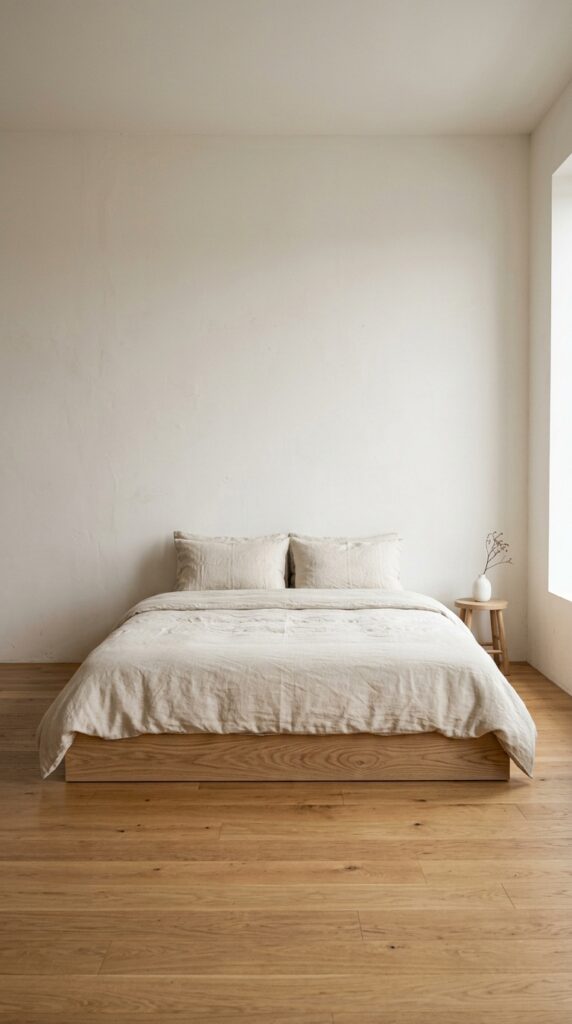
Vibe: Grounded — the bed as an object that belongs to the floor rather than rising above it.
Why it works: A low platform bed is the foundational furniture choice of minimalist bedroom design because it physically lowers the room’s visual center of gravity — the sleeping surface at 6–10 inches from the floor creates a horizontal emphasis that makes the room feel both more expansive vertically and more deliberately calm. The design principle is visual weight redistribution: moving the room’s heaviest object closer to the floor reduces the perceived visual mass in the upper two-thirds of the room, where the eye naturally travels first. No headboard is often the correct minimalist choice — it removes the bed’s most decorative element and lets the wall do the framing work.
How to get it: Source platform beds in unfinished or lightly oiled white oak with a clean, unembellished horizontal profile — no carved details, no storage drawers in the frame face, no upholstered panels. The frame should be the minimum structure required to support the mattress. Floyd, Muji, and CB2’s Calypso platform are reliable options at different price points. Keep the mattress height proportional — a thick pillow-top mattress on a 6-inch platform frame creates a visual conflict; a medium-profile mattress (10–12 inches) maintains the low-slung proportion.
💡 Quick Win: Remove the box spring from your existing bed frame and rest the mattress directly on the slats — this immediately lowers the sleep surface by 6–9 inches and shifts the bed toward the low, grounded proportion that defines minimalist design.
Shop The Look
| Product |
| White oak platform bed frame low profile no headboard |
| Undyed linen duvet cover queen natural |
| Linen pillow case set warm white pair |
| Low profile mattress 10 inch medium firm |
| White oak bed slats support replacement |
2. Warm White Walls in Flat Matte Finish
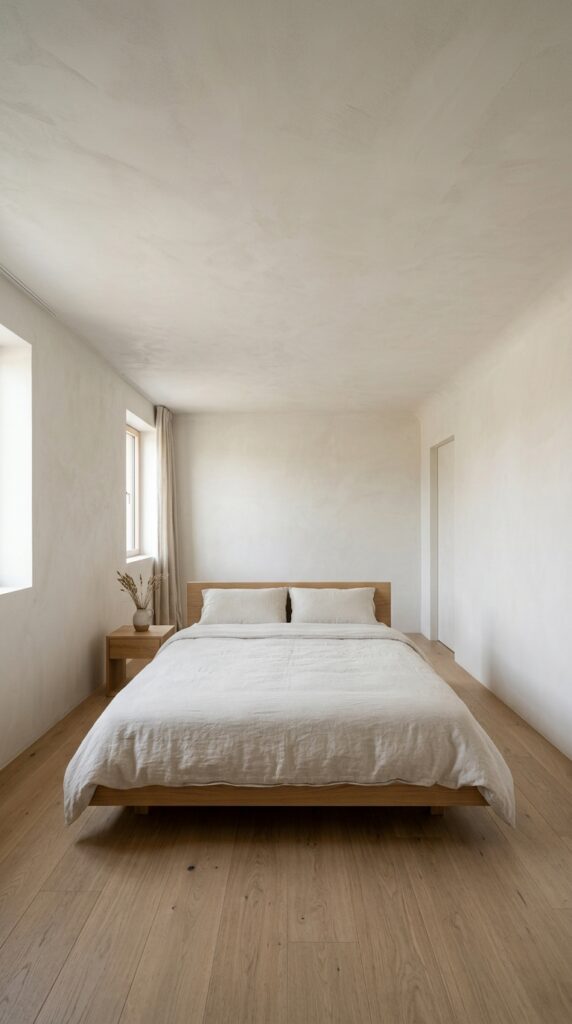
Vibe: Hushed — walls that absorb the day’s noise rather than reflect it.
Why it works: Warm white walls in a flat matte finish are the minimalist bedroom’s most fundamental surface choice because they serve as a neutral field that recedes visually, allowing the room’s few carefully chosen objects — the bed, a single piece of art, the light — to read with maximum clarity. The design principle is surface subordination: the wall should never compete with the objects in the room for visual attention. Matte finish is non-negotiable for this purpose — any sheen creates highlight-and-shadow variation across the wall surface that introduces visual movement and distraction. Warm white (not stark white) prevents the room from reading as clinical or cold.
How to get it: Benjamin Moore “White Dove” (OC-17) in Flat finish is the most reliably warm, versatile white for a minimalist bedroom — it reads cream in warm light and pure white in cool light, never drifting toward grey or yellow. Paint the ceiling the identical color and finish — eliminating the ceiling break line makes the room read as a continuous warm shell. Apply with a low-nap roller in one direction only for the smoothest possible flat finish.
Shop The Look
| Product |
| Warm white matte wall paint interior flat finish |
| Venetian plaster warm white DIY kit |
| Low nap paint roller cover 9 inch |
| Limewash paint warm white interior wall |
| Flat finish paint primer combo white |
3. Single Floating Nightstand: The One-Side Edit
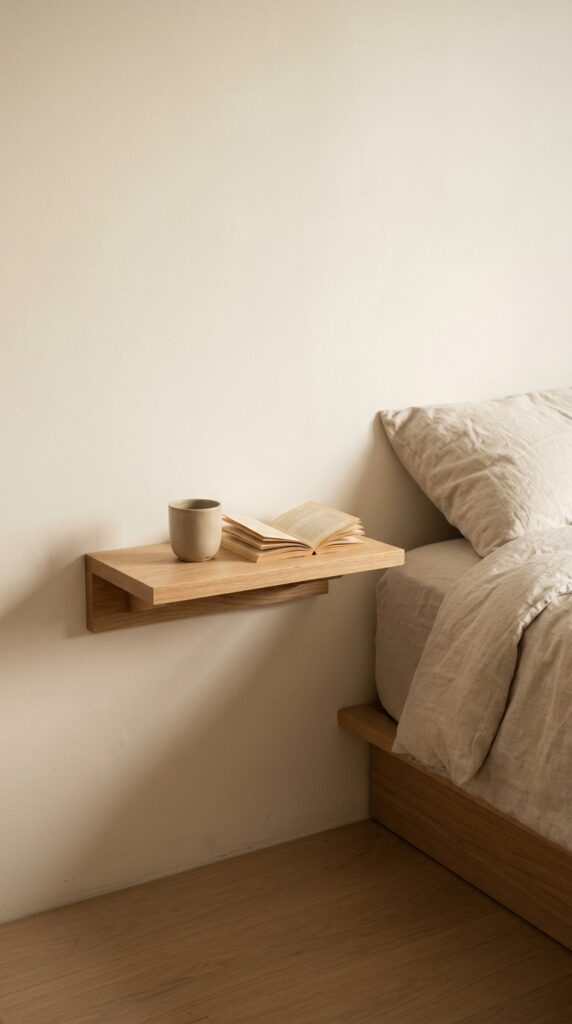
Vibe: Deliberate — the side of the bed that needed nothing proved it.
Why it works: Using a single nightstand instead of a matching pair is one of the most sophisticated minimalist bedroom gestures because it breaks the conventional symmetry that standard bedroom design imposes — and in doing so, creates a deliberate asymmetry that is far more interesting and more honest than two matching tables. The design principle is functional asymmetry: provide what is functionally needed (one nightstand for the primary sleeper’s side) and let the other side of the bed meet the wall cleanly, which creates a visual relief that makes the whole room feel more spacious and considered.
How to get it: Wall-mount the single nightstand rather than using a floor-standing table — the floating version frees the floor plane beneath it and reads lighter against the wall. Position it at a height where the surface is level with the top of the mattress — approximately 24–26 inches from the floor for a standard platform bed setup. Maximum three objects on the surface; two is better.
Shop The Look
| Product |
| Floating wall mount nightstand white oak small |
| Wall mount shelf bracket hidden support |
| Matte ceramic cup small warm putty |
| Hardcover book linen cover neutral |
| Wall mount nightstand set oak minimal |
4. No-Headboard Bed: The Wall Does the Work
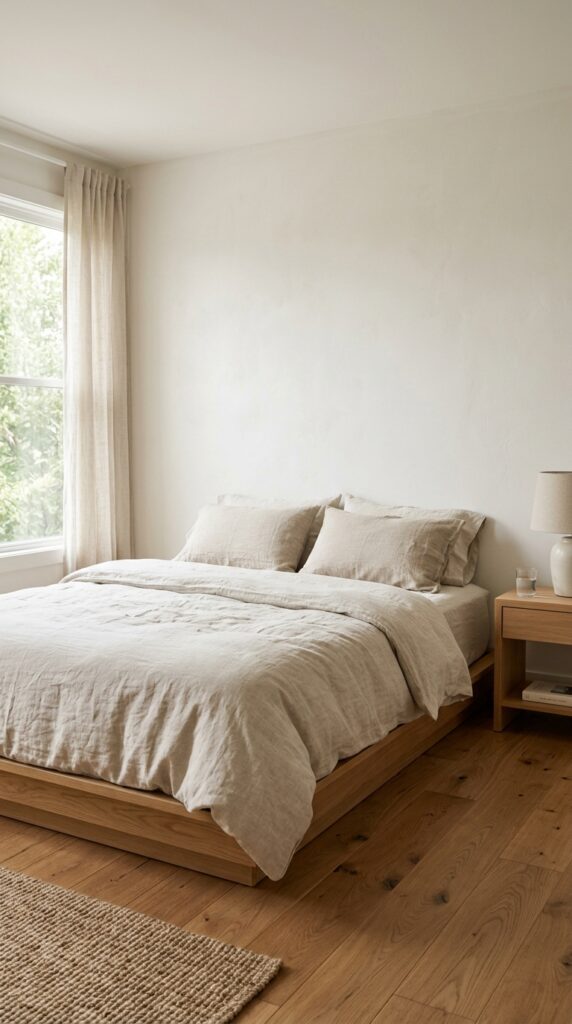
Vibe: Clean — a bed that needed no announcement.
Why it works: Removing the headboard eliminates the bedroom’s most consistently over-designed element — the piece of furniture most likely to carry decorative carving, tufted upholstery, or ornamental detail that conflicts with a minimalist intention. Without a headboard, the wall becomes the bed’s natural frame, and the bed’s form is defined purely by its horizontal platform geometry. The design principle is element subtraction for clarity: removing the headboard does not make the bed look incomplete; it makes the bed’s essential form — the platform, the mattress, the bedding — more visible and more intentional.
How to get it: Position the bed so the mattress head is 2–3 inches from the wall — close enough that the wall reads as the backdrop, not so close that the bedding touches the wall surface and creates scuff marks. If the room’s proportions feel incomplete without a vertical element behind the bed, a single slim horizontal shelf at pillow height (8 inches deep, spanning the width of the mattress) provides visual anchoring without the decorative weight of a headboard.
Shop The Look
| Product |
| Floating wall shelf wide shallow bed header |
| Platform bed frame headboard-less white oak |
| Bed wall bumper guard protector |
| Linen king shams warm white pair |
| Low platform bed no headboard walnut |
5. Monochromatic Bedding in One Linen Tone
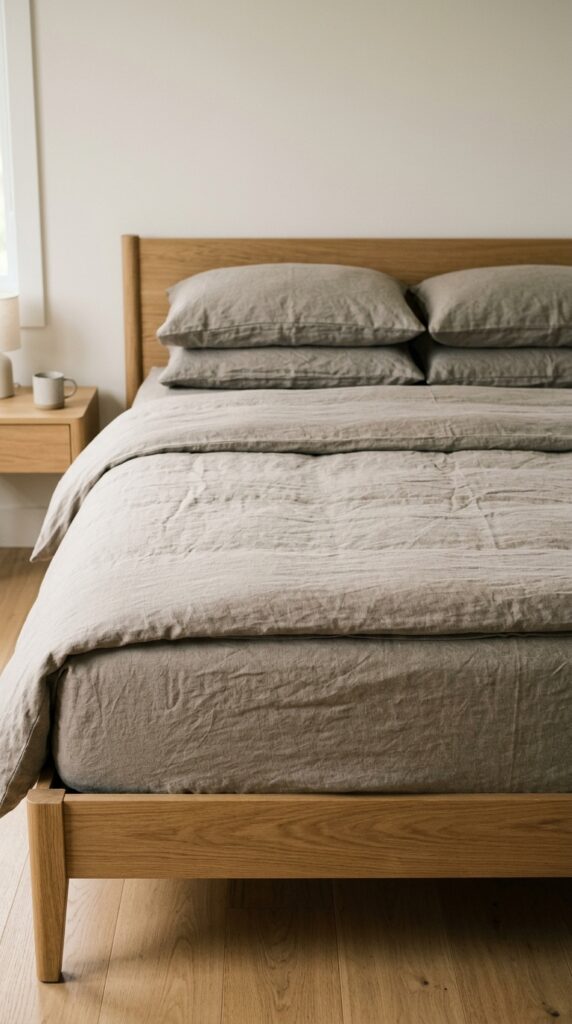
Vibe: Complete — a bed that requires nothing added to it.
Why it works: Dressing the bed entirely in one linen tone — the same color across the duvet, shams, and fitted sheet — is the most powerful single bedding decision in minimalist design because it turns the bed into a single unified object rather than a composition of competing layers and colors. The design principle is tonal unity: when all surfaces read as one material in one tone, the bed’s scale and form become visible as architecture rather than furniture. The slight natural variation within linen fabric — tone-on-tone texture from the weave — provides sufficient visual interest within that unity without introducing contrast.
How to get it: Order all bedding pieces from the same manufacturer’s same collection to guarantee dye-lot consistency — even slight tone variation between a duvet from one brand and shams from another will read as a mismatch in a monochromatic scheme. Stonewashed linen has the most natural texture variation; standard linen is more even. Both work; the stonewashed version has a slightly more organic, wabi-sabi quality. Brooklinen, Cultiver, and Parachute all produce reliable monochromatic linen bedding sets.
Shop The Look
| Product |
| Linen duvet cover set monochromatic warm greige |
| Linen fitted sheet matching warm greige |
| Stonewashed linen pillowcase set pair |
| Linen duvet cover undyed natural queen |
| Linen complete bedding set one tone |
6. Negative Space as Furniture: The Empty Corner
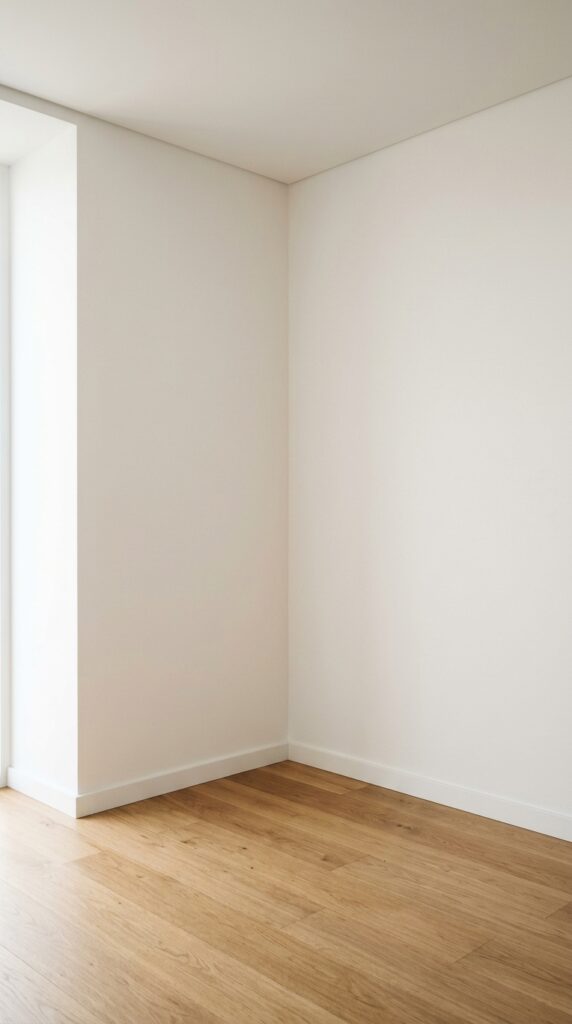
Vibe: Still — the corner that understood its job was to be empty.
Why it works: The deliberately empty corner is the most challenging and most rewarding minimalist bedroom technique because it requires overcoming the deeply ingrained design impulse to fill every corner and surface with something. An empty corner in a minimalist bedroom is not an oversight — it is an active design decision, an application of the Japanese concept of ma: the empty space has the same value as the occupied space, and together they create the room’s rhythm. The design principle is negative space as presence: the empty corner makes the occupied areas of the room more visible, more valued, and more precisely placed by contrast.
How to get it: Remove the object currently occupying your least-necessary corner and do not replace it. Live with the emptiness for two weeks — the impulse to fill it will diminish. If the corner reads as unfinished rather than intentional, paint it the same warm white as the surrounding walls and ensure the floor is clean and unobstructed to the baseboard. The corner’s quality of emptiness depends entirely on the cleanliness of its surfaces.
Shop The Look
| Product |
| Warm white wall paint flat matte corner |
| Floor cleaning solution hardwood natural |
| Corner baseboard trim natural white |
| Minimalist bedroom decor restraint guide |
| White oak floor cleaner polish natural |
7. Integrated Wardrobe with Flush Handle-Free Doors
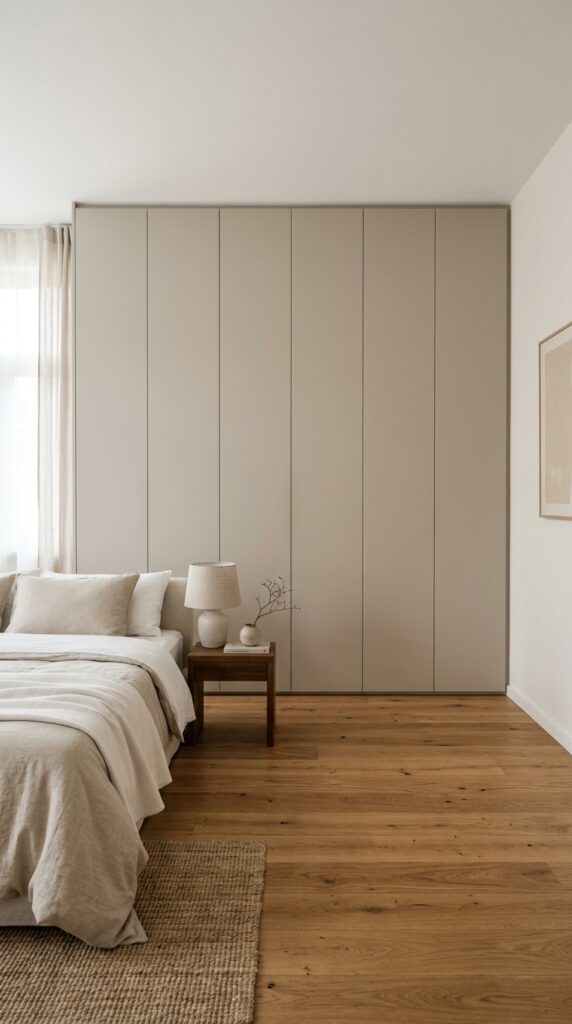
Vibe: Seamless — the storage that erased itself into the wall.
Why it works: A full-wall integrated wardrobe with flush, handle-free doors is the minimalist bedroom’s most architecturally ambitious storage solution because it makes all clothing storage invisible — the entire wardrobe face reads as a flat wall plane when closed. The design principle is storage concealment at scale: hiding the bedroom’s largest storage requirement behind a surface that reads as architecture rather than furniture removes the most visually demanding object from the room entirely. Ceiling-height doors amplify this effect by drawing the eye upward and making the wall appear continuous from floor to ceiling.
How to get it: Push-to-open hardware (touch-latch or push-catch mechanisms) eliminates the need for visible handles and is available from hardware suppliers including Blum and Salice at $5–$15 per door. The door faces should be painted the exact same color as the surrounding walls — even 1–2 degrees of tone difference will make the wardrobe doors visible as a separate element. For a retrofit (not built-in), IKEA’s PAX wardrobe system with GRIMO or HOKKSUND flat-front panel doors approximates this effect at accessible cost.
Shop The Look
| Product |
| Push to open cabinet latch touch hardware |
| Flat panel wardrobe door replacement white |
| PAX wardrobe frame white IKEA compatible |
| Ceiling height cabinet door extension kit |
| Concealed cabinet hinge soft close pair |
8. One Piece of Art, Perfectly Placed
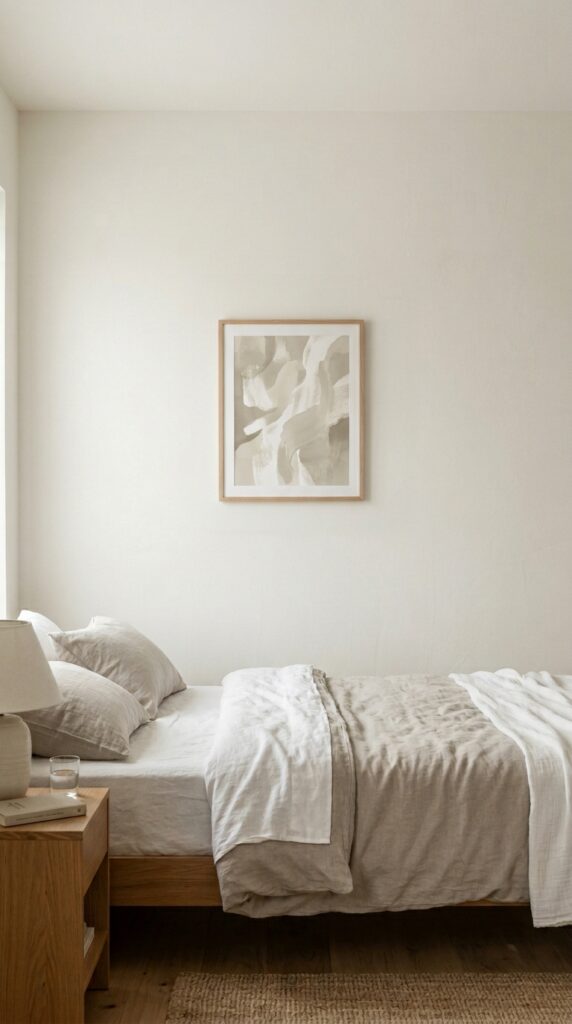
Vibe: Considered — one thing said clearly is worth ten things murmured.
Why it works: In a minimalist bedroom, one piece of art displayed alone carries more visual authority than ten pieces in a gallery arrangement because the surrounding empty wall space functions as a frame within a frame — the whitespace amplifies the artwork in the same way that silence amplifies a single note. The design principle is visual isolation for impact: an object surrounded by empty space demands attention; the same object surrounded by competing objects disappears into visual noise. The artwork itself should be tonal rather than colorful — warm greige, charcoal, or warm white abstract work keeps the room’s calm palette intact while the art contributes composition and texture.
How to get it: Hang at true eye level — the center of the artwork at 57–60 inches from the floor, which is the standard gallery hanging height and the position that reads most naturally from a standing position. Leave at least 12 inches of empty wall on each side of the artwork and at least 8 inches above and below — the empty margin is as important as the art itself in a minimalist context.
💡 Quick Win: Print a large abstract image from a free resource like Unsplash (search “abstract warm neutral texture”) at a print shop (24×30 inches costs $15–$25) and frame it in a simple natural oak frame — the result is indistinguishable from a gallery piece at a fraction of the cost.
Shop The Look
| Product |
| Abstract art print warm neutral tones large |
| Slim natural oak picture frame 24×30 |
| Abstract canvas wall art warm greige minimal |
| Art print warm linen texture neutral |
| Natural wood frame wall art minimalist |
9. Blackout Linen Curtains: Floor-to-Ceiling
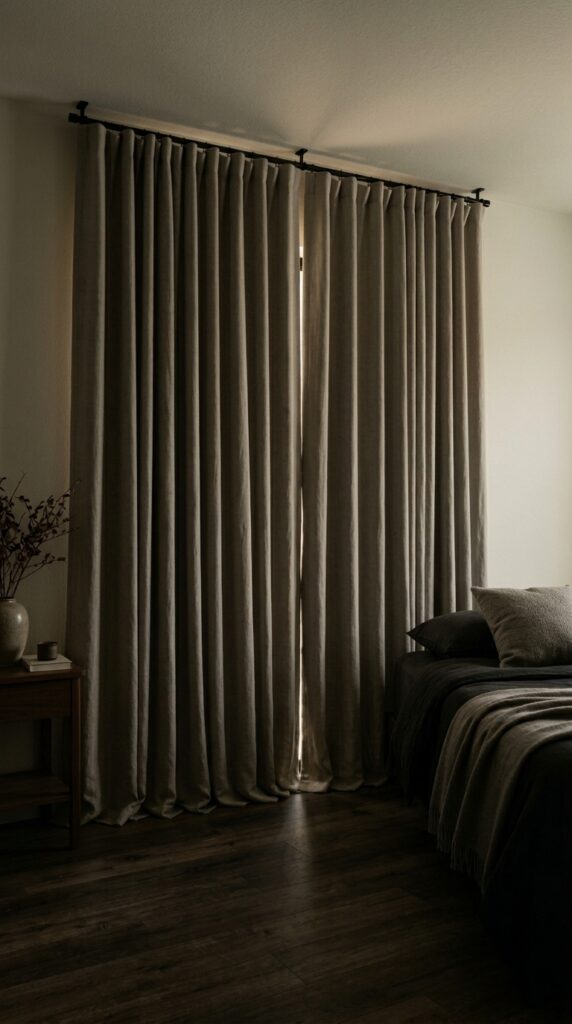
Vibe: Enveloping — the room that seals the day outside.
Why it works: Floor-to-ceiling blackout linen curtains serve the minimalist bedroom’s most important functional requirement — complete light control for sleep — while contributing two additional design benefits: the vertical height of ceiling-mount curtains draws the eye upward and makes the room feel significantly taller, and the soft weight of linen in a neutral tone adds warmth and texture to the wall without introducing pattern or color. The design principle is functional luxury: a curtain that reaches from ceiling to floor in natural linen fabric costs no more than a shorter curtain but delivers dramatically more visual impact and better light control.
How to get it: Mount the rod bracket within 2–4 inches of the ceiling — not at the window frame height. This is the single most important curtain installation detail for both light control and visual height. The curtain panel should be 1.5–2 times the window width for proper fullness when closed. Specify blackout-lined linen rather than unlined linen — the blackout lining is concealed inside the linen face and maintains the natural fabric appearance while providing complete light blockage.
Shop The Look
| Product |
| Blackout linen curtain panel warm greige floor length |
| Slim matte black curtain rod ceiling mount |
| Linen blackout curtain panel warm white |
| Ceiling mount curtain bracket kit |
| Linen curtain panel natural undyed blackout |
10. Concrete or Honed Stone Bedside Element
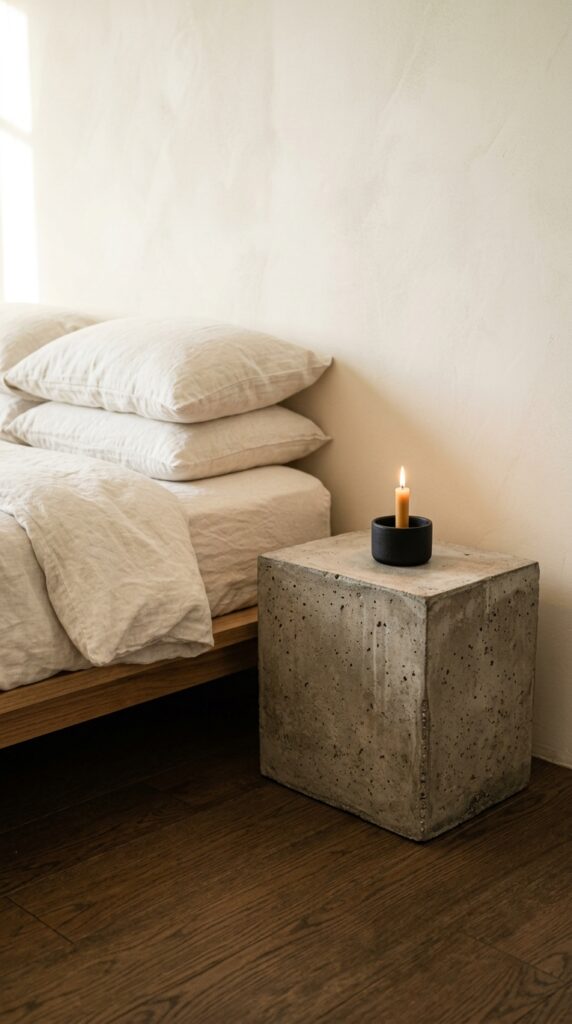
Vibe: Raw — a material that needed no refinement to be right.
Why it works: Concrete or honed stone bedside tables introduce the minimalist bedroom’s most grounding material contrast — the heavy, permanent quality of stone or concrete against the soft, lightweight quality of linen bedding. This material opposition is the design principle of tactile contrast: placing a material of high physical density beside a material of low physical density creates a visual tension that makes both materials more interesting. Concrete also embodies a specifically minimalist aesthetic value — it is honest about what it is, requires no finish or decoration, and gets more interesting with age and use.
How to get it: Cast concrete bedside tables are widely available from independent makers on Etsy ($80–$200) or can be DIY cast using a cardboard tube mold and standard concrete mix for under $20 in materials. Seal with a matte penetrating concrete sealer — avoid glossy sealer, which defeats the raw quality of the material. Honed travertine blocks from stone suppliers serve the same function at similar cost with a warmer, more organic variation in surface.
Shop The Look
| Product |
| Cast concrete side table cylindrical bedside |
| Honed travertine block side table |
| Concrete bedside table minimalist bedroom |
| Concrete sealer penetrating matte finish |
| Stone pedestal side table natural |
11. Warm Charcoal Linen: The Single Dark Anchor
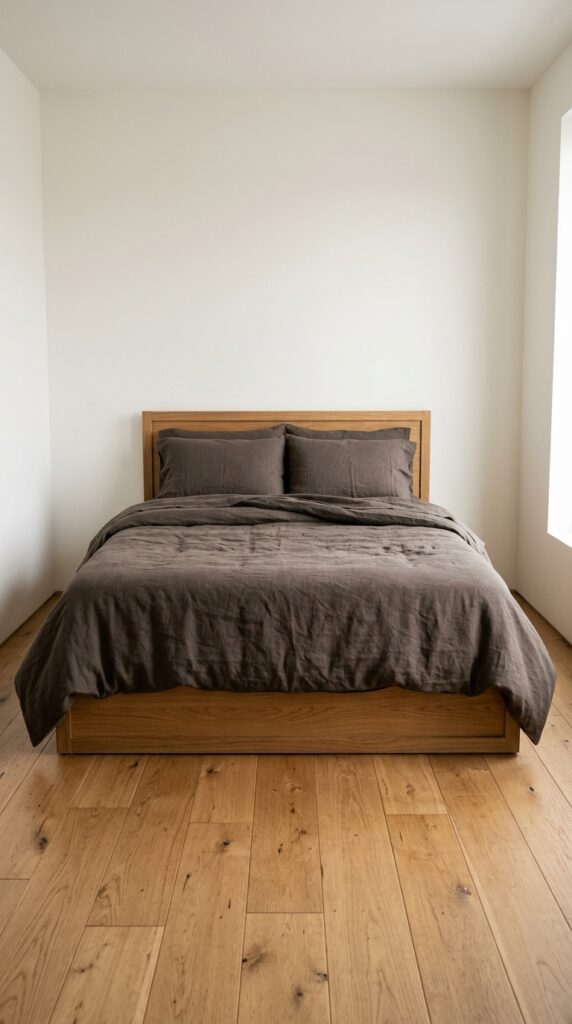
Vibe: Grounded — the dark center that makes the whole room feel anchored.
Why it works: Warm charcoal bedding in an otherwise warm-white minimalist bedroom creates the most controlled form of contrast available — a single dark element against a predominantly light field — and it works because the darkness is contained entirely to the bed. The design principle is single-point anchoring: one dark, heavy element in a light room gives the eye a resting point that makes the surrounding lightness feel more intentional rather than simply empty. The warm (brown) undertone in the charcoal is critical — cool grey charcoal creates a cold, clinical contrast; warm charcoal reads as part of the natural material palette.
How to get it: The charcoal bedding should be the room’s only departure from the warm-white palette — walls, floor, furniture, and all other surfaces remain light. If the charcoal bedding reads as the room’s single dark element, it works; if the room has additional dark elements (dark frames, dark furniture, dark rugs), the single-anchor effect is diluted. Cultiver’s “Chalk” and Brooklinen’s “Heathered Cashmere” in Stone are reliable warm charcoal linen options.
Shop The Look
| Product |
| Warm charcoal linen duvet cover queen |
| Charcoal stonewashed linen pillowcase set |
| Warm charcoal linen fitted sheet queen |
| Charcoal linen euro sham set |
| Dark warm grey linen bedding set complete |
12. Under-Bed Storage: Invisible Organization
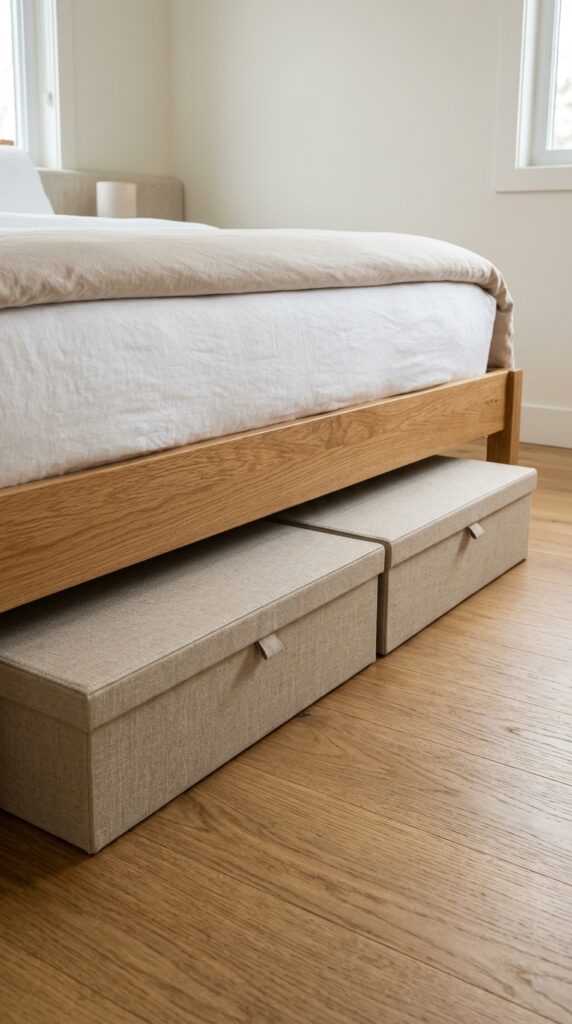
Vibe: Organized — the storage system that never needed to announce itself.
Why it works: Under-bed storage in a minimalist bedroom works only when it is invisible — identical, flat-lidded containers in a material that matches the room’s palette, pushed flush to the bed frame edge so no storage face is visible from standing height. The design principle is contained concealment: the storage exists, is functional, and is completely undetectable unless you look for it. This differs from casual under-bed storage (mismatched bins, visible product labels, different-sized boxes) which reads as visual clutter at floor level even when technically contained.
How to get it: Use two identical linen-covered flat storage boxes (maximum height 6 inches for under-frame clearance) in the same warm linen tone as the bedding. Push them fully beneath the bed until their front faces are flush with the outer bed frame edge. Never store anything loose under the bed — if it doesn’t fit in a container, it doesn’t belong under the bed. Muji’s polyester storage cases and The Container Store’s linen boxes are reliable options.
Shop The Look
| Product |
| Linen under bed storage box flat lid set |
| Under bed storage container slim with lid |
| Fabric storage bin flat under bed linen |
| Under bed storage bag zippered linen |
| Slim storage box set under bed with handles |
13. Pendant Lights Instead of Table Lamps
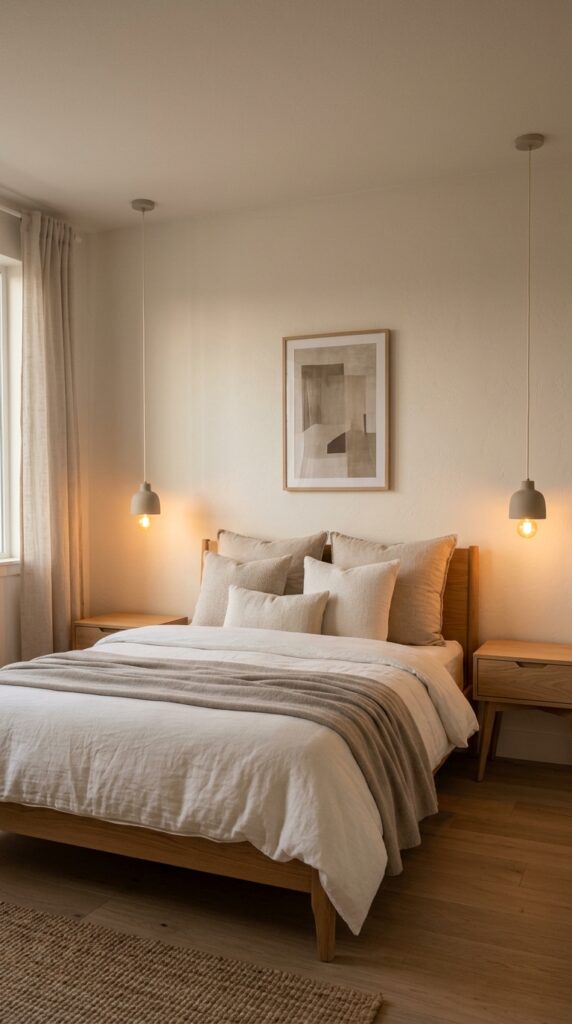
Vibe: Considered — light arrived at exactly the right height for exactly the right reason.
Why it works: Hanging bedside pendants rather than placing table lamps on nightstands frees the nightstand surface entirely — in minimalist design, freeing a horizontal surface from its occupants is always a gain. The design principle is vertical surface transfer: moving an object from a horizontal surface to a vertical or suspended position preserves the flat surface as empty space, which in minimalist design is more valuable than the object that occupied it. Pendant lights at reading height also provide better directional illumination for reading than table lamps at the same height because the light source is closer to the page.
How to get it: Swag-style pendant hooks require no electrician — install a ceiling hook above each nightstand position and run a cloth-covered cord to a nearby outlet using a plug-in swag pendant kit. Position the bottom of the shade at 48–52 inches from the floor — this is correct reading height when sitting up in bed and ensures the light source doesn’t shine directly into the eyes of a sleeping partner. Matte ceramic shades in putty or warm white are the most minimalist shade option.
Shop The Look
| Product |
| Plug in pendant light cord minimalist ceramic |
| Pendant light swag kit plug in bedroom |
| Matte ceramic pendant shade small putty |
| Ceiling swag hook pendant hardware |
| Minimal pendant light linen shade pair |
14. Linen Walls: Fabric-Paneled Warmth
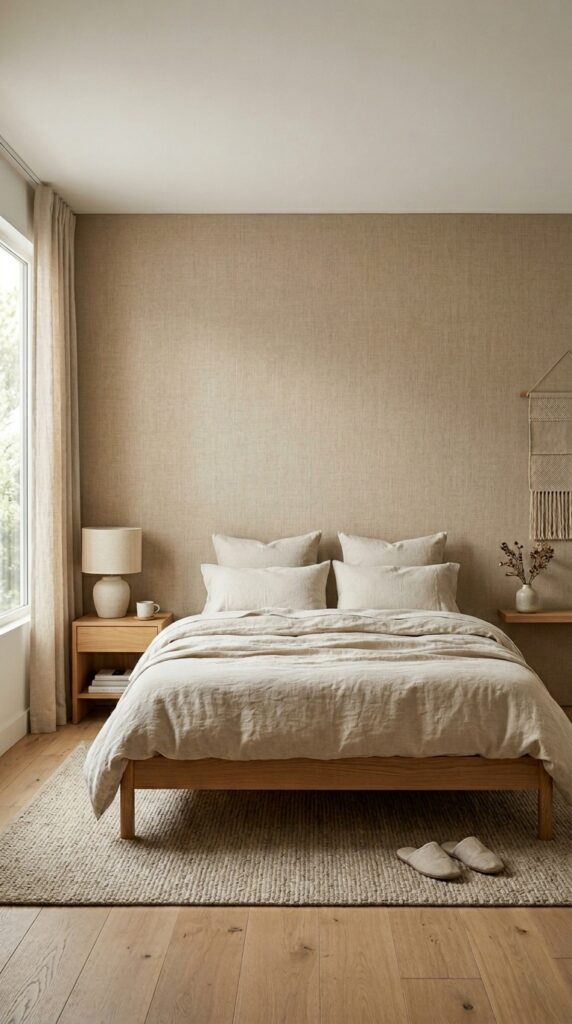
Vibe: Enveloping — a wall that became textile without ceasing to be architecture.
Why it works: A linen-paneled wall behind the bed is one of the most sophisticated material choices in minimalist bedroom design because it accomplishes texture, warmth, sound absorption, and headboard replacement simultaneously — one surface serving four functions. The design principle is material multitasking: in minimalist design, every element should serve the maximum number of purposes. The linen’s natural weave creates visible texture that catches light and creates micro-shadow variation throughout the day, making the wall surface animated without introducing pattern or color. Sound absorption is an underrated benefit — fabric walls meaningfully improve the acoustic quality of a bedroom.
How to get it: Build thin plywood panels (1/4-inch birch plywood) cut to the wall dimensions, wrap in natural linen (available from fabric wholesalers at $8–$15 per yard), and adhere to the wall with construction adhesive and finish nails at the top edge. The linen should be pulled taut before stapling to the plywood back — any slack will show as visible sag. The entire behind-bed wall installation requires approximately 4–6 yards of 60-inch-wide linen fabric for a king-size wall.
Shop The Look
| Product |
| Natural linen fabric by the yard upholstery weight |
| Birch plywood panel 1/4 inch wall panel |
| Linen upholstered wall panel headboard |
| Fabric staple gun upholstery professional |
| Natural linen fabric undyed wide bolt |
15. The Minimalist Dresser: Low, Wide, and Surface-Clear
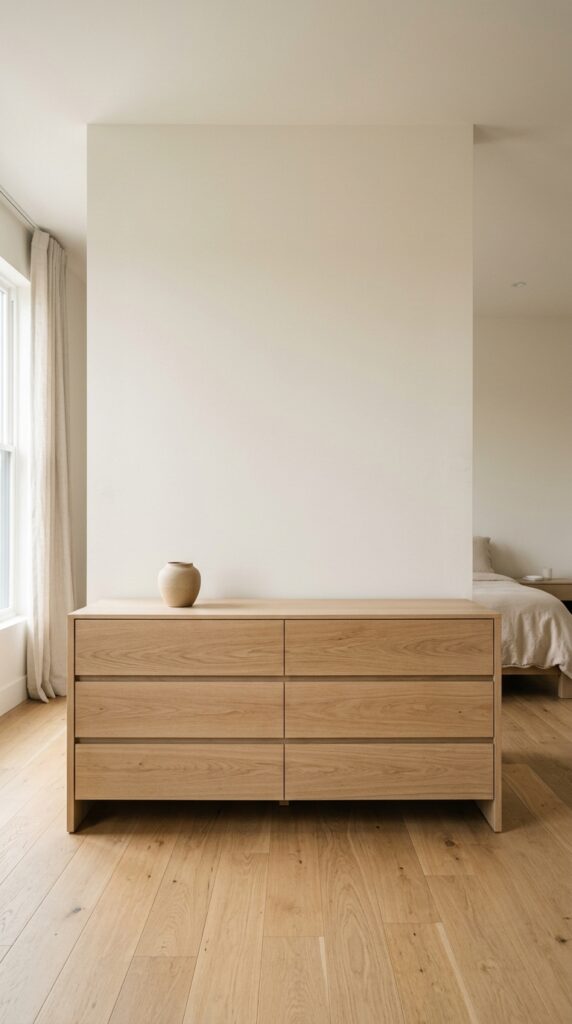
Vibe: Restrained — a dresser that kept its promise to the room.
Why it works: A low, wide dresser in a minimalist bedroom works precisely because its height (24 inches) keeps the top surface below the mid-wall line, making the empty wall above it the visual dominant element rather than the dresser itself. The design principle is low furniture, high wall: furniture that stays below the 30-inch mark preserves the upper two-thirds of the room’s wall height as open space, which is what creates the sense of openness and calm that minimalist bedrooms are designed to produce. The flush, hardware-free drawer faces make the dresser read as a continuous horizontal plane rather than a cabinet.
How to get it: Dresser top surfaces in a minimalist bedroom should hold a maximum of one object — anything more reads as accumulation. The one permitted object should be small (under 8 inches tall) and simple in form — a matte ceramic vessel, a small walnut tray, a single dried stem. Remove everything currently on your dresser surface and return only the single best object. The before-and-after will be immediately apparent.
Shop The Look
| Product |
| Low profile dresser white oak wide modern |
| Six drawer dresser handle free push open |
| Matte white dresser low wide minimalist |
| White oak six drawer chest modern |
| Push open drawer catch hardware set |
16. Natural Wood Floor: Unfinished White Oak
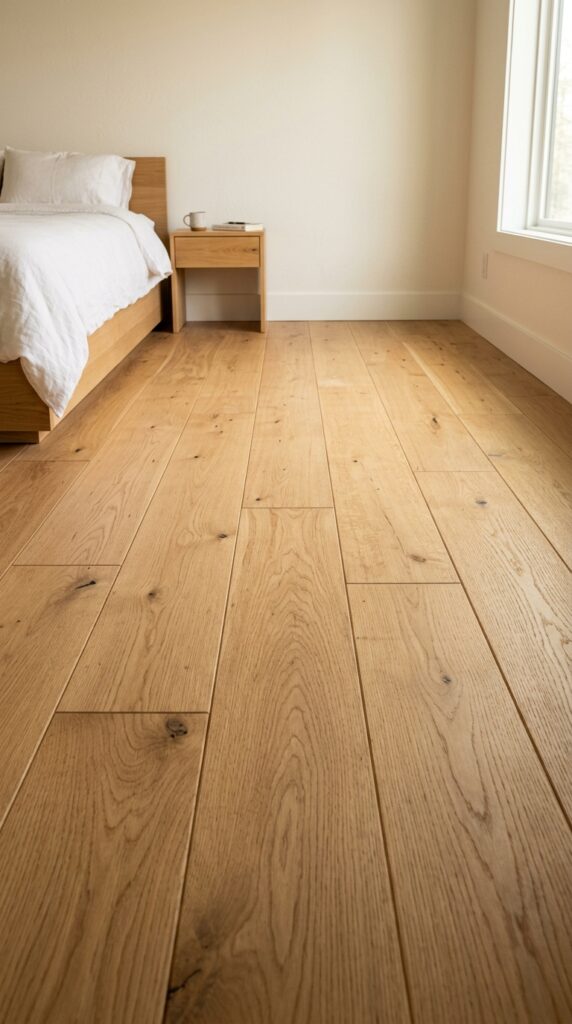
Vibe: Warm — a floor that the room built itself around.
Why it works: Wide-plank white oak flooring without a rug is the minimalist bedroom’s most confident material statement — it declares that the floor itself is beautiful enough to need no covering, and that the room’s warmth comes from the material rather than from layered textiles. The design principle is material confidence: choosing one high-quality natural material and allowing it to be fully visible is more powerful than covering it with a rug that adds softness but reduces the floor’s architectural presence. Wide planks (5 inches or wider) minimize the number of visible seams, creating a floor surface closer to a single continuous plane.
How to get it: Specify white oak flooring with a hardwax oil finish (Rubio Monocoat or Loba are the industry standards) rather than polyurethane — the hardwax oil penetrates the wood fiber rather than sitting on top of it, preserving the natural matte surface of the wood and allowing spot repairs without full refinishing. Avoid pre-finished floors with thick factory aluminum-oxide coatings, which produce a plastic sheen that conflicts with minimalist material values.
💡 Quick Win: If replacing flooring is not in budget, refinishing existing hardwood with a water-based matte polyurethane ($40–$60 per gallon) and choosing the lowest sheen level available (satin or flat) brings existing floors dramatically closer to the unfinished oak aesthetic.
Shop The Look
| Product |
| White oak hardwood flooring wide plank 5 inch |
| Hardwax oil finish natural matte floor |
| White oak floor cleaning natural oil soap |
| Wide plank white oak floor sample |
| Rubio monocoat hardwax oil floor finish |
17. Scent as the Invisible Layer: Minimal Candle Styling
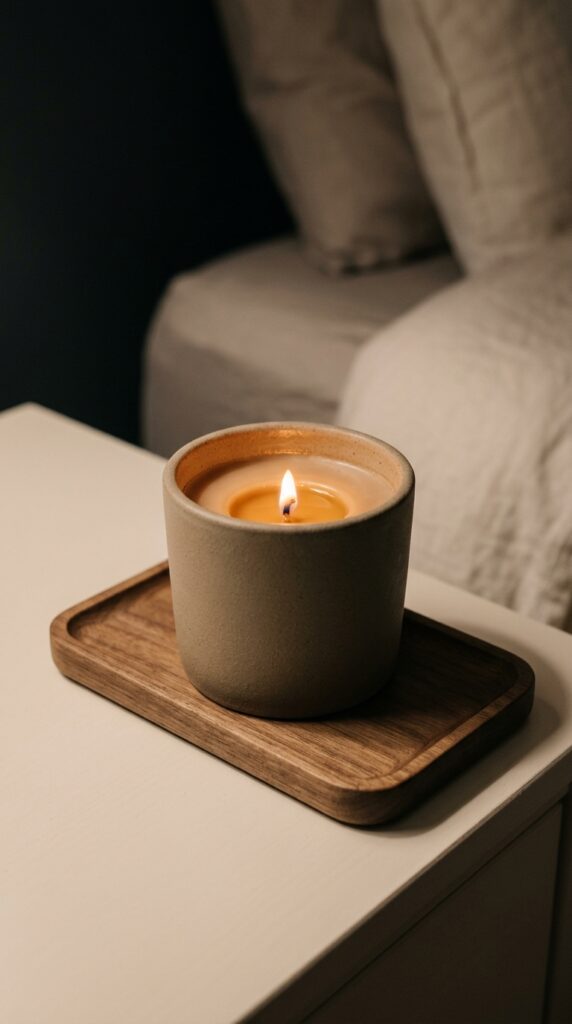
Vibe: Still — a flame that earns the attention of the entire room.
Why it works: A single candle in a quality ceramic vessel is the minimalist bedroom’s most effective sensory accent because it occupies minimal visual space while delivering maximum sensory impact — warmth, light, and scent simultaneously from one object the size of a coffee cup. The design principle is sensory concentration: one carefully chosen scent object in a bedroom does more to define the room’s atmosphere than ten decorative objects on a shelf, because scent triggers emotional and memory responses before the eye has processed anything. The vessel quality matters — a matte ceramic candle vessel reads as a permanent object; a glass jar candle reads as a consumable.
How to get it: Choose candle fragrances that read as natural and atmospheric rather than synthetic and sweet — sandalwood, cedarwood, vetiver, white tea, and warm amber are the most minimalist-appropriate fragrance profiles. Avoid heavily floral or food-inspired scents, which conflict with the serene, neutral quality of a minimalist bedroom. Transfer candle wax from commercial glass jars to matte ceramic vessels for a more considered presentation.
Shop The Look
| Product |
| Matte ceramic candle vessel large putty |
| Sandalwood cedar soy candle natural |
| Vetiver white tea candle minimal |
| Walnut candle tray small decorative |
| Minimalist candle holder ceramic white |
18. Built-In Bed Nook: Architecture as Furniture
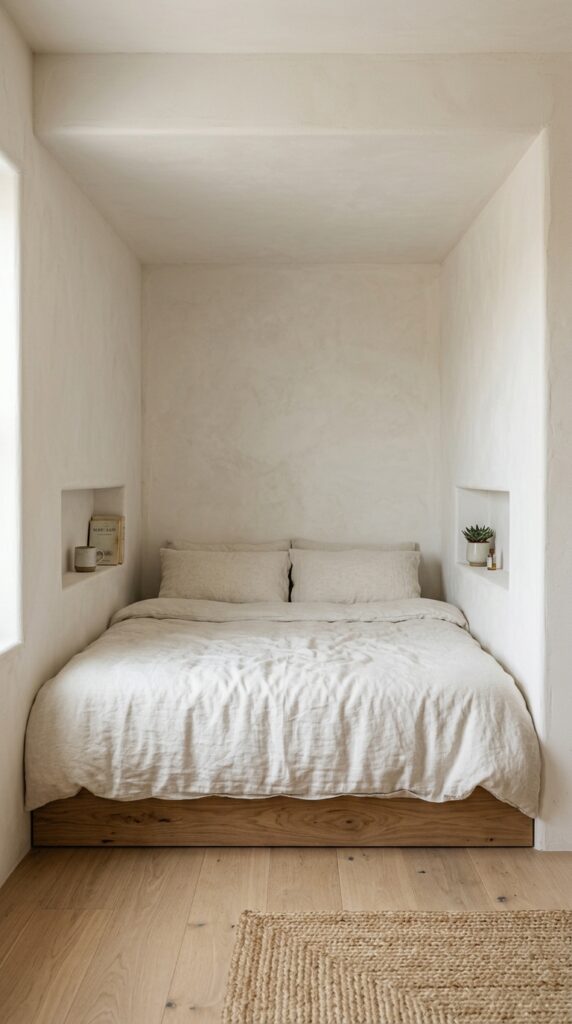
Vibe: Enclosed — a room within a room that has everything a human actually needs to sleep.
Why it works: A built-in bed nook achieves the ultimate minimalist bedroom ambition: eliminating the furniture-as-furniture distinction entirely by integrating the sleeping platform into the architecture of the room. When the bed is part of the wall rather than an object placed in front of it, the bedroom’s furniture count drops to near zero and the space reads as pure architectural volume. The design principle is furniture-architecture integration: the most minimal room is one where the architecture performs the functions that furniture typically serves, and the objects in the room are reduced to the irreducible minimum.
How to get it: A bed nook requires a wall recess of approximately 42 inches depth (for the mattress) by the mattress width plus 6–8 inches on each side. Build the sleeping platform from plywood with a MDF face, paint or plaster to match the surrounding walls exactly, and add small recessed niches in each side wall for a phone, glass of water, and light source. The mattress sits directly on the platform; no bed frame is needed.
Shop The Look
| Product |
| Mattress firm low profile bed nook |
| Built in bed platform plywood kit |
| Recessed wall niche shelf small insert |
| Warm white plaster paint finish |
| Platform bed nook mattress support |
19. Single Overhead Fixture: Pendant or Dome
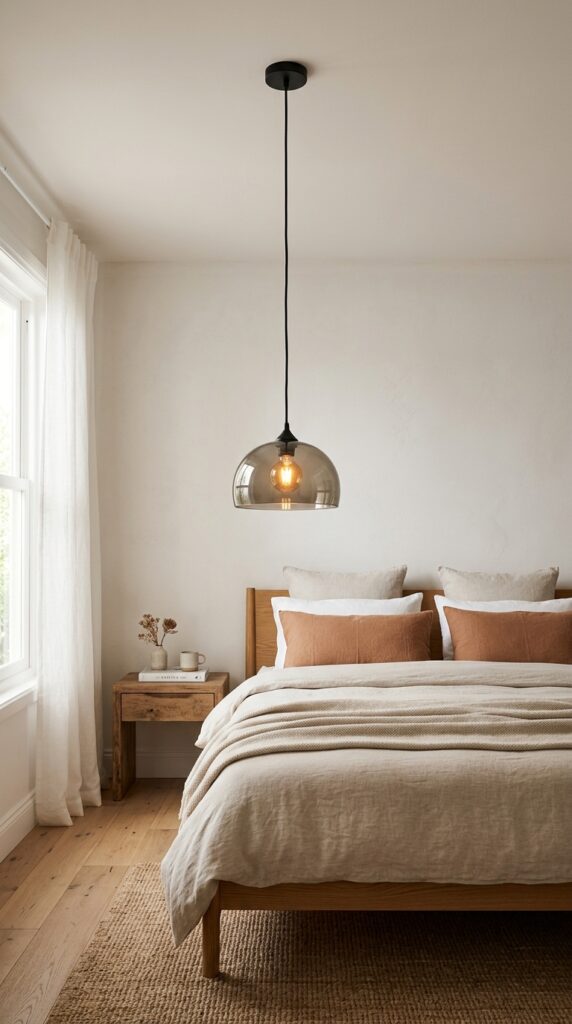
Vibe: Considered — the room lit by one source, and that was enough.
Why it works: A single overhead pendant centered over the bed replaces the typical minimalist bedroom’s multiple fixture approach — the recessed grid, the table lamp pair, the sconces — with one deliberate light source. The design principle is lighting reduction: fewer light sources create fewer visual interruptions in the ceiling plane and fewer objects to integrate into the room’s material palette. A single quality pendant also allows greater control over the room’s light atmosphere — one fixture on a dimmer circuit gives more nuanced control than multiple fixtures on different circuits.
How to get it: Center the pendant over the bed, not over the geometric center of the room (which is rarely the same position). Drop length should position the bottom of the shade at approximately 7 feet from the floor — high enough to not obstruct any standing position but low enough to read as part of the room rather than disappearing toward the ceiling. Specify a warm Edison LED bulb at 2200K on a dimmer for maximum atmosphere control.
Shop The Look
| Product |
| Blown glass dome pendant light bedroom |
| Matte white ceramic pendant light large |
| Pendant light cord kit plug in bedroom |
| Edison LED bulb 2200K warm E26 |
| Dimmer switch single pole LED |
20. Minimalist Bedroom for Small Spaces: The One-Wall Approach
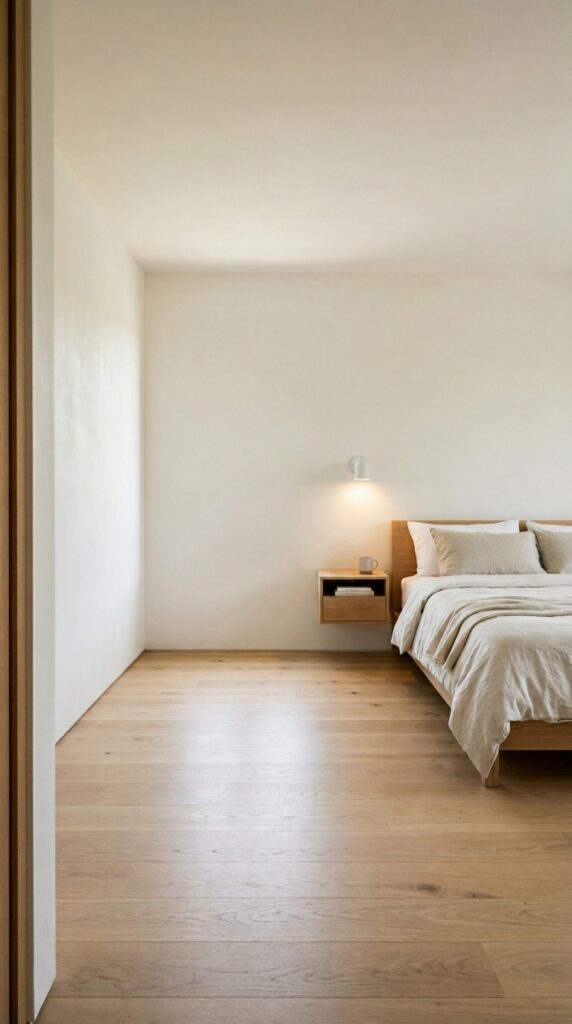
Vibe: Open — a small room that understood the value of what it didn’t put in it.
Why it works: In a small minimalist bedroom, concentrating all furniture along one wall — the one-wall approach — leaves three uninterrupted wall planes and the maximum possible floor area completely open, which creates the perception of a room significantly larger than its actual square footage. The design principle is perimeter concentration: pushing all function to the room’s edge maximizes the center as open space, which is what the brain registers as room size. This approach is drawn directly from Japanese small-space living, where the sleeping mat occupies minimal floor space and the room serves multiple functions throughout the day.
How to get it: Map the single longest wall in the room and position the bed, one nightstand, and one wall-mounted light along that wall only. Remove or eliminate every other piece of furniture. The room may initially feel under-furnished — this is correct; resist the impulse to fill the empty walls and floor. The spacious quality of the room depends entirely on the maintenance of the open space.
Shop The Look
| Product |
| Small platform bed twin or full white oak |
| Wall mount sconce plug in bedroom small |
| Floating nightstand wall mount compact |
| Small bedroom minimal complete set |
| Under bed storage flat for small room |
21. Textured Wall Treatment: Limewash or Venetian Plaster
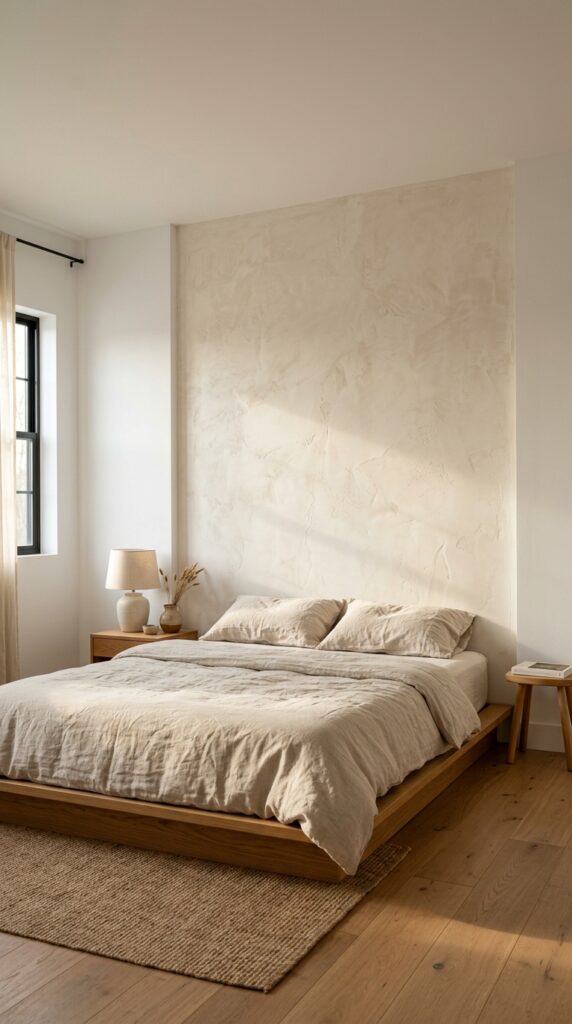
Vibe: Layered — one wall doing what no paint color alone could manage.
Why it works: A limewash or Venetian plaster accent wall introduces the minimalist bedroom’s most sophisticated form of visual interest — surface texture rather than color, which respects the neutral palette while providing a level of depth and animation that flat paint cannot achieve. The design principle is texture over color: in a room with a restricted color palette, the way light interacts with a surface becomes the primary decorative tool, and a hand-applied plaster wall creates continuously shifting micro-shadow variation that flat paint produces none of. Applied to one wall only — always the wall behind the bed — the textured surface creates a natural focal point without breaking the room’s tonal harmony.
How to get it: Portola Paints “Roman Clay” and American Clay “Marrakech” are the most accessible authentic lime plaster wall finishes for DIY application — both apply with a stainless steel trowel in overlapping figure-eight strokes. The key technique is the final burnishing pass: rubbing the nearly-dry surface with the flat of the trowel at a low angle compresses the surface and creates the characteristic depth and slight sheen of authentic Venetian plaster.
Shop The Look
| Product |
| Roman clay lime plaster wall finish warm white |
| Venetian plaster kit trowel apply warm white |
| Limewash paint wall kit interior |
| Stainless steel plaster trowel 6 inch |
| American clay wall finish natural plaster |
22. Capsule Wardrobe Visibility: Open Rail with Curated Edit
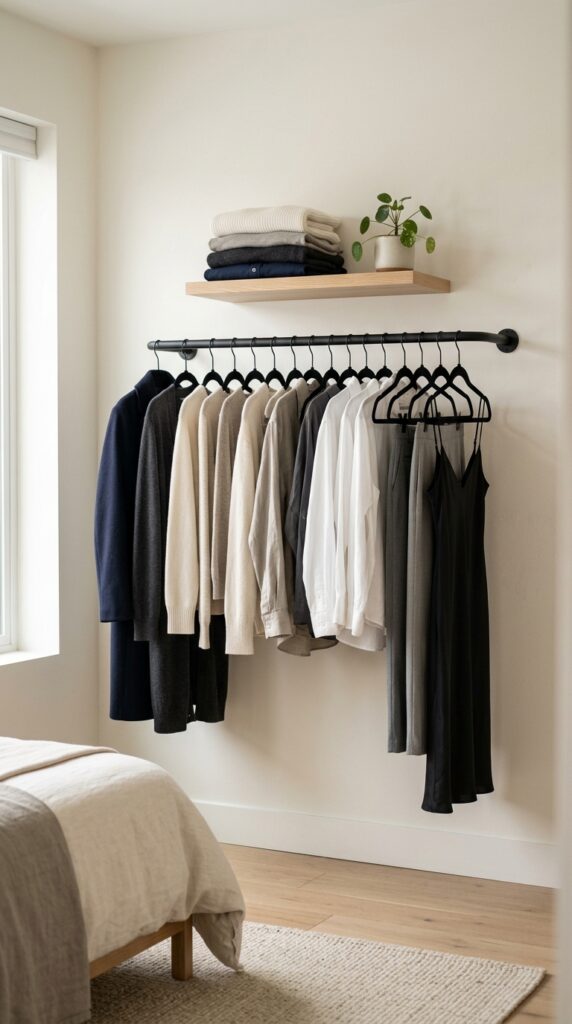
Vibe: Curated — a wardrobe that is also a declaration of intent.
Why it works: An open clothing rail with a fully curated, neutral-palette edit is the most honest expression of minimalist wardrobe philosophy — it makes the clothing itself part of the room’s visual palette rather than hiding it behind doors. This works only when two conditions are met: the garments are limited to a neutral color palette (white, cream, grey, navy, black) and the hangers are identical. The design principle is selective visibility: curated objects displayed openly are more beautiful than the same objects hidden behind doors, but uncurated objects displayed openly are worse than anything behind a door. This technique demands — and rewards — genuine wardrobe editing.
How to get it: Source slim velvet hangers in black or natural (Huggable Hangers or Amazon Basics) and replace all existing hangers immediately — mixed hanger types are the primary visual disruptor in open wardrobe systems. Edit garments to neutral tones only; any color should live in a drawer or separate closed storage. The rail should hold no more than 20 garments — beyond that, the display shifts from curated to crowded.
Shop The Look
| Product |
| Wall mount clothing rail matte black |
| Slim velvet hangers set black 50 pack |
| Open wardrobe rail system wall mount |
| White oak floating shelf wardrobe above |
| Natural wood clothing rail freestanding |
23. The Morning Light Alignment: Bed Facing East
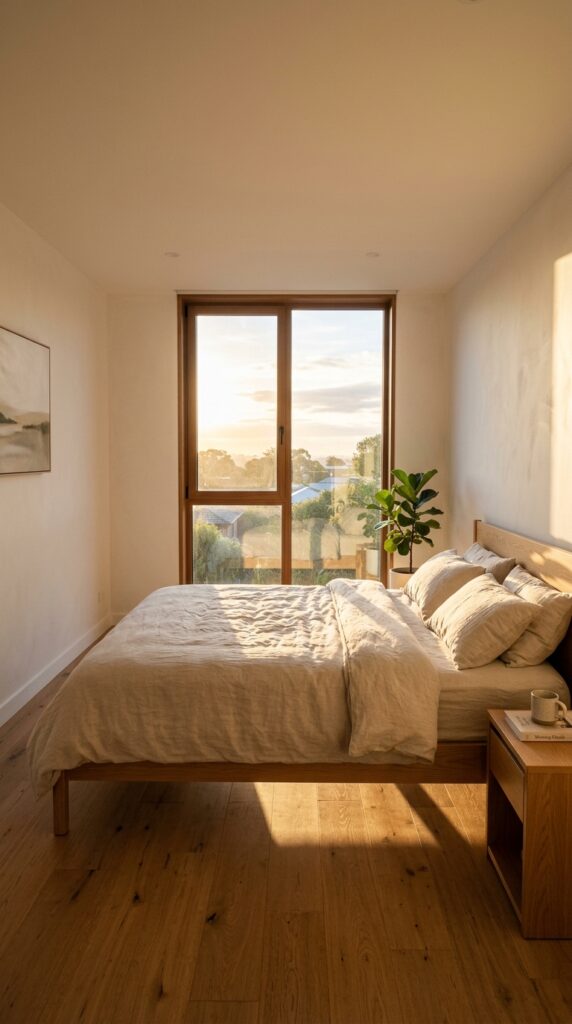
Vibe: Luminous — a room designed by the sun as much as by its owner.
Why it works: Positioning the bed to face the primary light source — ideally an east-facing window — aligns the room’s most important functional element with its most important environmental one, creating a daily experience where waking up involves moving toward light rather than away from it. This is a design principle borrowed from both Japanese and Scandinavian residential philosophy: light orientation as wellbeing. The quality of morning light in a bedroom oriented correctly is itself a design element — warm, raking, golden — that no artificial light source or wall color can replicate.
How to get it: Before finalizing bed placement, stand in each potential bed position at different times of day and observe where the light falls. East-facing windows produce the most desirable morning light; north-facing windows produce the most even, glare-free light throughout the day. Avoid positioning the bed where afternoon west light will create glare on the pillow — this produces poor sleep conditions and unflattering light quality.
Shop The Look
| Product |
| Sheer linen curtain morning light filter |
| Silk sleep mask light blocking natural |
| Sunrise alarm clock natural light wake |
| Blackout shade roller for afternoon west |
| Linen panel curtain sheer undyed |
24. Minimalist Bedroom Plant: One, Architectural
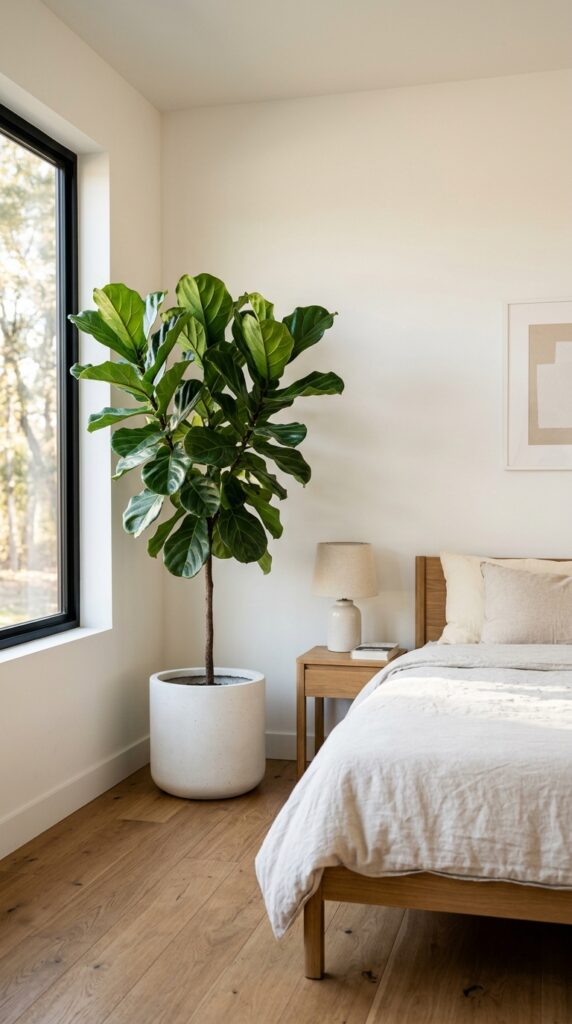
Vibe: Alive — the one living thing in the room, and it is enough.
Why it works: One large architectural plant in a minimalist bedroom introduces organic life — color, texture, and slow movement — without adding any object complexity. The design principle is singular botanical presence: one large plant with a strong, defined form reads as a design element; multiple small plants read as a collection that requires maintenance and visual management. The plant’s scale is critical — a small plant on a shelf reads as decoration; a floor-standing plant at 5–6 feet reads as architecture, occupying vertical space in the room with the same authority as furniture.
How to get it: Choose a plant with a strong, architectural silhouette — fiddle leaf fig (broad, sculptural leaves), snake plant (vertical, graphic), or olive tree (fine, silvery, asymmetric). Pot in a simple matte white or concrete vessel that is approximately 2/3 the diameter of the plant’s widest spread. Remove all other plants from the room; one architectural plant in a minimal space has far more impact than a curated plant shelfie.
Shop The Look
| Product |
| Fiddle leaf fig live plant indoor large |
| Snake plant live large indoor low light |
| Matte white concrete planter large indoor |
| Concrete plant pot minimalist large |
| Plant saucer waterproof large floor |
25. Morning Ritual Surface: The Tray Edit
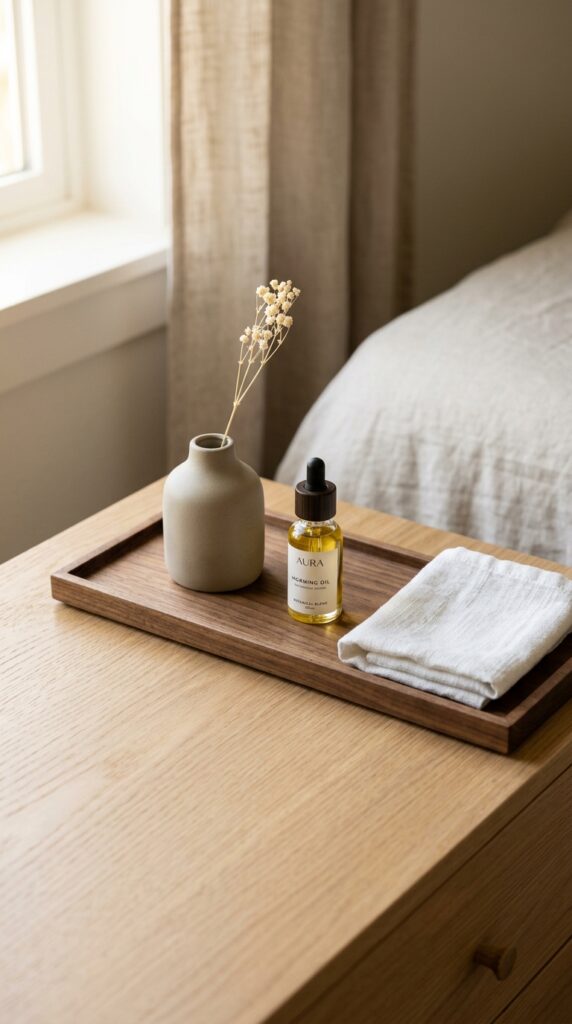
Vibe: Deliberate — three objects that know exactly what they are for.
Why it works: The tray edit is the minimalist bedroom’s most practical daily-life technique — it uses a defined tray perimeter to contain and organize the small personal objects that inevitably accumulate on bedroom surfaces, turning what would otherwise read as clutter into a composed still life. The design principle is bounded composition: a tray creates a frame, and anything within a frame reads as intentional regardless of what it is. The maximum object count on a bedroom tray is three — one tall, one medium, one small or flat — and all three should serve a function rather than existing as purely decorative.
How to get it: Choose a tray in warm walnut, dark slate, or matte concrete — materials with genuine weight and quality. Edit to three objects: remove everything currently on your bedside or dresser tray and return only the three items you actually use and reach for every morning. The fourth item you consider adding — return it to the drawer. The discipline of the three-object rule is what separates a tray vignette from surface accumulation.
Shop The Look
| Product |
| Walnut wood tray rectangular small minimal |
| Slate serving tray small decorative |
| Matte ceramic small dish tray ring holder |
| Dried stem single bud vase minimal |
| Linen hand cloth small square natural |
26. Small Minimalist Bedroom: The Capsule Room
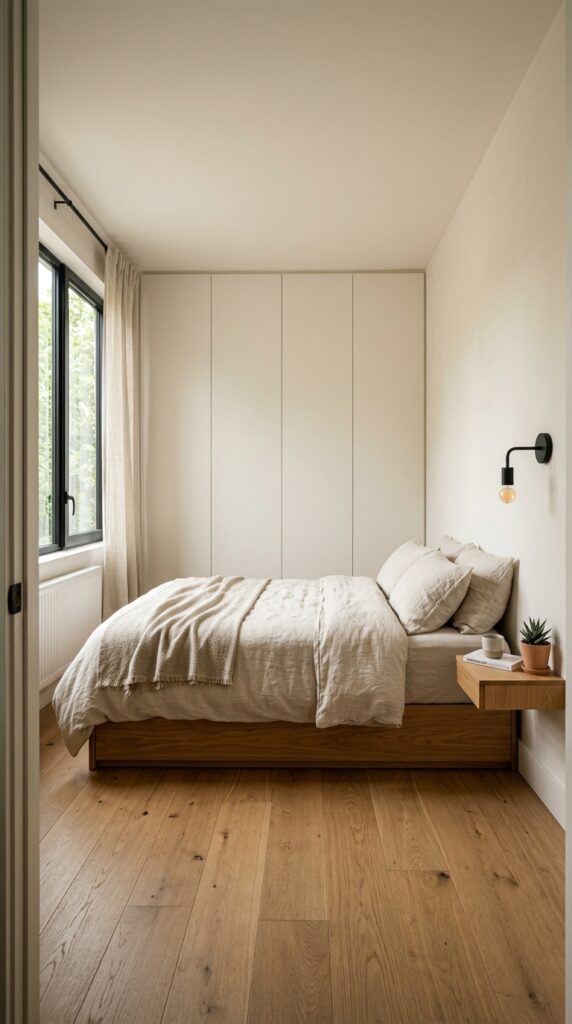
Vibe: Complete — every function met, nothing extra, the room needing nothing added.
Why it works: The capsule minimalist bedroom is the fullest expression of the style’s philosophy applied at the smallest scale — a room where every square foot serves a function, every surface is deliberately treated, and nothing exists without purpose. The design principle is maximum function at minimum footprint: a twin or full platform bed, one wall-mounted light, one floating shelf, and one flush wardrobe meets every human bedroom need within 100–120 square feet without compromise. The perceived spaciousness of this configuration — achieved through flush storage, a clear floor plane, and a warm-white palette — consistently surprises people who measure the room’s square footage before entering it.
How to get it: Treat the capsule bedroom as an optimization problem rather than a decorating one: list every function the room needs to serve (sleep, clothing storage, ambient light, task light, personal objects) and find the smallest-footprint, least-visually-intrusive solution for each. When every function has a solution, add nothing more. The capsule bedroom is finished when it has exactly what it needs — not when it feels comfortable enough to stop editing.
💡 Quick Win: Remove every object from your bedroom that doesn’t directly serve sleeping, dressing, or reading. Store the removed objects out of sight for two weeks. At the end of two weeks, return only the items whose absence you genuinely noticed. Most people return three to five objects; the rest stay in storage and are eventually given away.
Shop The Look
| Product |
| Twin platform bed white oak low profile |
| Full size platform bed minimal white oak |
| Wall mount sconce bedroom plug in minimal |
| Floating wall shelf bedroom nightstand small |
| Complete capsule bedroom furniture set minimal |
How to Start Your Minimalist Bedroom Transformation
The single correct first move is not buying anything — it is removing. Before any purchase, any paint, any new furniture: remove every object from the bedroom that does not serve sleep, dressing, or reading and place it in another room. This single act — which costs nothing and takes one hour — will reveal the room’s actual bones: its proportions, its light quality, its floor area, its wall space. Most people discover that the bedroom they wanted was already there, buried under accumulated objects. The first purchase comes only after the edit, and it is always paint: Benjamin Moore “White Dove” in Flat, applied to walls and ceiling simultaneously, which establishes the neutral field on which every subsequent decision becomes clearer.
The most common mistake in minimalist bedroom design is confusing minimalism with sparseness — creating a room that feels cold, unfinished, and accidentally empty rather than deliberately serene. This happens when the editing removes objects but doesn’t replace them with quality: a bare bed with cheap synthetic bedding, an empty wall with no considered material surface, a cleared dresser with a plastic lamp. The fix is always material quality over object quantity — one linen duvet, one piece of genuine art, one quality candle in a ceramic vessel communicates warmth and intention that ten mismatched objects cannot. Minimalism is not the absence of things; it is the presence of the right things.
Three specific items under $50 for immediate minimalist bedroom impact: a set of slim black velvet hangers ($12–$18 for 50) that unify any open or visible wardrobe immediately; a single large abstract art print in warm neutral tones from a print shop ($15–$25 for a 24×30-inch print) hung alone with generous wall space around it; and a warm amber Edison LED bulb at 2200K ($8–$15) to replace the existing bulb in your bedside lamp and shift the room’s evening light temperature toward the warm, calm quality that minimalist bedrooms depend on.
A starter minimalist bedroom edit — paint, new bedding, bulb swap, and removed clutter — runs $150–$400 and takes one weekend. A mid-level transformation adding a new platform bed frame, pendant lights, and floor-to-ceiling blackout linen curtains runs $800–$2,000. A full minimalist renovation with integrated flush wardrobes, limewash plaster walls, wide-plank oak floors, and built-in storage runs $5,000–$15,000 depending on room size and specification. The investment calculus in minimalist design is different from other styles: fewer, more expensive pieces always outperform more, cheaper pieces — a $600 white oak platform bed will serve the room for twenty years; four $150 pieces of bedroom furniture will require replacement within five.
Frequently Asked Questions About Minimalist Bedroom Design
What is the difference between minimalist and Scandinavian bedroom design?
Both styles share an appreciation for natural materials, neutral palettes, and functional furniture, but they diverge in warmth and texture tolerance. Scandinavian design (particularly the hygge tradition) permits and encourages more textile layering, more botanical elements, more visible warmth through cushions, throws, and warm-toned wood — the goal is cozy comfort within a simple framework. Minimalist design is more austere: it specifically resists layering for its own sake and treats every added element as requiring justification. A Scandinavian bedroom might have five pillows, a chunky throw, a plant shelf, and a woven rug; a minimalist bedroom has two pillows, one material on the bed, one plant, and likely no rug. The shared territory is quality over quantity and natural materials over synthetic, but minimalism applies a more rigorous editing standard.
What colors work best in a minimalist bedroom?
The minimalist bedroom palette is built on warm neutrals — never cool ones. Warm white (Benjamin Moore “White Dove,” Farrow & Ball “Pointing,” Sherwin-Williams “Alabaster”) for walls and ceiling. Warm greige (Benjamin Moore “Pale Oak,” Farrow & Ball “Elephant’s Breath”) for a slightly warmer alternative. Warm charcoal (Sherwin-Williams “Grizzle Gray,” Benjamin Moore “Kendall Charcoal”) used only in bedding as the room’s single dark anchor. The critical rule is undertone consistency: every tone in the palette must carry a warm (yellow or brown) undertone. Cool greys, blue-toned whites, and any green with a blue cast introduce a coldness that conflicts with the warm, natural material palette that makes minimalist bedrooms feel inviting rather than clinical.
How do I add warmth to a minimalist bedroom without adding clutter?
Warmth in a minimalist bedroom comes entirely from material quality and light temperature — not from object quantity. The five most effective warmth additions that add no visual clutter: switch all bulbs to 2200K warm amber LED; choose 100% linen bedding over cotton (linen’s natural texture reads warmer); select white oak or walnut furniture over painted MDF (natural wood grain adds warmth at no visual cost); apply a warm limewash or Venetian plaster to the wall behind the bed (texture creates warmth without color); and add one quality candle in a ceramic vessel on the nightstand tray. These five changes warm a minimalist bedroom comprehensively without adding a single object that reads as decoration or clutter.
Can a minimalist bedroom have color?
Yes, but with strict conditions. Minimalist bedrooms accommodate one color departure from the neutral base, and that color must be natural in origin — the green of a single large plant, the warm charcoal of linen bedding, the amber of a ceramic vessel. Introduced colors — paint colors beyond warm white, colorful art prints, decorative textiles in non-neutral tones — can work if limited to a single element in the room and consistent with the warm undertone family. The test: remove the colored element mentally and ask whether the room is better or worse without it. If better, the color isn’t earning its place. A minimalist bedroom with a single deep burgundy throw pillow used deliberately can be more interesting than the same room in pure white — but only if every other element has been edited with equal precision.
How do I maintain a minimalist bedroom long-term?
The minimalist bedroom requires an ongoing editing practice, not a one-time renovation. The most reliable maintenance strategy is the one-in-one-out rule: every object brought into the bedroom requires removing one existing object. This prevents gradual re-accumulation, which is the primary failure mode of minimalist interiors — the careful renovation followed by slow drift back toward clutter over 12–18 months. A second strategy is the weekly surface reset: every surface in the room (nightstand, dresser top, floor) returns to its designated empty or minimal state once per week. Five minutes of active editing weekly prevents the months-long renovation required to recover from gradual accumulation. The minimalist bedroom is not a destination; it is a daily practice.
Ready to Create Your Dream Minimalist Bedroom?
These 26 ideas have moved through the complete architecture of minimalist bedroom design — from the foundational platform bed and warm white wall, through storage integration, lighting precision, material warmth, and the small-space techniques that turn a tight footprint into a serene retreat. Every idea in this list is, at its core, the same idea expressed differently: choose less, choose better, let the space itself be the experience. Start today by spending one hour removing — not buying, not planning, just removing — every object from your bedroom that doesn’t serve sleep, dressing, or rest. Set those objects outside the room and sleep in what remains. Most people sleep better that first night than they have in months. Save the ideas that felt like relief rather than effort — those are the ones that belong to your version of this.