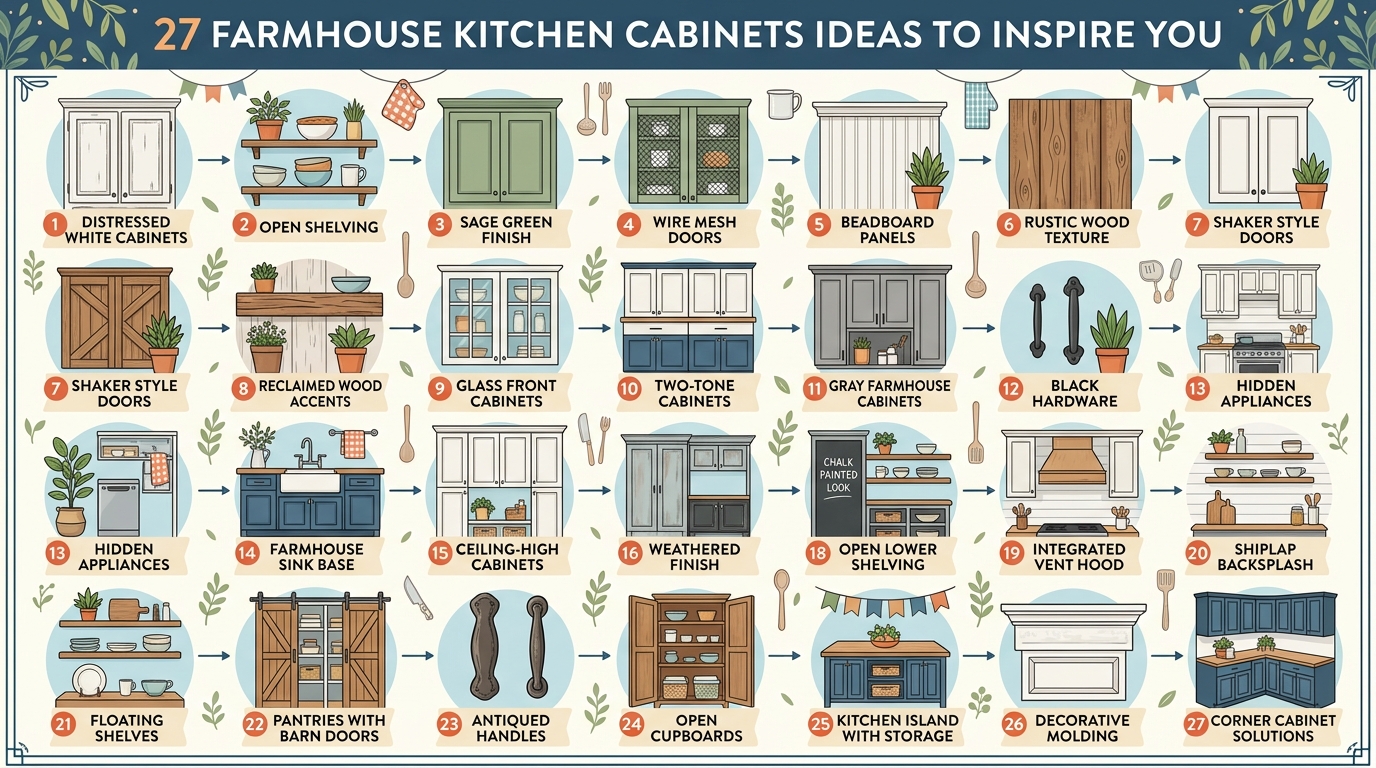
Farmhouse kitchen cabinets blend rustic warmth with everyday functionality — they’re characterized by shaker-style doors, natural wood tones, aged hardware, and a deliberately unpretentious feel rooted in 19th-century American rural homes. Here are 27 farmhouse kitchen cabinet ideas that cover color, material, layout, lighting, and more — every one worth saving.
There’s a particular stillness to a farmhouse kitchen. Morning light falling across apron-front sinks, the soft heft of a painted cabinet door, the honest grain of unfinished oak — it all adds up to a space that asks you to slow down. This style doesn’t perform. It simply is: grounded, lived-in, and quietly confident. Here are 27 ideas worth saving — and stealing.
Why Farmhouse Style Works So Well
Farmhouse design traces its roots to the functional vernacular architecture of 19th-century American rural life, where beauty was an accidental byproduct of utility. Unlike the deliberate curation of mid-century modern or the intellectual restraint of Scandinavian minimalism, farmhouse style evolved from genuine necessity — unpainted wood, durable iron hardware, open shelving for quick access. That honest origin is exactly why it resonates so deeply today.
The material palette is specific and repeatable: warm white (Benjamin Moore “Chantilly Lace” or Sherwin-Williams “Alabaster”), dusty sage, and creamy off-white anchor the color story. Textures lean into imperfection — shiplap paneling, bead-board cabinet inserts, butcher block counters, linen curtains, and unfinished white oak open shelves. Hardware is almost always unlacquered brass, aged bronze, or matte black in simple cup-pull or bin-pull profiles. You could shop a farmhouse kitchen from those descriptions alone.
Post-pandemic, people began questioning what their homes were actually for — and many concluded that warmth mattered more than visual novelty. Farmhouse style met that moment perfectly. Pinterest data has consistently shown “farmhouse kitchen” among the top searched interior terms since 2020, and the trend has only deepened as sustainability concerns push people toward natural materials and enduring aesthetics over fast-refresh design cycles.
Small kitchens can absolutely achieve this style — in fact, the farmhouse aesthetic was built for compact, working spaces. Prioritize a hero cabinet color in a soft warm white, add one open shelf to break up visual mass, and choose cup-pull hardware in an aged finish. Keep countertops clear and let a single functional object (a cast-iron pot, a ceramic crock) do the decorating.
Style at a Glance
| Element | Detail |
| Philosophy | Functional beauty; warmth over perfection |
| Key Materials | Unfinished white oak, shiplap, butcher block, linen, aged iron |
| Key Colors | Warm white, dusty sage, creamy off-white, warm charcoal |
27 Farmhouse Kitchen Cabinet Ideas
1. Warm White Shaker Cabinets with Unlacquered Brass Pulls
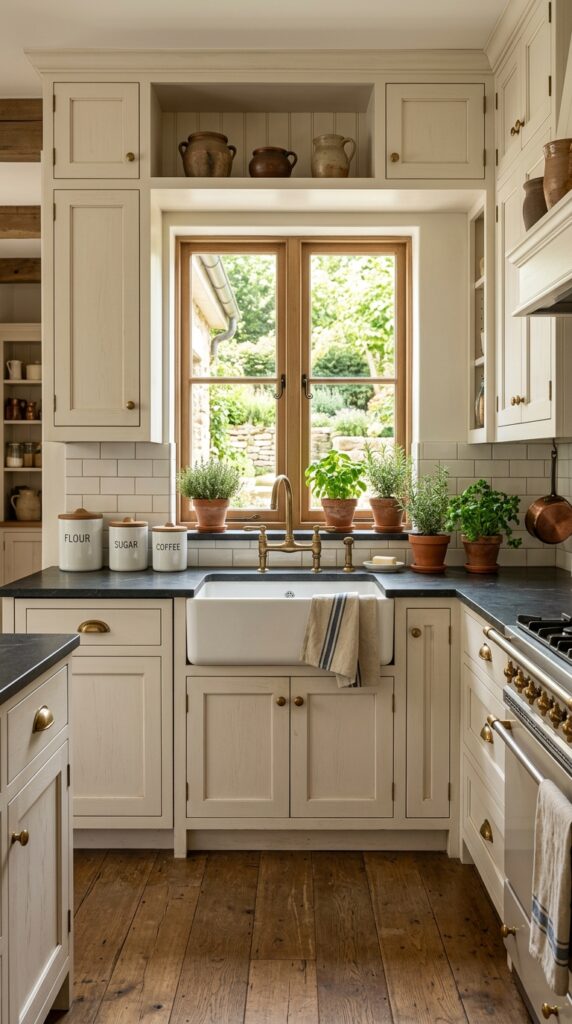
Vibe: Sun-warmed and still, like a kitchen that’s been well-loved for decades without ever trying too hard.
Why it works: Shaker-style cabinet doors are the defining silhouette of farmhouse kitchens — their recessed center panel creates a shadow line that adds visual depth without ornamentation. Warm white reads differently from stark white: it absorbs and softens natural light rather than reflecting it harshly, which keeps the space from feeling clinical. Unlacquered brass hardware evolves with age, developing a natural patina that reads as authenticity rather than decoration.
How to get it: Paint existing cabinets in Benjamin Moore “White Dove” (OC-17) — it has just enough warmth to read cream in natural light without going yellow. Swap hardware to 3¾” unlacquered brass cup pulls from a hardware retailer; install with a template jig for perfectly consistent placement.
💡 Quick Win: Replace just your sink cabinet doors with shaker-profile ones before committing to a full repaint — it’s a single Saturday project that previews the complete look for under $80.
🛍️ Shop the Look — Amazon Product Ideas
| # | Product Search Phrase | Why It Fits |
| 1 | unlacquered brass cup pulls 3.75 inch | Authentic aging hardware |
| 2 | shaker cabinet door replacement 24×30 | Shaker profile update |
| 3 | Benjamin Moore White Dove sample pot | Color preview tool |
| 4 | white ceramic kitchen canister set farmhouse | Countertop accent |
| 5 | linen dish towel set farmhouse stripe | Texture + warmth |
2. Two-Tone Cabinets: Greige Lowers, White Uppers
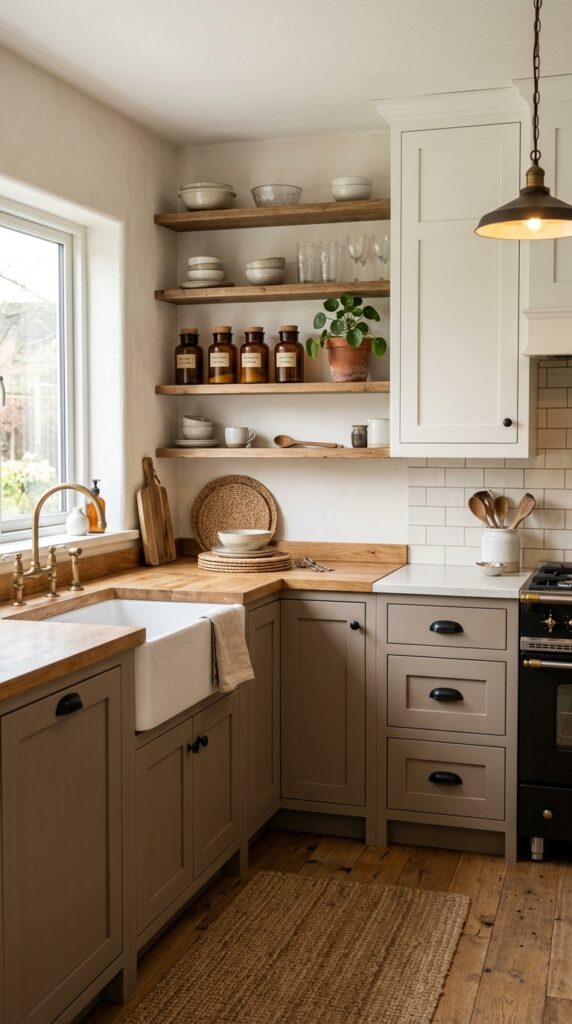
Vibe: Grounded at the base, open above — a kitchen that feels both anchored and light at the same time.
Why it works: Two-tone cabinetry uses the principle of visual weight distribution: heavier, deeper color at the lower cabinets grounds the space while pale uppers keep the eye moving up, making ceilings feel higher. The greige-to-white transition works specifically because greige (gray + beige) shares warm undertones with antique white — they’re from the same color family, preventing visual clash. Matte black hardware on the lowers adds contrast that sharpens the whole composition.
How to get it: Use Sherwin-Williams “Accessible Beige” (SW 7036) on lowers — it reads as warm greige in most lighting conditions. Paint uppers in “Alabaster” (SW 7008) for a soft antique white that doesn’t compete. Keep all hardware the same profile across both tones for cohesion.
🛍️ Shop the Look — Amazon Product Ideas
| # | Product Search Phrase | Why It Fits |
| 1 | matte black bin pull 5 inch cabinet hardware | Lower cabinet hardware |
| 2 | amber glass storage jars farmhouse | Open shelf styling |
| 3 | rattan woven placemats set of 4 | Natural texture accent |
| 4 | terracotta ceramic plant pot 4 inch | Warm color pop |
| 5 | paint sample pot Sherwin-Williams Accessible Beige | Color test first |
3. Open Shelving in White Oak
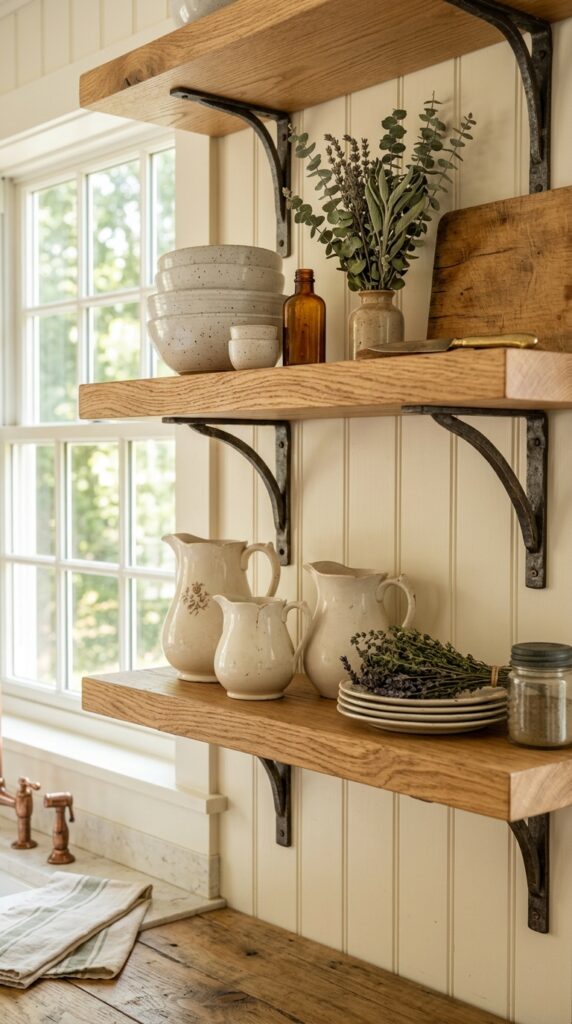
Vibe: Layered and lived-in, like shelves that evolved over years rather than being styled in an afternoon.
Why it works: Open shelving eliminates the visual mass of upper cabinet boxes, which makes small or medium kitchens feel noticeably more spacious. White oak specifically works in farmhouse spaces because its grain pattern is open and pronounced — it reads as natural rather than refined, carrying the honest material story the style depends on. The key design principle here is negative space: what you don’t put on the shelves matters as much as what you do.
How to get it: Source 2″-thick white oak slabs from a lumber yard (not a big-box store) and finish with Rubio Monocoat in “Pure” to preserve the natural tone without yellowing. Mount on hand-forged iron shelf brackets, spaced at 32″ intervals to prevent sag under ceramic weight.
💡 Quick Win: Add a single floating oak shelf above your stove for herb pots and a small cutting board — it’s a $60–$80 project that immediately reads as a farmhouse design feature.
🛍️ Shop the Look — Amazon Product Ideas
| # | Product Search Phrase | Why It Fits |
| 1 | white oak floating shelf bracket iron farmhouse | Shelf mounting hardware |
| 2 | ironstone pitcher white farmhouse kitchen | Classic shelf accent |
| 3 | dried eucalyptus bundle natural decor | Organic shelf element |
| 4 | white ceramic stacking bowls set | Functional shelf styling |
| 5 | Rubio Monocoat Pure wood finish | Natural wood sealant |
4. Sage Green Cabinets with Cream Subway Tile
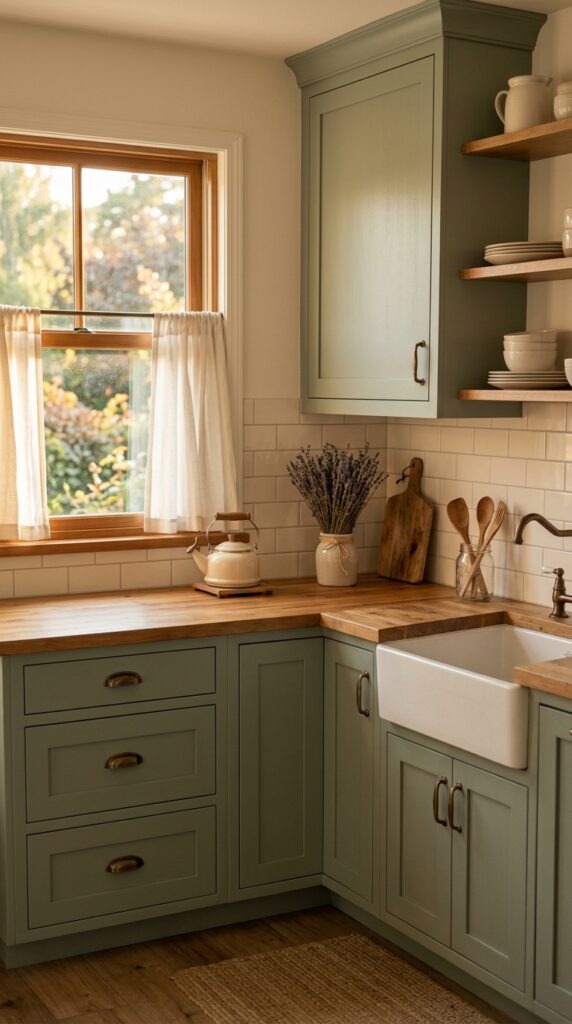
Vibe: Hushed and herb-scented — a kitchen that feels genuinely restful to stand in.
Why it works: Sage green sits in a specific, muted corner of the green spectrum that avoids feeling trendy or garish — it has enough gray in it to recede, which gives cream subway tile the room to hold visual attention. The combination works because both colors are pulled from the same historical palette used in English country houses and American Shaker communities. Aged bronze hardware reinforces that sense of time-earned patina without looking costume-y.
How to get it: Paint cabinets in Farrow & Ball “Mizzle” (No. 266) or Benjamin Moore “Aganthus Green” HC-140 for a dusty sage that ages beautifully under different light conditions. Grout subway tile in “Haystack” (Mapei) — a warm off-white that softens the grid without disappearing entirely.
🛍️ Shop the Look — Amazon Product Ideas
| # | Product Search Phrase | Why It Fits |
| 1 | aged bronze cabinet pull farmhouse 3.75 inch | Period-correct hardware |
| 2 | cream subway tile 3×6 backsplash | Backsplash material |
| 3 | butcher block countertop cutting board large | Counter surface warmth |
| 4 | white enamel stovetop kettle farmhouse | Sage complement accent |
| 5 | dried lavender bundle farmhouse decor | Scent + color accent |
5. Glass-Front Cabinet Inserts with Chicken Wire
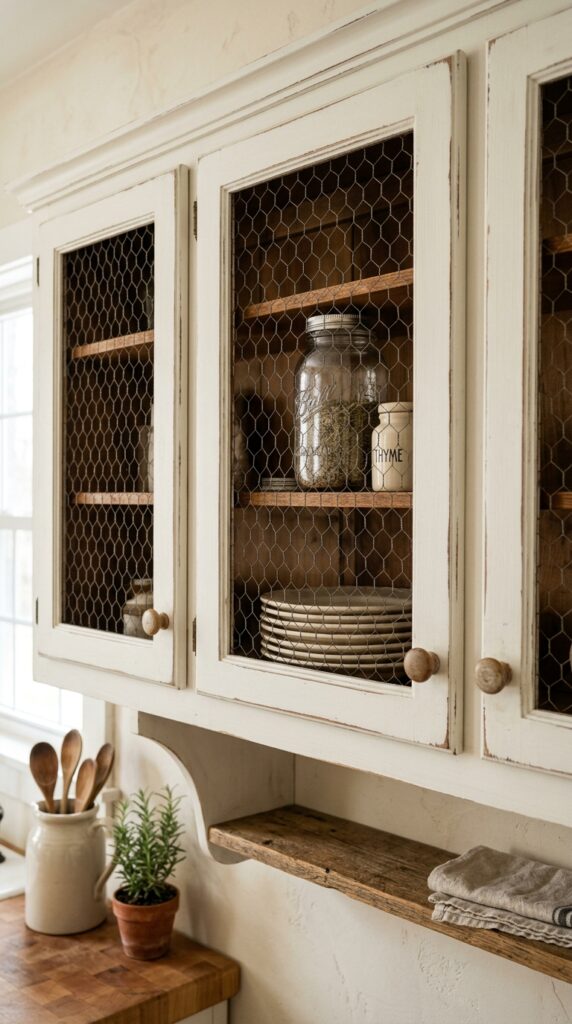
Vibe: Raw and nostalgic, like something rescued from an old general store and given a second life.
Why it works: Chicken-wire inserts in cabinet doors are a direct reference to the built-in pie safes and pantry cabinets of early American farmhouses — they provided ventilation while keeping pests out. In a modern context, they break up the solid face of upper cabinets with visual permeability, giving a glimpse of the shelves inside without the full commitment of open shelving. The wire pattern creates a fine geometric texture that contrasts well with the smooth painted door frame.
How to get it: Purchase flat-panel cabinet doors and have a local glass shop cut openings and frame them with routed channels. Source 19-gauge galvanized hardware cloth (not decorative chicken wire, which is too delicate) and staple it to the interior face of the door before reinstalling the glass retainer strips.
💡 Quick Win: Order pre-made chicken-wire cabinet door inserts from Etsy sellers who cut them to custom dimensions — budget $40–$70 per door, delivered ready to install.
🛍️ Shop the Look — Amazon Product Ideas
| # | Product Search Phrase | Why It Fits |
| 1 | galvanized hardware cloth 19 gauge roll | Chicken wire material |
| 2 | white ironstone dinner plates set farmhouse | Cabinet display styling |
| 3 | Ball mason jar set wide mouth 32oz | Classic cabinet accent |
| 4 | wooden cabinet knob round unfinished | Simple period hardware |
| 5 | ceramic spice jar set with labels farmhouse | Functional display item |
6. Beadboard Cabinet Doors in Antique White
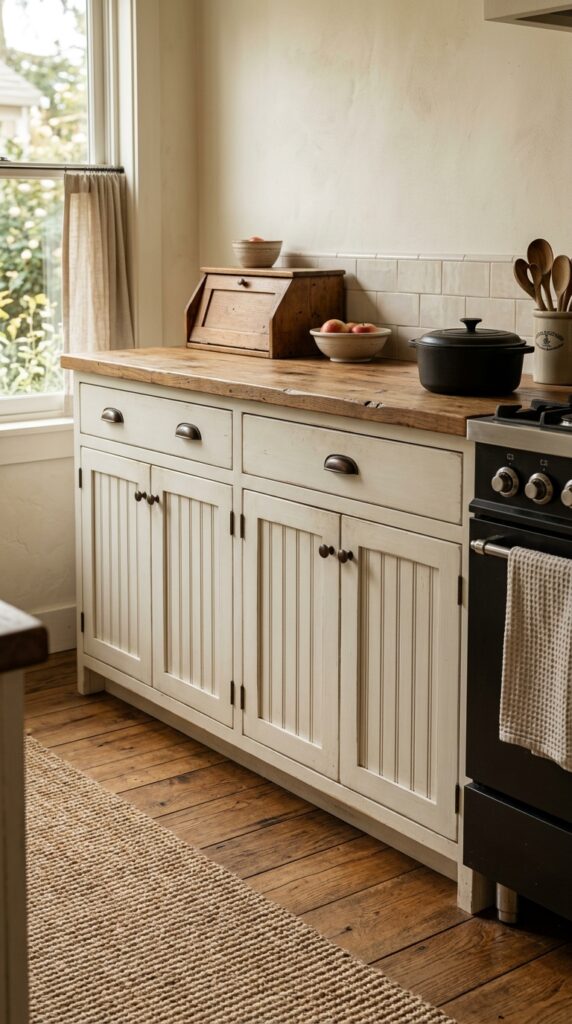
Vibe: Cottage-warm, like a kitchen that was clearly built for cooking actual meals by actual people.
Why it works: Beadboard — narrow vertical planks or routed grooves that mimic them — adds texture to an otherwise flat cabinet face, creating a vertical rhythm that echoes wall-height paneling and draws the eye upward. The grooves catch shadow, making them look more three-dimensional than their shallow depth suggests. Unlike shaker doors that rely on geometric simplicity, beadboard brings an almost textile-like surface quality that pairs especially well with antique white because the matte paint settles differently in the grooves than on the flat faces.
How to get it: Apply paintable beadboard wainscoting panels cut to cabinet door size, adhered to flat-front doors with construction adhesive and pin nails. Sand lightly, prime with Zinsser BIN shellac-based primer, and topcoat in Benjamin Moore “Linen White” OC-146 for an antique rather than bright finish.
🛍️ Shop the Look — Amazon Product Ideas
| # | Product Search Phrase | Why It Fits |
| 1 | paintable beadboard panel sheet 4×8 | Cabinet door texture |
| 2 | oil-rubbed bronze bin pull 3 inch | Period hardware match |
| 3 | seagrass kitchen runner rug farmhouse | Floor texture layer |
| 4 | wooden bread box farmhouse counter | Counter functional decor |
| 5 | cast iron Dutch oven 5 quart | Farmhouse cooking anchor |
7. Under-Cabinet Edison Bulb Strip Lighting
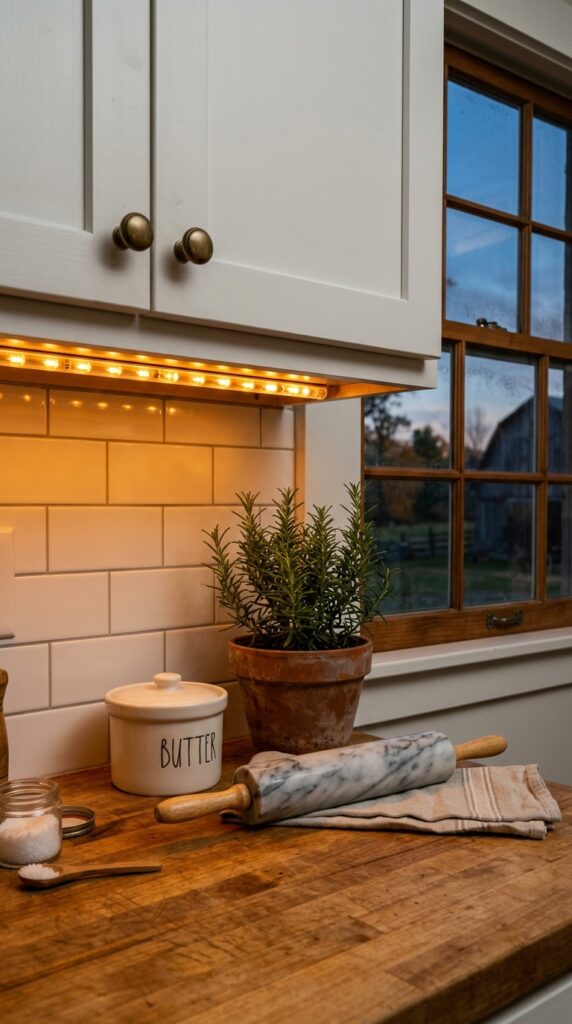
Vibe: Moody and intimate — the kitchen equivalent of candlelight, but actually practical.
Why it works: Under-cabinet lighting serves two design functions simultaneously: it provides task illumination for the counter surface, and it creates a warm pool of light that separates the cabinet zone from the counter zone, giving the kitchen layered depth. Edison-style LED strips specifically (rather than standard cool-white LEDs) emit light in the 2200–2700K range, which reads as amber-warm and complements wood tones and antique white paint without washing them out in yellow.
How to get it: Install plug-in LED strip lights rated at 2200K–2700K (warm amber) beneath the cabinet overhang with clip-in channels painted to match the cabinet underside. Run cords through a hole bored into the cabinet interior to hide the plug — pair with a simple switched outlet inside the cabinet.
💡 Quick Win: Plug-in puck lights in brushed brass (Brilliant Evolution brand, ~$30 for a 3-pack) are a zero-install under-cabinet solution that adds immediate warmth without drilling a single hole.
🛍️ Shop the Look — Amazon Product Ideas
| # | Product Search Phrase | Why It Fits |
| 1 | warm white LED under cabinet strip light 2700K | Task + ambiance lighting |
| 2 | plug-in puck light brushed brass set | No-install warm light |
| 3 | marble rolling pin kitchen farmhouse | Warm counter accent |
| 4 | ceramic butter crock farmhouse white | Classic countertop item |
| 5 | terracotta herb pot small set | Living counter element |
8. Charcoal Blue Navy Lower Cabinets
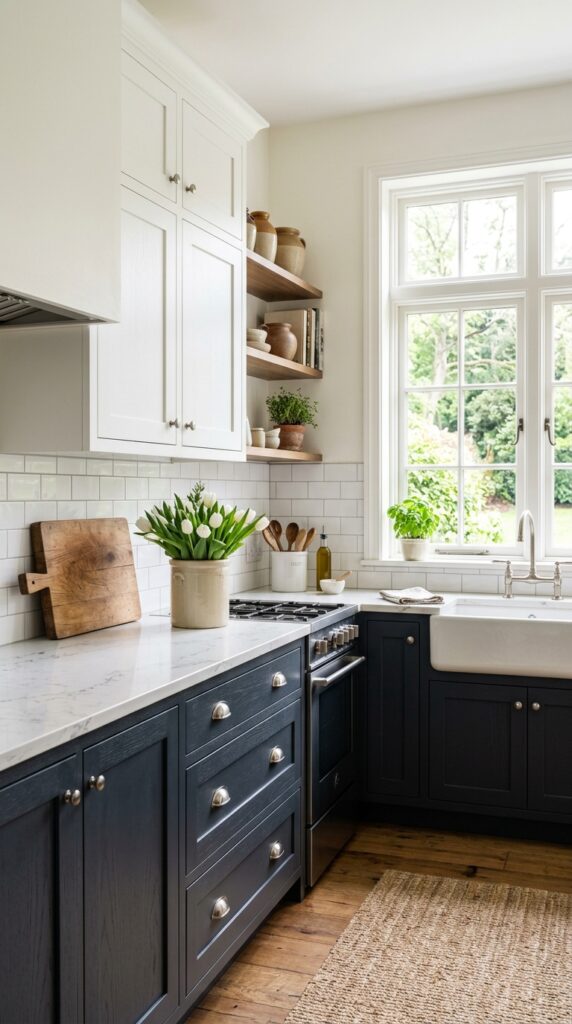
Vibe: Confident and grounded — a kitchen that doesn’t apologize for having a point of view.
Why it works: Deep charcoal-navy used on lower cabinets exploits the principle of visual anchoring: the heavy color grounds the base of the room, drawing the eye downward and making the overall composition feel stable rather than top-heavy. The specific charcoal-navy tone — which contains warm gray undertones rather than pure blue — avoids reading as stark or nautical, keeping it firmly within the farmhouse vocabulary. White uppers reflect light back into the space, balancing the weight below.
How to get it: Use Benjamin Moore “Hale Navy” HC-154 for the lowers — it’s a proven farmhouse-compatible navy that reads differently in morning light (bluer) versus evening light (deeper charcoal). Pair with brushed nickel cup pulls rather than brass to keep the combination from feeling too matchy.
🛍️ Shop the Look — Amazon Product Ideas
| # | Product Search Phrase | Why It Fits |
| 1 | brushed nickel cup pull 3.75 inch kitchen | Lower cabinet hardware |
| 2 | crockery vase white farmhouse kitchen | Counter floral anchor |
| 3 | marble effect quartz countertop sample | Counter material sample |
| 4 | Benjamin Moore Hale Navy paint sample | Color preview tool |
| 5 | wooden end grain cutting board large | Counter functional accent |
9. Reclaimed Wood Island Cabinet Base
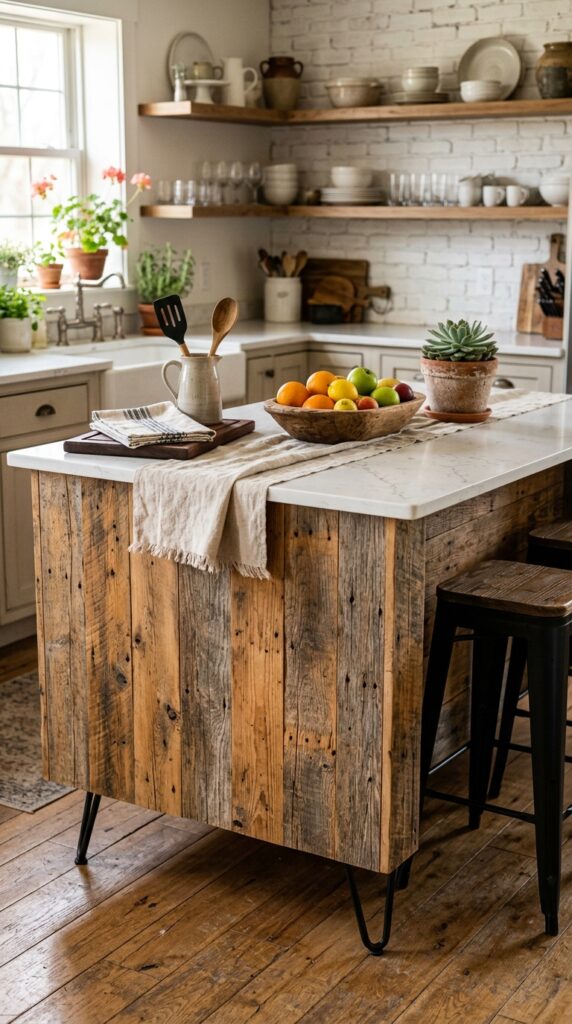
Vibe: Raw and time-worn — an island that looks like it was salvaged from a barn and made better by the journey.
Why it works: Reclaimed wood on an island base introduces material heterogeneity — the variation in plank color, grain, and character marks breaks the homogeneity of painted cabinetry in a way that feels earned rather than designed. The design principle at work is strategic contrast: pairing the raw, weathered base with a smooth, pale quartz top creates a tension between imperfection and polish that defines the most sophisticated farmhouse kitchens. Hairpin iron feet lift the base slightly, giving it furniture-like elegance.
How to get it: Source barn wood planks from a reclaimed lumber dealer or architectural salvage yard (price varies by region, typically $4–$12 per linear foot). Build a simple plywood box base, then face it with planks in a random-width pattern. Finish with a matte clear sealer to protect without covering the natural patina.
🛍️ Shop the Look — Amazon Product Ideas
| # | Product Search Phrase | Why It Fits |
| 1 | reclaimed wood wall panel planks adhesive | Wood facing material |
| 2 | black iron hairpin furniture legs set 4 | Island base feet |
| 3 | wooden fruit bowl farmhouse rustic | Island surface anchor |
| 4 | linen table runner natural farmhouse | Island top styling |
| 5 | small concrete or stone succulent planter | Organic counter accent |
10. Floor-to-Ceiling Pantry Cabinets in Warm White
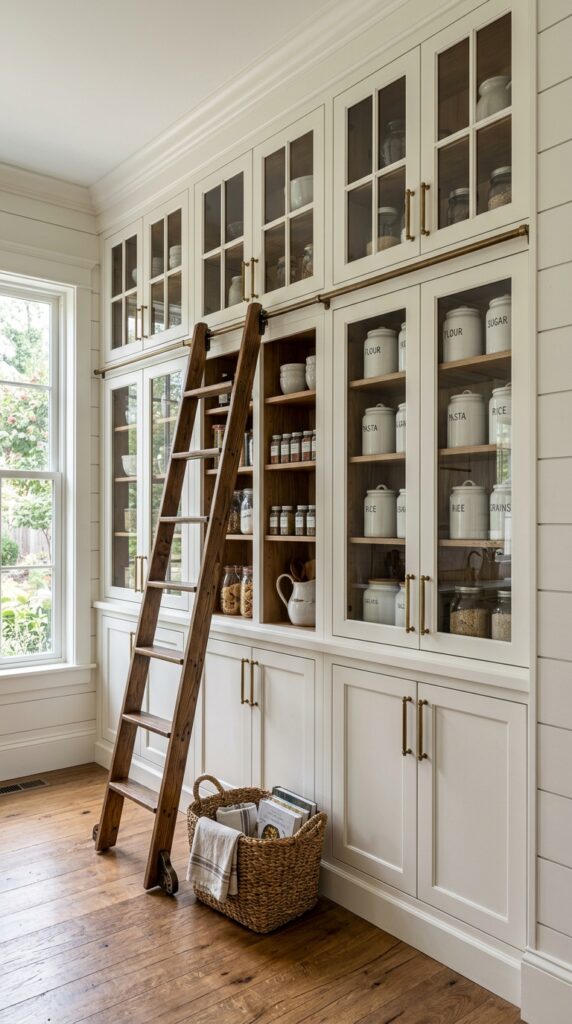
Vibe: Quietly ordered — the kind of organized that feels calm rather than rigid.
Why it works: Floor-to-ceiling cabinetry eliminates the awkward gap between cabinet tops and ceiling — a gap that collects dust and breaks the vertical line of the room. When cabinets run ceiling-height, the wall reads as a unified architectural element rather than furniture sitting in a room. The proportion shift also makes ceiling heights feel deliberate, not accidental. A rolling library ladder adds both function and a visual narrative — the suggestion of a working kitchen rather than a showroom.
How to get it: Specify cabinets built to ceiling height (add filler strips and crown molding at the ceiling line) rather than standard 30″ upper cabinets. Frame upper doors with glass inserts for the top row to keep the tall wall from feeling like a solid dark mass.
💡 Quick Win: Add a simple wooden ladder (painted or natural) leaning against pantry cabinets — it adds the floor-to-ceiling visual story without any installation, for under $45.
🛍️ Shop the Look — Amazon Product Ideas
| # | Product Search Phrase | Why It Fits |
| 1 | antique brass bar pull 8 inch cabinet | Pantry door hardware |
| 2 | wood decorative ladder small farmhouse | Pantry visual accent |
| 3 | white ceramic pantry canister set large | Organized pantry display |
| 4 | woven seagrass basket large storage | Floor-level organization |
| 5 | glass front cabinet door insert panel | DIY glass insert option |
11. Butcher Block Countertops with White Painted Cabinets
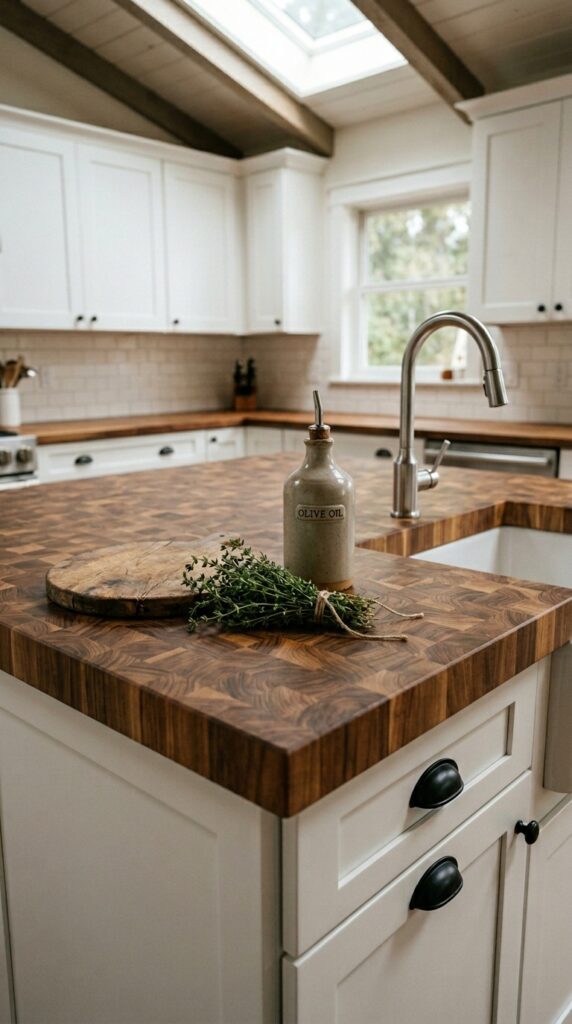
Vibe: Sun-warmed and functional — a counter surface that looks better every time you use it.
Why it works: Butcher block’s warmth against white painted cabinets is a textbook application of complementary contrast — cool white and warm wood sit opposite each other on the temperature scale, making both elements look more alive. The wood also introduces organic texture at eye level where counters are most visible, grounding a kitchen that might otherwise feel sterile in all-white. Importantly, butcher block shows age as beauty — knife marks, oil stains, and wear become character rather than damage.
How to get it: Choose hard maple (end-grain for cutting boards, edge-grain for general counters) and finish monthly with food-safe mineral oil, followed by a beeswax-mineral oil blend sealant. Avoid polyurethane — it creates a plastic film that chips and requires stripping rather than refreshing.
🛍️ Shop the Look — Amazon Product Ideas
| # | Product Search Phrase | Why It Fits |
| 1 | food-safe mineral oil butcher block conditioner | Counter maintenance must |
| 2 | beeswax wood butter countertop finish | Sealing + protection |
| 3 | stoneware olive oil dispenser farmhouse | Counter cooking accent |
| 4 | small round wooden cutting board | Counter styling accent |
| 5 | chrome bridge faucet farmhouse kitchen | Classic faucet style |
12. Apron Sink Cabinet with Decorative Panel
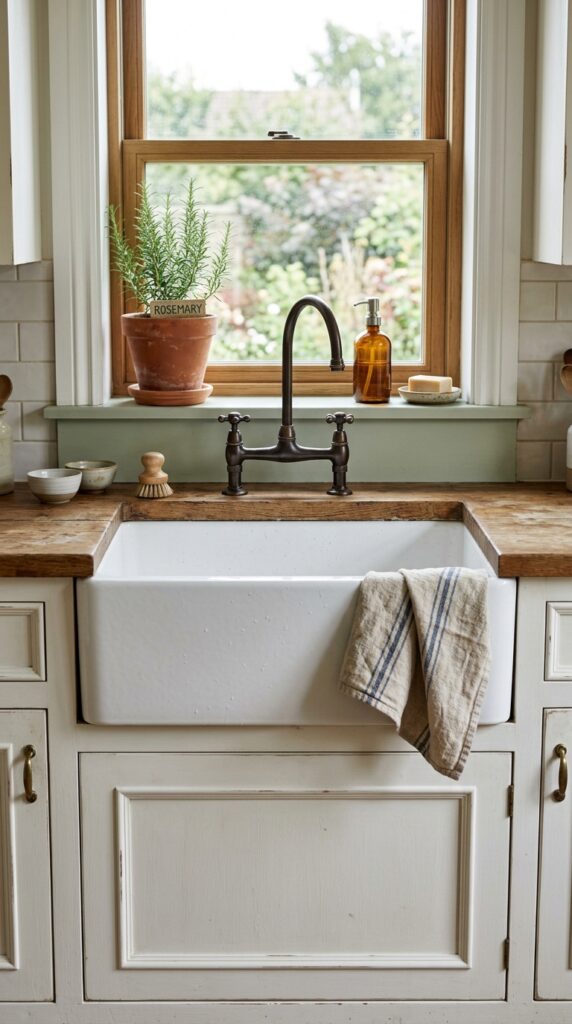
Vibe: Anchoring and deliberate — the apron sink is the hearth of this kitchen, the thing everything else is organized around.
Why it works: The apron-front (farmhouse) sink originated in homes without indoor plumbing, where deep basins held water for multiple tasks. Its exposed front face made cabinet depth impractical, creating the distinctive open-apron look that defines the style. In contemporary kitchens, this visible front is a design feature: it breaks the unbroken line of cabinet fronts and creates a focal point at the sink wall. The decorative panel on the apron front adds shadow and texture where most sinks offer only blank cabinetry.
How to get it: If retrofitting an existing kitchen, note that farmhouse sinks require a specially built or modified base cabinet — the sink sits forward of the standard cabinet box. Purchase a sink-base cabinet specifically rated for farmhouse/apron installation, or have a local cabinet maker modify the existing base to remove the front face and support the sink from below.
🛍️ Shop the Look — Amazon Product Ideas
| # | Product Search Phrase | Why It Fits |
| 1 | fireclay farmhouse apron front sink 30 inch | Sink anchor piece |
| 2 | oil-rubbed bronze gooseneck bridge faucet | Period-correct faucet |
| 3 | cotton waffle dish cloth set farmhouse | Sink-side textile |
| 4 | small ceramic soap dispenser farmhouse | Counter utility accent |
| 5 | windowsill herb planter farmhouse ceramic | Sink window greenery |
13. Open Lower Cabinets with Wicker Basket Drawers
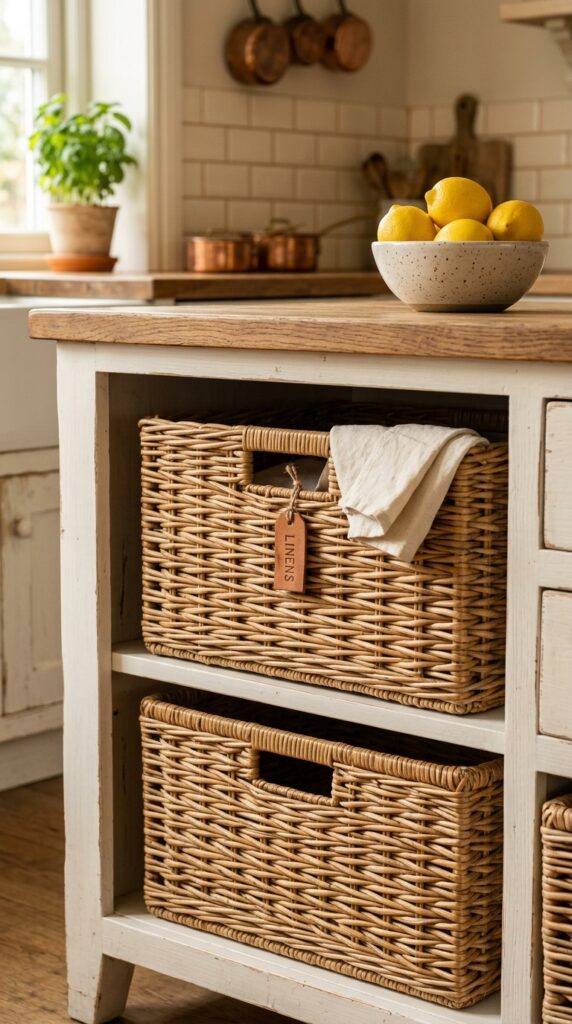
Vibe: Natural and unhurried — organized in a way that actually breathes.
Why it works: Open base shelving with wicker basket inserts solves a classic storage challenge: the need for contained organization without the visual closedness of cabinet doors. Wicker introduces the organic woven texture that anchors farmhouse style — it references the handcraft traditions the aesthetic draws from. The slightly varied tones in natural wicker (some honey, some pale tan) prevent the look from feeling mass-produced, even when the baskets are purchased identically.
How to get it: Remove base cabinet doors and store them. Measure the interior shelf depth and width, then order seagrass or rattan baskets from a home goods retailer, sized to slide in with ½” clearance on each side. Label baskets with hanging brass tags or chalk tags for a functional farmhouse finish.
💡 Quick Win: A set of 3–4 seagrass pull-out bins ($18–$28 each at most home goods stores) transforms open lower cabinet shelves into styled storage in under 10 minutes.
🛍️ Shop the Look — Amazon Product Ideas
| # | Product Search Phrase | Why It Fits |
| 1 | seagrass basket bin set kitchen storage | Open shelf organizer |
| 2 | wicker basket with handle farmhouse label | Labeled storage option |
| 3 | hanging brass tag label set chalkboard | Farmhouse basket labels |
| 4 | ceramic lemon bowl farmhouse kitchen | Counter color accent |
| 5 | linen tea towel set natural stripe | Basket-tucked textile |
14. Staggered Upper Cabinet Heights for Visual Interest
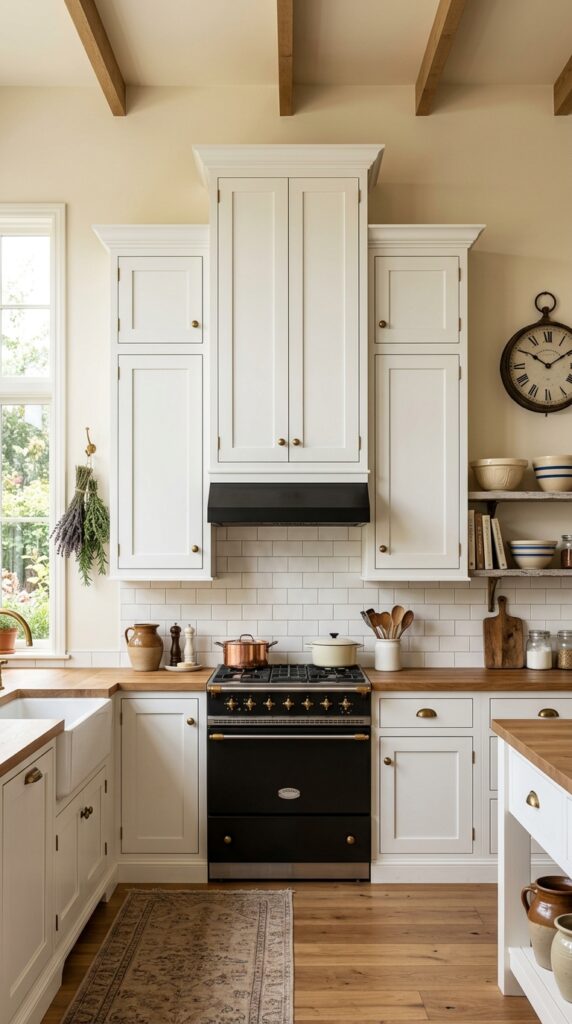
Vibe: Structured but not stiff — a kitchen with personality built into its architecture rather than just its accessories.
Why it works: Staggered upper cabinet heights create architectural rhythm — the variation in the cabinet roofline prevents the visual flatness that occurs when all cabinets terminate at the same height. The taller central cabinet above the stove acts as a visual anchor for the cooking zone, framing the stove as the kitchen’s functional heart. This is the design principle of hierarchy: one element is given prominence, which makes the surrounding elements feel intentionally placed rather than randomly distributed.
How to get it: When ordering or specifying cabinets, request one or two taller 42″ upper cabinets for key focal points (above the stove, above a window) and standard 30″ or 36″ cabinets elsewhere. Apply crown molding at each individual cabinet height rather than running a continuous line — this emphasizes rather than smooths the variation.
🛍️ Shop the Look — Amazon Product Ideas
| # | Product Search Phrase | Why It Fits |
| 1 | antique brass cabinet knob farmhouse 1.25 inch | Hardware for varied heights |
| 2 | farmhouse wall clock large white | Wall accent above cabinets |
| 3 | dried herb bundle kitchen hook decor | Cabinet-adjacent wall accent |
| 4 | crown molding paintable wood trim | Cabinet top molding |
| 5 | white ceramic mixing bowl set nesting | Open shelf display |
15. Chalk Paint Distressed Cabinet Finish
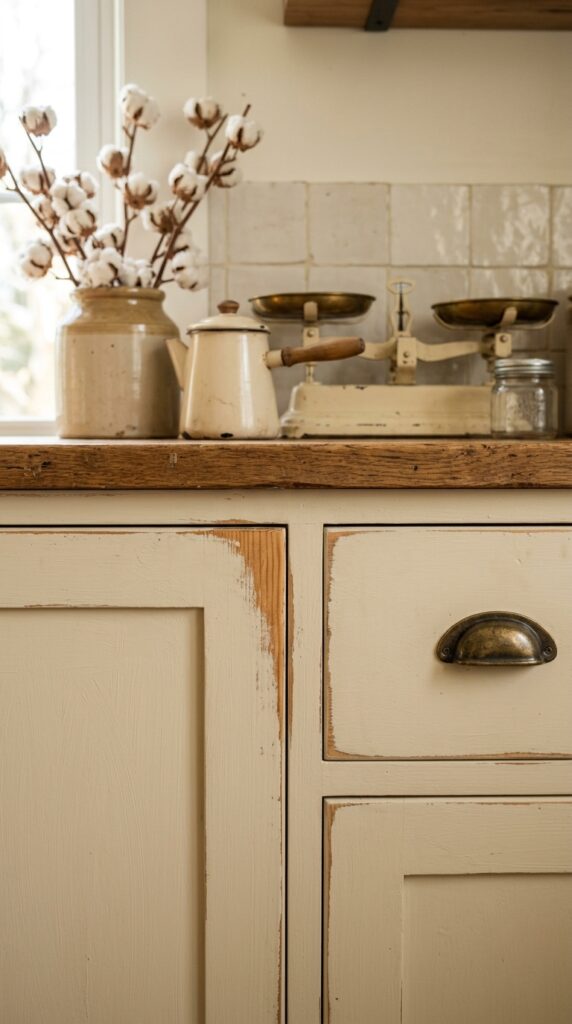
Vibe: Vintage and time-worn — the kind of finish that makes new cabinets look like they’ve always been there.
Why it works: Chalk paint’s characteristic matte, porous texture absorbs light rather than reflecting it, which eliminates the sheen that makes modern cabinets look factory-made. The deliberate distressing at edges and corners simulates genuine wear patterns — furniture and cabinets naturally show age first at contact points — making the effect credible rather than theatrical. The warmth of the underlying wood showing through the edges adds a color gradient that plain painted cabinets cannot achieve.
How to get it: Apply Annie Sloan Chalk Paint in “Old White” directly to clean, dry cabinet doors — no primer needed. After two coats and full drying, lightly sand edges with 120-grit sandpaper, focusing on corners, door edges, and hardware surrounds. Seal with Annie Sloan Clear Wax to protect without adding sheen.
💡 Quick Win: One quart of Annie Sloan Chalk Paint covers approximately 150 square feet — enough for a small kitchen’s upper cabinets and costs around $40, making this a genuinely budget-accessible full-look project.
🛍️ Shop the Look — Amazon Product Ideas
| # | Product Search Phrase | Why It Fits |
| 1 | Annie Sloan chalk paint Old White quart | Distressed finish paint |
| 2 | clear furniture wax chalk paint sealer | Protective matte finish |
| 3 | vintage kitchen scale antique style | Counter period accent |
| 4 | dried cotton stems bunch natural decor | Soft counter styling |
| 5 | small white enamel coffee pot farmhouse | Counter narrative piece |
16. Cabinet Hardware Gallery Wall of Black Iron
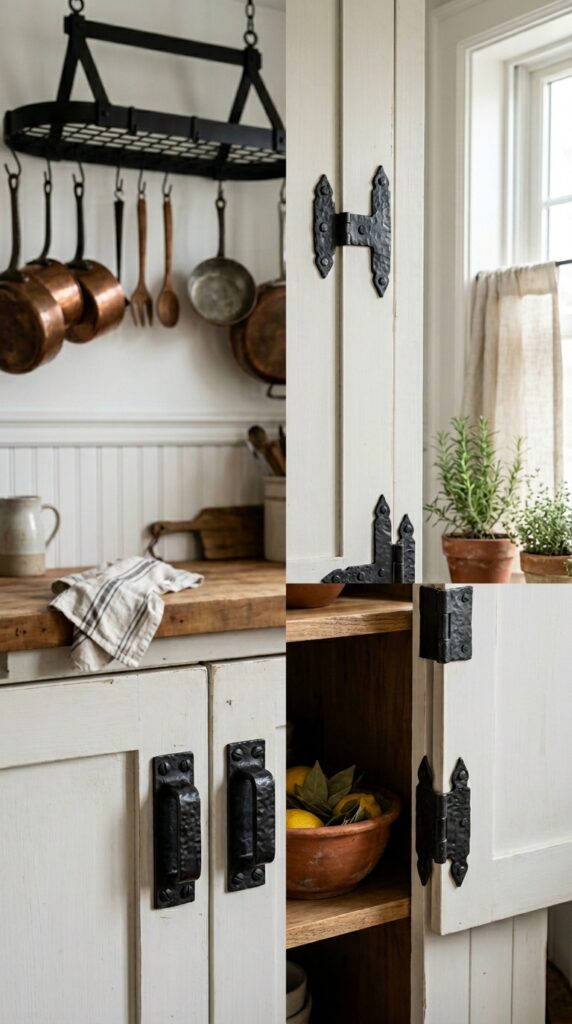
Vibe: Artisan and grounded — hardware that reads like it was made by hand, not stamped from a machine.
Why it works: Matte black iron hardware on white cabinets creates maximum contrast at the smallest scale — the dark hardware pops against light cabinet faces, making each door feel intentionally detailed. When that hardware reads as hand-forged (textured, slightly irregular, with square profiles and exposed screw heads), it shifts the entire kitchen’s material story from “updated farmhouse” to “historically considered.” The contrast principle here is dual: color contrast (black on white) reinforced by texture contrast (rough iron on smooth paint).
How to get it: Source hand-hammered iron pulls from specialty hardware suppliers — search for “Colonial Iron Works” or similar. Install all hardware at exactly the same position on every door using a simple cardboard drilling template: consistency in placement makes the imperfection of the hardware look intentional rather than sloppy.
🛍️ Shop the Look — Amazon Product Ideas
| # | Product Search Phrase | Why It Fits |
| 1 | hand-forged matte black iron cup pull farmhouse | Artisan cabinet hardware |
| 2 | black strap hinge cabinet door decorative | Period hinge detail |
| 3 | black iron pot rack ceiling mount kitchen | Overhead statement piece |
| 4 | cabinet hardware drilling template jig | Precise installation tool |
| 5 | terracotta bowl set farmhouse kitchen | Warm counter color |
17. Kitchen Hutch in Antique Pine
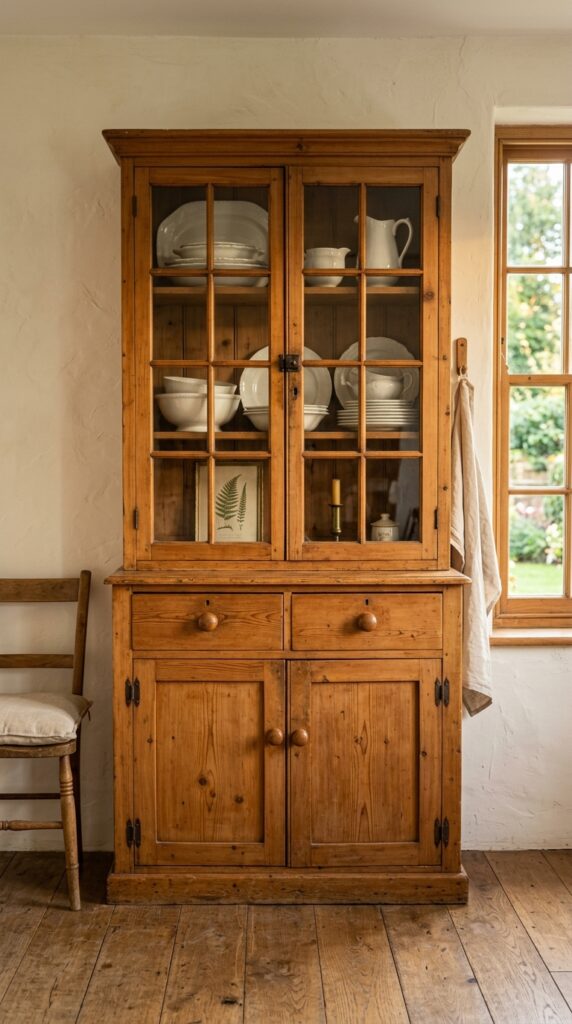
Vibe: Nostalgic and warm — furniture that remembers something, even if you don’t know exactly what.
Why it works: A freestanding hutch introduces the visual language of antique furniture into a kitchen dominated by built-in cabinetry — it’s the piece that makes a kitchen feel curated rather than installed. Antique pine specifically ages to a warm amber that no new wood or paint can replicate; its surface carries the evidence of time in a way that reads as genuine. The combination of display shelves above and concealed storage below solves both function and style: the glass fronts are selective — you only display what you want to show.
How to get it: Search architectural salvage shops, estate sales, and rural antique stores for original hutches before buying reproduction pieces — original pine hutches often cost less than reproduction versions and bring genuine character. Spot-clean and wax with a paste furniture wax rather than refinishing — the aged surface is the point.
🛍️ Shop the Look — Amazon Product Ideas
| # | Product Search Phrase | Why It Fits |
| 1 | freestanding farmhouse hutch cabinet white wood | Standalone display storage |
| 2 | white ironstone platter serving set | Hutch display styling |
| 3 | brass candlestick holder farmhouse table | Display shelf accent |
| 4 | botanical framed print kitchen farmhouse | Leaning shelf art |
| 5 | paste furniture wax clear neutral | Hutch maintenance product |
18. Lantern Pendants over a Kitchen Island
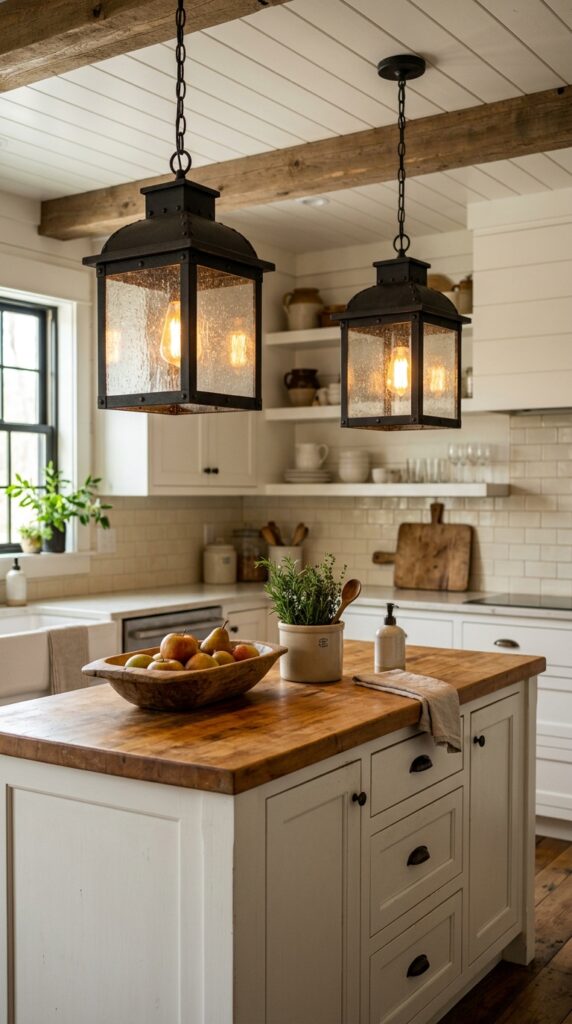
Vibe: Layered and golden — a kitchen that looks entirely different, and better, after dark.
Why it works: Pendant lighting over an island serves three purposes: task illumination, zone definition, and vertical visual anchoring. Lantern-style pendants specifically — with their framed, four-sided profile — are drawn directly from barn lanterns and outdoor gas fixtures, making them visually coherent in a farmhouse context. Seeded glass panels diffuse the bulb’s light while remaining translucent, creating a glow rather than a glare. The downward-facing light also dramatically improves the visibility of food prep without creating the shadowless flatness of recessed lighting.
How to get it: Hang pendants at 30″–36″ above the island surface — measured from the countertop, not the floor. In kitchens with 9′ ceilings, hang at 30″; for 10’+ ceilings, allow up to 36″. Space two pendants at one-third and two-thirds of the island length for balanced proportion.
🛍️ Shop the Look — Amazon Product Ideas
| # | Product Search Phrase | Why It Fits |
| 1 | black iron lantern pendant light seeded glass | Island focal lighting |
| 2 | Edison bulb vintage filament E26 set | Pendant bulb warmth |
| 3 | large wooden dough bowl farmhouse decor | Island anchor piece |
| 4 | small crock herb planter farmhouse kitchen | Counter living element |
| 5 | pendant light canopy black adjustable rod | Pendant hanging hardware |
19. Narrow Galley Kitchen with All-White Cabinets
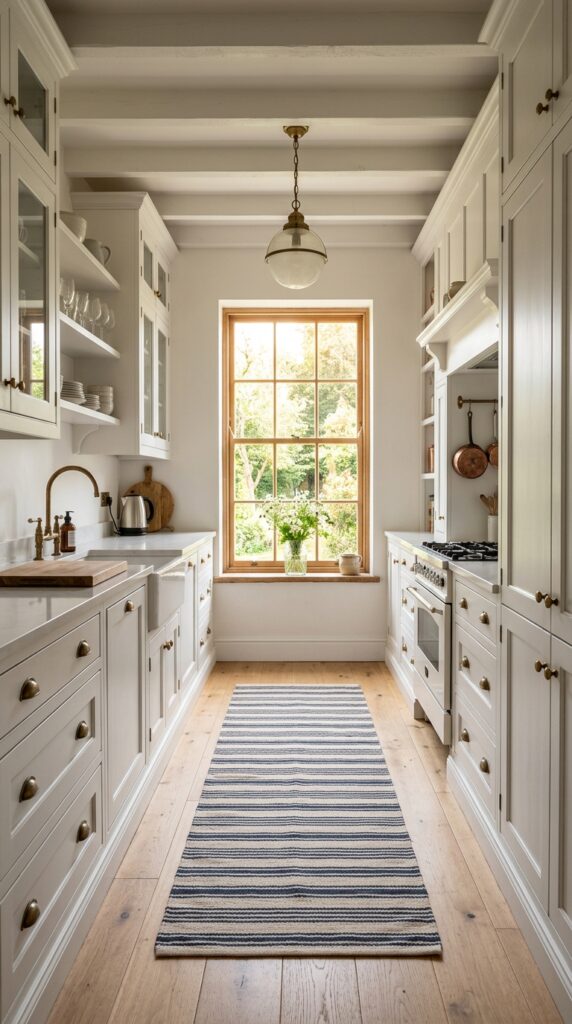
Vibe: Orderly and light-filled — a small kitchen that doesn’t waste a single inch but still manages to breathe.
Why it works: In a galley layout, all-white cabinetry works by maximizing light reflectance — white bounces available light from the end window back and forth between opposing wall surfaces, making the corridor feel longer and wider than it is. The critical technique is the runner rug: placed on the floor between opposing cabinet runs, it provides the visual anchor that prevents all-white from feeling cold or clinical. The pattern in the runner also breaks the uninterrupted white horizontal plane at floor level.
How to get it: Keep upper and lower cabinets in the same white — no two-tone in a galley, as it breaks the continuous brightness that makes the space feel open. Draw the eye toward the light source by keeping the window at the end wall clear of obstruction, with only a single small object on the sill.
💡 Quick Win: A striped cotton runner in blue-and-cream ($35–$55 online) transforms an all-white galley from cold to characterful in five minutes flat — no tools, no paint.
🛍️ Shop the Look — Amazon Product Ideas
| # | Product Search Phrase | Why It Fits |
| 1 | cotton stripe kitchen runner rug blue cream | Galley floor anchor |
| 2 | slim cup pull white cabinet 3 inch | Small space hardware |
| 3 | single-stem bud vase ceramic white small | Windowsill minimal accent |
| 4 | overhead pendant light farmhouse small galley | Galley ceiling light |
| 5 | cabinet door bumper pads clear adhesive | Quiet close upgrade |
20. Shiplap Backsplash Behind Open Shelves
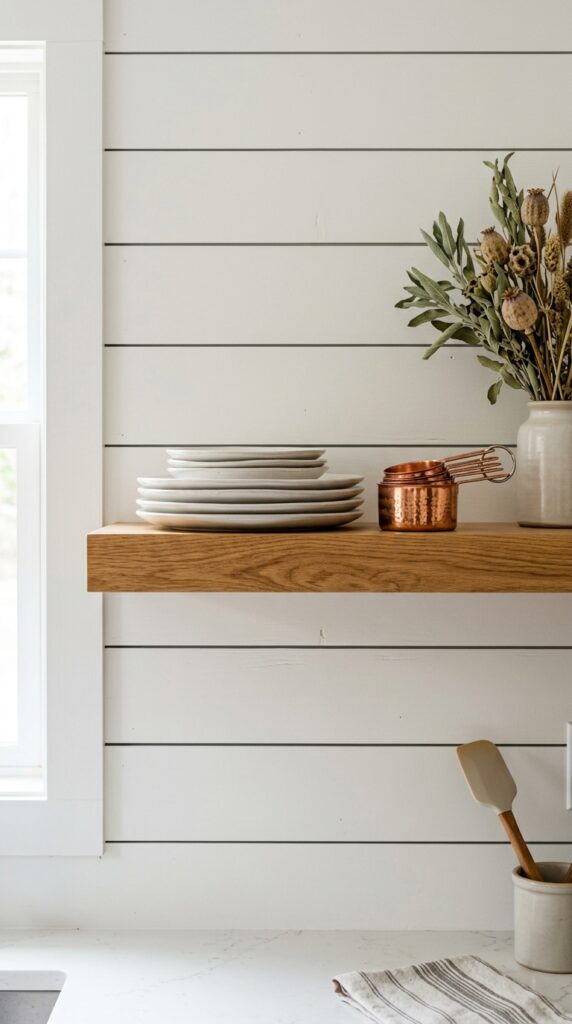
Vibe: Textural and layered — a wall surface that earns its keep even before a single object is placed in front of it.
Why it works: Shiplap used as a backsplash rather than a standard tile creates an entirely different kind of wall surface — one defined by horizontal lines and shadow rather than grid and grout. The horizontal boards create the illusion of width, a critical asset in any kitchen layout. When shelves float in front of shiplap, the boards visible between and behind the shelf levels create a sense of visual depth — the wall appears to recede, making the room feel larger than it is.
How to get it: Use ¼” MDF shiplap panels (not solid wood) for the backsplash area near the stove — they lie perfectly flat and are easier to paint. Apply with construction adhesive and finish nails. Paint with a semi-gloss sheen (higher than walls) so steam and splash wipe away cleanly.
🛍️ Shop the Look — Amazon Product Ideas
| # | Product Search Phrase | Why It Fits |
| 1 | shiplap peel and stick wall panels white | Easy shiplap application |
| 2 | copper measuring cup set hanging display | Warm shelf accent |
| 3 | dried botanical stems arrangement | Organic shelf layering |
| 4 | white ceramic stack plates display set | Shelf functional display |
| 5 | construction adhesive paneling shiplap | Shiplap installation supply |
21. Vintage-Inspired Hardware with Ceramic Knobs
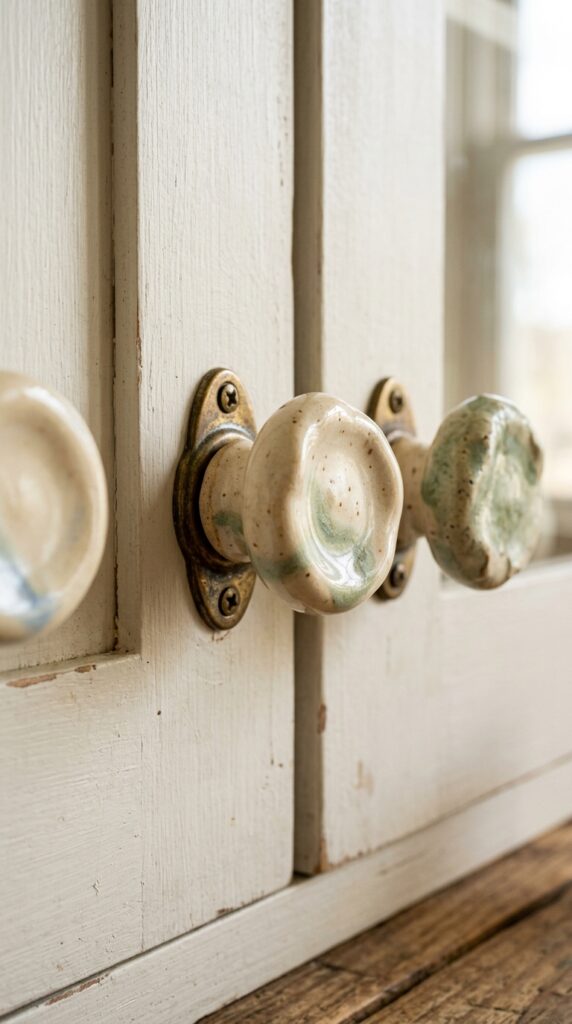
Vibe: Intimate and handcrafted — the detail that makes visitors lean in for a closer look.
Why it works: Ceramic cabinet knobs operate at the finest scale of design detailing — they’re the element most people notice at arm’s reach, where broader design choices fade from view. Hand-glazed ceramics bring variability: each knob catches light slightly differently, holds glaze at slightly different depths, making an entire kitchen feel more carefully considered than it would with factory-stamped hardware. The principle in play is tactile contrast: smooth painted cabinets benefit from the dimensional, slightly irregular surface of a ceramic knob.
How to get it: Source hand-thrown ceramic knobs from independent ceramicists on Etsy rather than big-box stores — expect $6–$14 per knob, which adds up for a full kitchen but pays off in character. Specify ¾” post length if retrofitting existing holes; or request custom lengths for thicker doors.
🛍️ Shop the Look — Amazon Product Ideas
| # | Product Search Phrase | Why It Fits |
| 1 | handmade ceramic cabinet knob farmhouse set | Artisan hardware centerpiece |
| 2 | ceramic glaze knob cream sage set | Sage-toned option |
| 3 | brass screw post cabinet knob insert | Hardware mounting supplies |
| 4 | cabinet knob backplate aged brass round | Hardware detail upgrade |
| 5 | white painted shaker cabinet touch-up kit | Door maintenance paint |
22. Warm Terracotta Accent Wall Behind White Cabinets
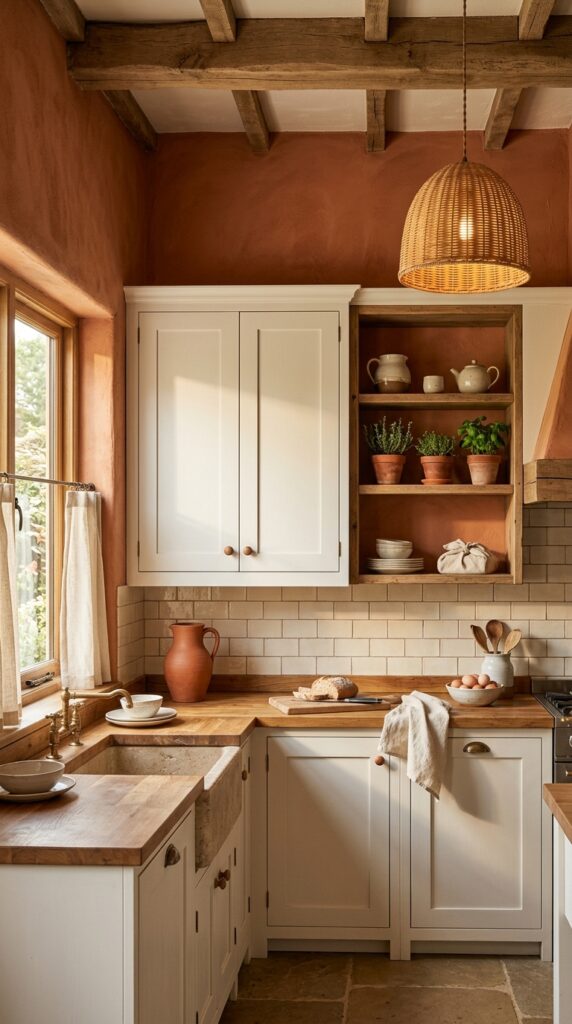
Vibe: Earthy and grounded — a kitchen that feels connected to the land, not the showroom.
Why it works: Terracotta as a wall color behind white cabinets creates warm contrast without competition: the clay tone recedes slightly in most lighting while giving white cabinet fronts a rich backdrop that makes them look brighter and crisper. The terracotta-to-white contrast works because the colors are analogous in warmth — both have yellow undertones — which prevents visual conflict while still creating clear differentiation. This is the design principle of warm-warm contrast: two warm tones in different values create harmony rather than clash.
How to get it: Paint in Benjamin Moore “Tucson Tawny” (2173-30) or Sherwin-Williams “Cavern Clay” (SW 7701) — both are the dusty, muted end of terracotta rather than the garish orange end. Apply only above cabinet height and on walls behind open shelving; leaving cabinet-height walls white keeps the lower portion from feeling enclosed.
🛍️ Shop the Look — Amazon Product Ideas
| # | Product Search Phrase | Why It Fits |
| 1 | terracotta paint sample Sherwin Williams Cavern Clay | Color preview |
| 2 | terracotta ceramic pot kitchen farmhouse set | Cabinet color echo |
| 3 | rattan woven pendant light shade farmhouse | Ceiling warmth texture |
| 4 | natural cream linen curtain panel | Soft window treatment |
| 5 | jute basket with leather handle farmhouse | Floor texture anchor |
23. Corner Cabinet with Lazy Susan and Glass Doors
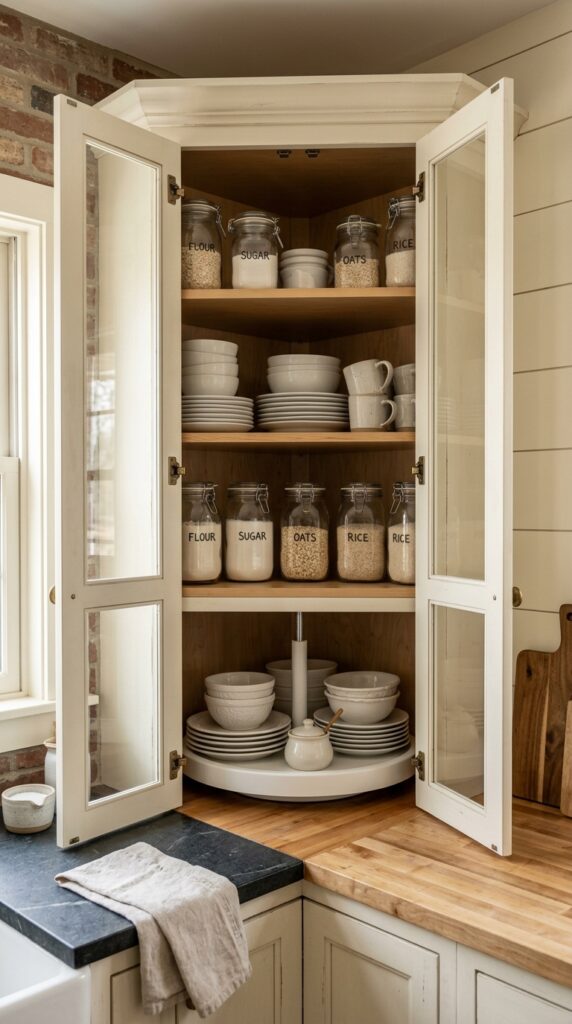
Vibe: Quietly efficient — storage that earns its footprint by actually working.
Why it works: Corner cabinets are notoriously dead space in traditional kitchens — deep and inaccessible unless equipped with proper hardware. A lazy Susan mechanism solves the functional problem while glass doors solve the aesthetic one: glass keeps the corner from becoming a solid mass of painted wood and creates a transparent window into the storage within. In farmhouse kitchens, this matters because the style prizes honest display — showing what’s inside rather than concealing everything behind opaque doors.
How to get it: Replace existing corner cabinet doors with glass-front versions — a local cabinetmaker can retrofit frames for approximately $150–$250 per door. Install a quality full-round lazy Susan (not a kidney-shaped one) rated for your shelf diameter; the Knape & Vogt brand produces reliable, heavy-duty versions for around $45–$70.
🛍️ Shop the Look — Amazon Product Ideas
| # | Product Search Phrase | Why It Fits |
| 1 | lazy Susan turntable cabinet organizer round | Corner cabinet function |
| 2 | glass cabinet door insert corner farmhouse | Glass door option |
| 3 | white ceramic serving bowl set stackable | Corner display styling |
| 4 | clear glass jar canister set pantry | Cabinet display storage |
| 5 | brass cabinet knob bifold door small | Corner door hardware |
24. Painted Cabinet Interior in Dusty Blue
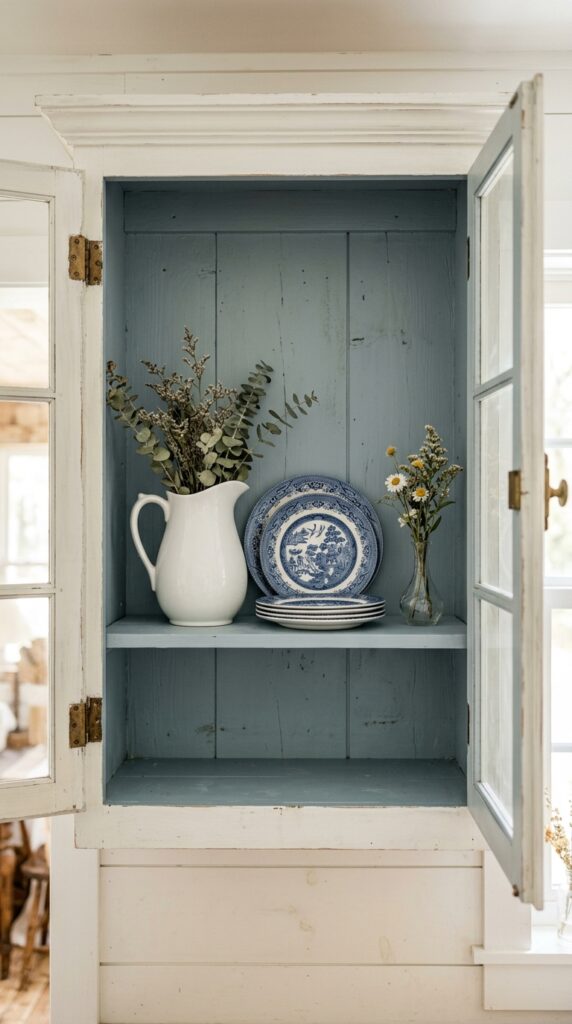
Vibe: Quietly surprising — a detail discovered gradually, not announced.
Why it works: Painting only the interior of glass-front cabinets creates a visible color field that appears to be deeper within the cabinet than the exterior surface — it adds visual depth. The dusty blue-gray works specifically because it’s a receding color: blues and cool-neutrals appear to push back when used as backgrounds, making the shelves and objects in front of them appear to float. White dishware against dusty blue creates the same relationship as typography on a colored page — maximum readability and elegance.
How to get it: Paint cabinet interiors (back wall and side walls only) in Farrow & Ball “Borrowed Light” No. 235 — a legendary dusty blue-gray that works in both low and high light. Tape carefully at the door frame line and use a 1″ brush for the back corners. One quart covers most standard upper cabinets.
💡 Quick Win: This is the most dramatic inside-the-cabinet change you can make for under $15 in paint — it requires zero hardware, no door removal, and about 90 minutes per cabinet box.
🛍️ Shop the Look — Amazon Product Ideas
| # | Product Search Phrase | Why It Fits |
| 1 | Farrow and Ball Borrowed Light paint sample | Interior cabinet color |
| 2 | blue transferware dinner plate set farmhouse | Cabinet display styling |
| 3 | white ceramic pitcher farmhouse kitchen | Against-blue display piece |
| 4 | small glass bud vase set farmhouse | Delicate shelf accent |
| 5 | foam angled paintbrush 1 inch cabinet | Detail painting tool |
25. Integrated Appliance Panel Fronts in Shaker Style
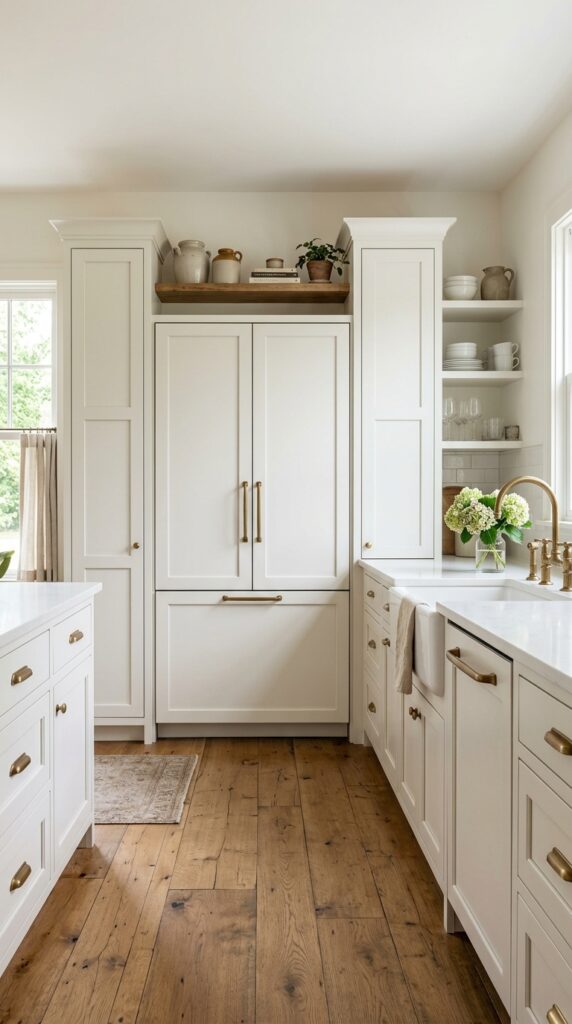
Vibe: Serene and unified — a kitchen where your eye moves across the room without anything breaking the composition.
Why it works: Panel-front appliances eliminate the most anti-farmhouse element in modern kitchens: reflective stainless steel. Stainless interrupts the warm, matte, textural vocabulary of farmhouse design with a cold, industrial material that belongs to a different aesthetic entirely. By covering appliances in matching shaker panel fronts, the entire kitchen wall reads as a single continuous cabinet composition — the eye moves across it without snagging on a stainless-steel interruption. This is the design principle of visual continuity through material consistency.
How to get it: Order panel-ready appliances (many dishwasher and refrigerator brands offer panel-ready versions) and have your cabinet supplier fabricate matching panel fronts to fit the appliance frames. Most cabinet makers offer this as a standard service. The refrigerator cabinet surround typically requires a custom built-in frame to achieve the flush-panel look.
🛍️ Shop the Look — Amazon Product Ideas
| # | Product Search Phrase | Why It Fits |
| 1 | dishwasher panel front kit shaker white | Appliance panel cover |
| 2 | recessed flush cabinet pull antique brass | Integrated pull handle |
| 3 | cabinet filler strip shaker profile white | Panel gap filler |
| 4 | panel adhesive construction bond cabinet | Panel installation supply |
| 5 | white shaker overlay door 24×34 replacement | Panel front material |
26. Compact Kitchen with Single Statement Cabinet Wall
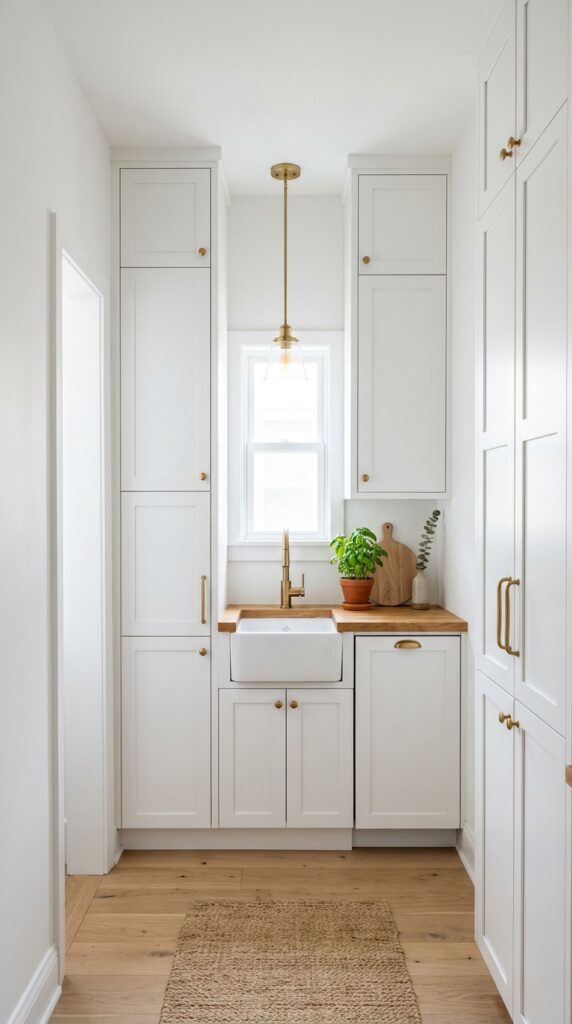
Vibe: Still and considered — a small kitchen that feels deliberate rather than limited.
Why it works: In a compact kitchen, committing to one impactful design element — a full wall of farmhouse cabinetry — works better than attempting partial farmhouse gestures everywhere. The principle is concentration: focus all the design investment on a single wall, execute it with precision (ceiling height, quality hardware, a proper sink), and let everything else be minimal. The tall cabinets also maximize storage, solving the small-kitchen problem that keeps most compact spaces feeling cluttered — without enough concealed storage, accessories pile up and the farmhouse look becomes impossible to maintain.
How to get it: Measure the single best wall in your compact kitchen — typically the longest or the one most visible from the entry. Specify floor-to-ceiling shaker cabinets for that wall only, and keep opposing walls in plain white. This approach costs approximately 40% less than a full kitchen cabinet replacement while delivering nearly the same visual impact.
🛍️ Shop the Look — Amazon Product Ideas
| # | Product Search Phrase | Why It Fits |
| 1 | mini farmhouse apron sink 24 inch small | Compact sink choice |
| 2 | small brass cup pull 2.5 inch cabinet | Small space hardware |
| 3 | slim pendant light farmhouse small kitchen | Space-smart lighting |
| 4 | compact herb planter countertop terracotta | Minimal living accent |
| 5 | thin profile cutting board wall mounted | Space-saving counter tool |
27. Scallop-Edge Cabinet Trim for Vintage Charm
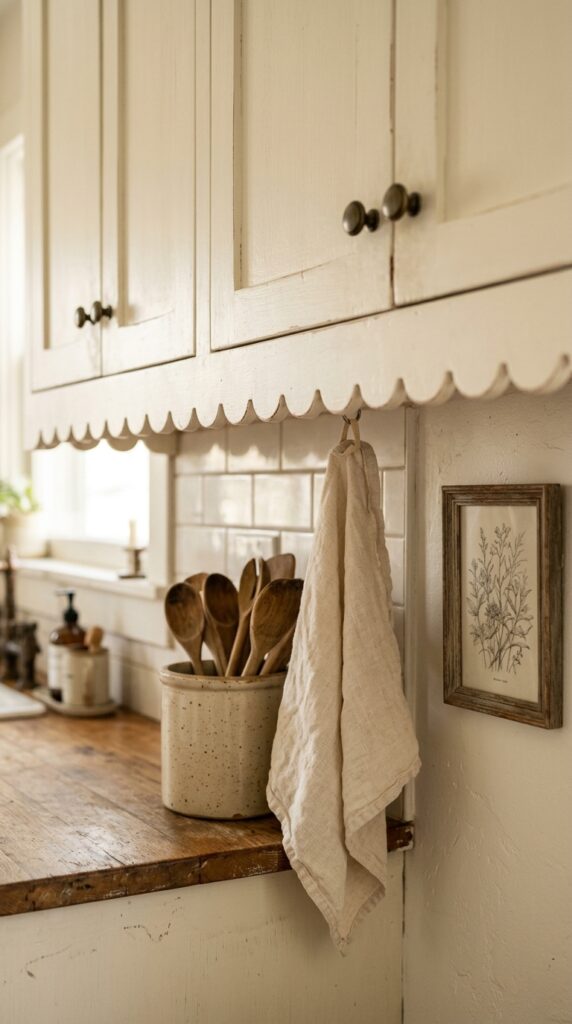
Vibe: Charming and detail-rich — the kind of architectural whimsy that makes a kitchen feel genuinely designed rather than installed.
Why it works: Scallop-edge trim on the base rail of upper cabinets is a reference to the decorative trim found on antique pie safes, open dressers, and 19th-century country kitchen furniture. It’s purely decorative — but decoration deployed at the right scale creates the sense that someone cared enough to choose this rather than that. The principle at work is ornamental punctuation: a single decorative detail placed at a transition point (where cabinet meets open air above the counter) gives the eye somewhere to rest and appreciate.
How to get it: Router a scallop profile along a 1″ × 3″ poplar strip — or purchase pre-routed decorative trim from a millwork supplier — and attach it to the bottom face rail of existing upper cabinets with wood glue and pin nails. Sand, prime with shellac-based primer, and paint to match the cabinets. The entire trim run for a standard kitchen costs under $40 in materials.
💡 Quick Win: Pre-routed scalloped wood trim strips are available from millwork suppliers and online lumber retailers for approximately $3–$5 per linear foot — the cheapest architectural detail you can add to farmhouse cabinets.
🛍️ Shop the Look — Amazon Product Ideas
| # | Product Search Phrase | Why It Fits |
| 1 | decorative scallop wood trim strip paintable | Cabinet apron trim material |
| 2 | pin nail gun 18 gauge trim nailer | Trim installation tool |
| 3 | Zinsser BIN shellac primer spray | Trim priming product |
| 4 | botanical print framed kitchen wall art | Beside-cabinet accent |
| 5 | ceramic crock white large farmhouse counter | Below-cabinet counter anchor |
How to Start Your Farmhouse Kitchen Cabinet Transformation
The one first move is to repaint your existing cabinet doors in Benjamin Moore “White Dove” (OC-17). Not a different white — this specific one. White Dove has warm undertones that prevent the stark, hospital-brightness of cooler whites, and its slightly creamy character means it reads as antique white in north-facing kitchens while staying crisp in south-facing ones. This single action anchors every subsequent farmhouse decision, because every hardware choice, countertop material, and accessory choice will be made against this established warm-white foundation.
The most common mistake beginners make is choosing hardware in too many finishes. A kitchen with brushed nickel faucets, aged brass pulls, chrome light fixtures, and matte black hinges looks chaotic — each finish pulls in a different direction. Pick one metal family (aged brass is the most versatile for farmhouse) and apply it consistently to pulls, hinges, faucet, and light fixtures. Inconsistent hardware is the single most common reason a farmhouse kitchen looks unfinished rather than curated.
For under $50, three items create immediate farmhouse impact: a bundle of dried pampas grass ($14–$20) in a secondhand stoneware crock, a cotton waffle-weave dish towel in natural linen ($8–$12 at most linen shops), and a small cutting board propped against the backsplash ($12–$22 at kitchen goods stores). These three objects cost almost nothing but read as intentional styling decisions that pull the whole room into focus.
Realistically, a weekend accomplishes cabinet repainting (including door removal, sanding, and two coats) and hardware swaps. A starter farmhouse kitchen — paint, new hardware, styling accessories — is achievable for $200–$600. A fuller transformation with new countertops, open shelving additions, and a farmhouse sink runs $3,000–$8,000 depending on market and scope. A full cabinet replacement in farmhouse style typically falls between $8,000–$20,000.
Frequently Asked Questions About Farmhouse Kitchen Cabinets
What’s the difference between farmhouse and cottage style kitchen cabinets?
Farmhouse and cottage kitchen styles overlap significantly, but farmhouse draws from American rural utility traditions — it tends toward larger scale, more rustic materials, and a less precious aesthetic. Cottage style, by contrast, leans British and slightly more decorative, with more color variation, floral references, and delicate hardware. Farmhouse kitchens typically feature shaker doors, apron sinks, and aged iron or brass hardware; cottage kitchens might include painted tongue-and-groove cabinet panels, china knobs, and softer, more pastel color palettes. If your instinct is toward Sherwin-Williams “Alabaster” and an unlacquered brass pull, you’re farmhouse. If you’re reaching for “Duck Egg Blue” and a ceramic flower knob, you’re cottage.
What is the best paint color for farmhouse kitchen cabinets?
Benjamin Moore “White Dove” (OC-17) and Sherwin-Williams “Alabaster” (SW 7008) are the two most reliable warm whites for farmhouse cabinets — both have creamy undertones that prevent harshness in natural light. For colored farmhouse cabinets, Farrow & Ball “Mizzle” (No. 266) is the gold standard dusty sage, and Benjamin Moore “Hale Navy” (HC-154) is the definitive farmhouse navy. Avoid pure whites like “Chantilly Lace” for cabinets in low-light kitchens — they read as gray-blue without sufficient natural light.
How much does it cost to get farmhouse-style kitchen cabinets?
Cost varies dramatically by approach. Repainting existing cabinets in a farmhouse color typically costs $300–$800 in materials if DIY, or $1,500–$4,000 professionally sprayed. New semi-custom shaker cabinets from retailers like IKEA (AXSTAD or BODBYN fronts) run $3,000–$7,000 for a medium kitchen. Full custom farmhouse cabinets from a cabinetmaker cost $15,000–$40,000 for a full kitchen. Hardware replacement alone — a surprisingly impactful change — costs $150–$600 for a full kitchen depending on pull style and count.
Can I mix modern appliances with farmhouse cabinets?
Yes — the key is concealment or material choice. Panel-front dishwashers and refrigerators hide modern appliances entirely behind matching cabinet fronts. For appliances you can’t panel (ranges, microwaves), choose matte black, retro-profile, or enamel-coated versions rather than stainless steel. A matte-black gas range sits comfortably in a farmhouse kitchen; a stainless convection oven fights it. Brands like SMEG and Big Chill produce retro-profile appliances purpose-built for heritage kitchen aesthetics.
What hardware works best with farmhouse kitchen cabinets?
Unlacquered solid brass cup pulls and bin pulls are the most historically accurate farmhouse hardware choice — they develop a living patina over years that reinforces the aged aesthetic. Aged oil-rubbed bronze is the second-best option, with similar warmth but a darker, more iron-like tone. Matte black hand-forged iron pulls are the most rustic option, best for kitchens leaning toward the raw, utilitarian end of farmhouse rather than the refined cottage end. Avoid satin nickel, brushed chrome, or polished chrome in a farmhouse kitchen — these finishes belong to contemporary and transitional styles and read as inconsistent.
Ready to Create Your Dream Farmhouse Kitchen?
These 27 ideas cover the full range of what makes farmhouse kitchen cabinets work — from color choices like dusty sage and warm white, to material decisions like shiplap backsplashes, reclaimed wood islands, and hand-thrown ceramic hardware, to layout strategies for both expansive and compact spaces. Transformation doesn’t demand that everything change at once — swap the hardware this weekend, repaint the cabinet doors next month, add a floating oak shelf when the budget allows. The single most useful thing you can do today: pull a pint of Benjamin Moore “White Dove” from your nearest paint store and hold it against your existing cabinets in natural daylight — that five-minute test tells you immediately whether it’s the right foundation for your kitchen. When the farmhouse kitchen finally comes together, it gives you something modern design rarely does: the feeling that you belong in your own space. Save the ideas that made you pause, pin the ones that felt like your kitchen — and start from there.